

Trump–Pope, round two: the issue of the 'just war' looms large
On the eve of US Secretary of State Rubio's visit on 7 May, Trump and the Pope engaged in a fresh exchange of views regarding the war in Iran. Nevertheless, a desire for dialogue remains, beginning with the question of the criteria that could justify military intervention.


Thank goodness US Secretary of State Marco Rubio was due to mend relations between the US administration and Pope Leo XIV at the meeting scheduled for Thursday, 7 May. US President Donald Trump had caused serious tension with the Vatican and evident unease among American Catholics with his harsh criticism of the Pontiff, and repeated himself on the eve of Rubio’s meeting with the Pope.
During a radio talk show on the evening of 4 May, when asked by interviewer Hugh Hewitt why the Pope had not spoken out about the case of Jimmy Lai, the Catholic Hong Kong publisher and journalist imprisoned for defending democracy, Trump reiterated his criticism of the Pope for condemning the war on Iran: ‘The Pope,’ he said, ‘prefers to talk about how it’s fine for Iran to have a nuclear weapon, and I don’t think that’s good. I think he’s putting many Catholics and many other people in danger.'
He expressed the same sentiment twenty days ago when he also described Leo XIV as 'weak on crime and terrible at foreign policy'. There was nothing new in this, but the fact that he repeated his criticisms on the eve of his Secretary of State’s meeting at the Vatican lends these words enormous, potentially devastating weight.
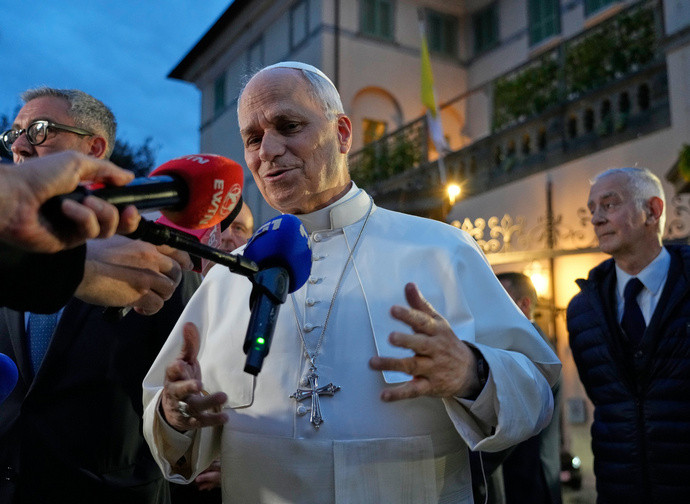
Pope Leo, in his now customary impromptu press conference on Tuesday in Castel Gandolfo, predictably responded in kind: ‘From the moment I was elected, I said “Peace be with you” – he declared. The Church’s mission is to preach the Gospel and peace. If anyone wishes to criticise me for proclaiming the Gospel, let them do so truthfully. The Church has spoken out against all nuclear weapons for years, so there is no doubt about that. I simply hope to be heard for the sake of the Word of God”.
However, at the same time, Pope Prevost did not wish to exacerbate the conflict. Speaking of tomorrow’s meeting with Secretary of State Rubio, who is a practising Catholic, he said he hoped it would be ‘a good dialogue’ and that they would be able to ‘understand one another well’ with confidence and openness. ‘I think the issues he is coming for are not those of today. We shall see...' He added.
There was an immediate attempt to tone things down on the American side, too. Before setting off for Italy, Rubio himself denied that the visit to the Vatican was intended to ease tensions between the United States and the Holy See: ‘It is a trip we planned earlier, and obviously things have happened in the meantime,’ he said. However, he added that there are ‘many things to discuss with the Vatican’.
Playing an even greater role as 'firefighter' is the US ambassador to the Holy See, Brian Burch, who is himself a devout Catholic. He told Reuters: 'Nations have disagreements, and I think one of the ways to resolve them is through fraternity and genuine dialogue.' Rubio is coming to the Vatican, Burch continued, 'to have a frank discussion on US policy and engage in dialogue'.
The watchword is therefore to play down the significance of Trump’s remarks and prevent his out-of-control outbursts from hindering discussion of the real issues on the table, which are by no means easy, starting with the Middle East. Starting, in fact, with the Middle East.
However, significant economic interests also underpin relations between the Vatican and the United States, and these must not be overlooked, even if they are not directly linked to diplomatic relations.
On 2 May, Pope Leo received the members of the Papal Foundation in audience for the first time. This association of American millionaires aims to support the activities of the Popes and has become one of the main sources of funding for Vatican initiatives over the years. However, under Pope Francis, this flow had been reduced to a trickle for reasons that are easy to guess, but now the taps have been turned back on. In fact, the Papal Foundation announced that, by 2026, 'more than fifteen million dollars had been committed to 144 projects in 75 countries', setting a new record in the organisation's 38-year history.
Therefore, it is in no one's interest to create antagonism between the Pope and President Trump or exacerbate tensions between the Holy See and the United States. This is not so much because the generous American Catholic donors are staunch Trump supporters, but because there are underlying tensions within the American Catholic community regarding certain issues that are particularly topical today. Starting with peace, or rather the limits of military intervention.
A growing polarisation is emerging between those who are unreservedly pacifist and have found their point of reference in the three 'Bergoglian' cardinals, Blase Cupich, Robert McElroy and Joseph Tobin — who signed an unprecedented anti-Trump statement last January — and those who uphold the doctrine of the 'just war', which some would extend to include war against Iran.
An example of this is the article that appeared in the 4 May edition of the Wall Street Journal, written by the Catholic columnist William McGurn, which focuses specifically on the clash between Trump and the Pope. McGurn criticises the Church's lack of clarity on the theory of the 'just war', stating that 'the Church still believes in principle', yet many within the Church have concluded that 'just wars are simply not possible'. According to McGurn, the Church today lacks a shared vision of the criteria for a just war, generating the current 'confusion', meaning that 'war in Iran may be just in theory, but never in practice'.
However, the Catechism of the Catholic Church (nos. 2308–2309) actually speaks of 'legitimate defence' rather than 'just war', setting out four criteria: grave harm caused by the aggressor; lack of alternatives; proportionate use of force, which should not cause more harm than that inflicted by the aggressor; and reasonable hope of success.
While it is left to those in government to exercise prudent judgement in applying these criteria, it is clear that a war against Iran cannot be justified, even when considering the disturbing possibility that the Ayatollahs' regime might acquire nuclear weapons. Finally, the course of the war only serves to confirm the absurdity of this military venture.
