

Lefebvre's method: flaunt the faith to conceal the schism
In response to the threat of sanctions raised by the Congregation for the Doctrine of the Faith, the Fraternity presents its own self-certification of obedience and Catholicity. This is an edifying refrain that has been repeated since Lefebvre's time and glosses over the de facto distancing from the Church, even rejecting its sacraments.
– Dossier: The FSSPX Case

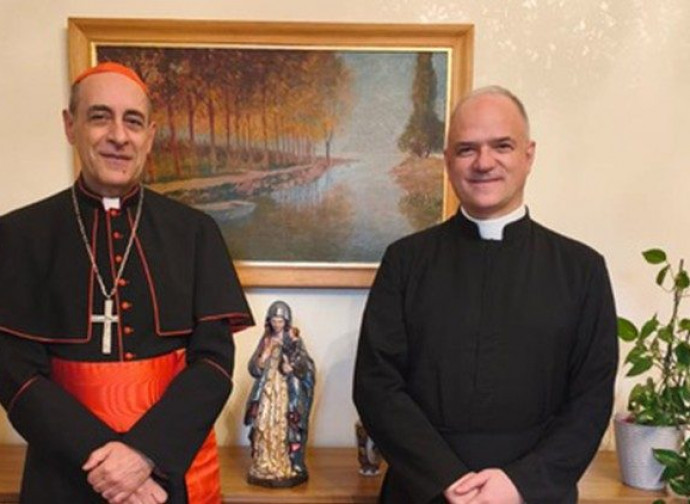
On 13 May, Cardinal Víctor Manuel Fernández, Prefect of the Congregation for the Doctrine of the Faith, published a statement confirming that the ordinations scheduled for 1 July and announced by Fr Davide Pagliarani, Superior of the Priestly Fraternity of St Pius X, will entail excommunication 'latae sententiae'.
The following day, Fr Pagliarani responded with a Declaration of Catholic Faith addressed directly to Pope Leo, expressing “its devotion to the Catholic Faith, concealing nothing, either from Your Holiness or from the Universal Church”, which he considers to be the “minimum indispensable to be in communion with the Church”. The FSSPX superior laments that he has never been properly heard nor received “any truly satisfactory response,” to the concerns raised over the years. On the contrary, “the only solution truly considered by the Holy See has appeared to be that of canonical sanctions. To our great regret, it seems to us that canon law is thus being used, not to confirm in the Faith, but to lead away from it.”.
Anyone familiar with the Fraternity's relationship with the Holy See over the years will recognise this statement as a characteristic feature of these relations: leading the unsuspecting reader to believe that the problem lies exclusively with 'Rome', while portraying the Fraternity as Catholic because it professes the 'faith of all time' (which is not true, as there are significant errors in the statement). Therefore they say, dear Pope, we present you with a doctrinal statement to show that we believe what the Church has always believed. If you excommunicate us, you are excommunicating the Tradition of the Church and showing that you are the schismatic.
Archbishop Lefebvre did the same in his famous declaration of 21 November 1974, the 'founding' text of the FSSPX, in which he proclaimed, 'For this reason, we firmly adhere to all that has been believed and practised in the faith, customs, worship, catechetical teaching, priestly formation and the institution of the Church — the Church of all time — as codified in the books published before the modernist influence of the Council, awaiting the true light of Tradition to dispel the darkness that obscures the sky of eternal Rome.' The darkness is in Rome; the light is in Ecône. The problem therefore concerns Rome, not the Fraternity.
Statements of this kind serve one purpose: to demonstrate to the faithful, many of whom are understandably disoriented and hesitant regarding the threat of excommunication, especially those who have begun attending FSSPX chapels in recent years, that the Society is Catholic. The excommunication that will follow the consecrations is then presented as an act of malice or misunderstanding on Rome’s part, or even proof that Rome has lost the faith. This is because, by condemning the Society, Rome would also be condemning the faith expressed in the declaration. Fr Pagliarani’s reasoning is clear: we proclaim the Catholic faith; you merely strike at us with canon law. The choice is between the integrity of the faith and canonical legalism. Who would not sympathise with the FSSPX when it is put like that?
Yet the truth is quite different. This declaration aims to mislead readers so that they do not see the real problem underlying the Society's decision to consecrate bishops against the Pope's express will is schism. This schism is founded on an inadequate and therefore false conception of the Church. No bishop can be a true Catholic bishop unless he is received into the episcopal college by the Pope, who is the head of that college. No bishop can legitimately exercise his ministry except in communion with the Catholic Church. There is no 'state of necessity' that dispenses with this hierarchical communion established by Jesus Christ and confirmed by the Church. The Church of all time. It is the Fraternity that has repeatedly refused this communion, systematically rejecting every proposal for canonical regularisation — without which there can be no communion with the Apostolic See — in order to claim total autonomy from the Catholic hierarchy. This is, by definition, called schism.
As for 'concealing nothing from His Holiness or the universal Church', one can only smile. The Fraternity always forgets to explain to the Pope and the Church why it advises the conditional re-ordination of ‘conciliar Church’ priests who ‘convert’, prohibits the use of consecrated particles in Novus Ordo Masses, establishes churches, altars and seminaries without consulting the local ordinary, allows its own priests to officiate at weddings without the necessary delegations for canonical form (and thus the validity of the sacrament) and prevents its priests from communicatio in sacris with Catholic priests and the faithful from participating in the 'reformed' sacraments. If the Fraternity were to explain the meaning of all these 'customs', it would make it clear to the Pope once and for all that the one, indefectible Church of Christ no longer has its centre of unity in Rome, but in Menzingen. If Moscow is the Third Rome for the Russian Orthodox, then Menzingen is the Fourth for the Fraternity.
However, inscrutable divine providence has seen to it that the least suitable person is engaged with the traditionalist world in an attempt to mend rifts. Tucho Fernández will be remembered in Church history for rousing the episcopate of an entire continent against blessings for same-sex couples, which he desired so strongly. His 'clarifications' on the subject have only created more confusion and dissatisfaction. He represents a world that overturns the Church's teaching by trumpeting a non-existent continuity achieved by distorting the texts of the Magisterium or the Doctors of the Church.
The Fraternity's gravely erroneous position must not cause us to forget the numerous doctrinal and disciplinary problems afflicting the Church, of which Fernández is one of the saddest and most eloquent expressions.
The lack of sanctions against Msgr. Joseph Brennan for his scandalous participation in the consecration of an Anglican bishop is certainly not a sign of a desire to confirm the faithful in the truth of the faith. However, this grave situation afflicting the Catholic Church must never be a reason to drag souls outside of Catholic unity. Some seem to have forgotten that, as St Pius X taught in the well-known catechism, 'Schismatics are baptised people who obstinately refuse to submit to legitimate pastors and are therefore separated from the Church, even if they do not deny any truth of the faith'. This truth is not reflected in Fr Pagliarani’s Declaration.
