
Mladic is dead, but the appetite for war remains
There will be a state funeral in Serbia for war criminal Ratko Mladić, who died in an international prison in The Hague. Mass demonstrations are hailing him as a hero. It demonstrates that, more than 30 years after the end of the conflict, there has been no process of reconciliation.

If one thing is clear following Ratko Mladić’s death in prison in The Hague, it is that the war in Bosnia – and more broadly across the Balkans – is far from over almost 31 years after the signing of the Dayton Accords, which marked the end of the bloody fighting in Bosnia and Herzegovina that had begun three and a half years earlier.
If anyone had any doubts, the Belgrade government dispelled them yesterday by announcing that General Mladić will receive a state funeral with 'all the military and state honours to which he is entitled'. These are chilling words when we consider that Ratko Mladić is a war criminal and a key figure in the crimes committed in Bosnia, ranging from ethnic cleansing and rape to systematic torture and the destruction of entire villages. Above all, he was responsible for the massacre of 8,000 inhabitants of the predominantly Muslim town of Srebrenica in July 1995, and for the long siege of Sarajevo, during which hundreds of civilians were randomly shot by snipers.
It would take too long to list all the crimes committed under Mladić's direct command. He was the right-hand man of the then Serbian president, Slobodan Milošević, who was convicted of war crimes and died in The Hague in 2006. Mladić was also the right-hand man of Radovan Karadžić, the president of Republika Srpska, to which the Dayton Accords granted 49 per cent of Bosnian territory. Karadžić is currently serving a life sentence in a British prison on the Isle of Wight.
These crimes are extensively documented and led to Karadzic's imprisonment in 2011 after 15 years on the run. He was subsequently handed a life sentence by the International Criminal Tribunal for the former Yugoslavia in 2017, which was upheld in 2021. However, these crimes are denied in Serbia, where Mladić is instead portrayed as a national hero and a defender of the Serbs. He is also said to be a victim of an international conspiracy that sought his death in The Hague prison, even though the man dubbed the ‘Butcher of Srebrenica’ died aged 84 following a long illness for which he received every possible medical treatment.
It is not just a few political leaders who regard him as a national hero; President Aleksandar Vučić, Justice Minister Nenad Vujic, and other members of the government have all risen through the ranks of the most radical nationalism. The glorification of Mladić is widespread among the general public, particularly in Republika Srpska, where thousands of citizens, mainly young people, continue to march through the streets chanting his name.
Consider, for instance, the images emerging from Zvornik, a town littered with mass graves from which tens of thousands of non-Serbs were forcibly expelled, never to return, even after the war ended. A significant, impromptu demonstration took place in the town, with participants chanting Ratko Mladić's name. The same happened in many other towns. This same popularity is also widespread in Serbia. During a Europa League match on Thursday evening, immediately after news of his death broke, Red Star Belgrade supporters unfurled a banner reading: 'General, eternal glory and thank you'.
These are worrying signs that speak volumes about the prevailing atmosphere in Bosnia and the wider Balkan region thirty years after the end of the armed conflict. Anyone who thought that an ad hoc international tribunal with numerous exemplary convictions would be enough to deliver justice and promote reconciliation was sorely mistaken: a total of 90 people were definitively convicted, including 62 Serbs, 18 Croats, 5 Muslims and others. None of those indicted or convicted has ever shown any signs of remorse, admitted responsibility or apologised, nor have they offered any form of compensation — even though no sum of money could ever bring back the dead or return their bodies to their loved ones. On the contrary, as we have seen, the post-war Serbian ruling class immediately engaged in historical revisionism. In school textbooks, Mladić and his associates are not portrayed as war criminals, but as national heroes who established the Republika Srpska in Bosnia.
After all, Mladić, Karadžić and others are not 'monsters' or psychopaths, as they are often portrayed, even in the West. Rather, they embody a widespread culture and ideology – that of 'Greater Serbia' – and were its staunchest advocates. This is not to blame the entire Serbian people, but it would be foolish to think that these war criminals appeared out of thin air or escaped from a psychiatric clinic.
In the face of this, we cannot turn a blind eye once again. Having highlighted the responsibilities of Mladić and the Serbian leadership, we must also acknowledge the serious responsibilities of the international community. The UN must take the lead, as the Srebrenica massacre took place under the watch of the Dutch Blue Helmets, who had been entrusted with protecting the town's Muslim population. This was a well-known disgrace, but what was revealed by a 2015 investigation by the British weekly newspaper The Observer is less well known: namely, the complicity of the Western powers in that massacre. France, the United Kingdom, the United States and the UN leadership are alleged to have allowed the fall of Srebrenica to secure the agreement to end the war, which was signed a few months later in November 1995. The British newspaper claims that the Serbs would never have accepted an agreement that did not allow for the 'removal' of Bosnian Muslims from UN-protected areas such as Srebrenica, Gorazde and Zepa. Thus, when Mladić’s militias advanced towards Srebrenica, the UN peacekeepers and Western powers turned their backs.
Even worse, according to testimonies gathered by The Observer, the UN peacekeepers supplied the Serb militias with 30,000 litres of fuel to transport and bury the victims.
Justice would require these political leaders to be held accountable at an international level too; condemning Mladić, Karadzic and Milošević is not enough. Half-truths neither deliver justice nor build peace. The smouldering fire beneath the ashes in the Balkans is there to prove it.
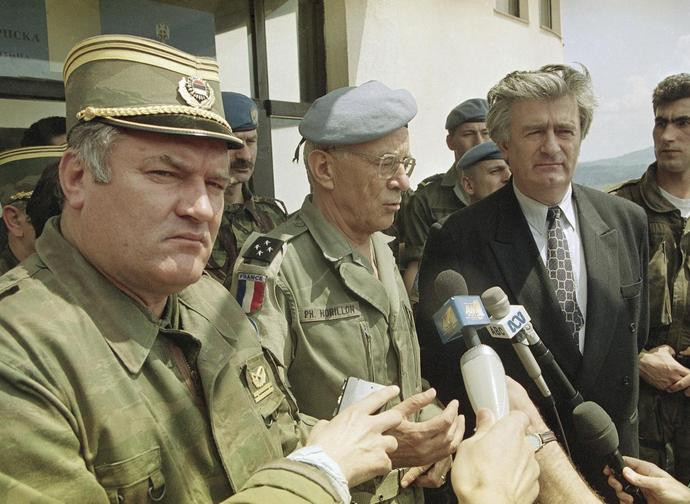
Pictured: Ratko Mladić (left) and Radovan Karadžić (right) with UN Commander General Philippe Morillon after a meeting to discuss the situation in Bosnia (18 May 1993). Photo: LaPresse
