

Cardinal Müller: Co-Redemptrix is a truth contained in Revelation
At the international conference De Maria numquam satis, held in Rome on 7–8 October 2026, Cardinal Müller fully vindicated the Marian title of 'Co-Redemptrix' and the truth expressed by that title. Following Cardinal Burke’s address, he affirmed that this truth is objectively contained in the revelation that God has made to humankind.

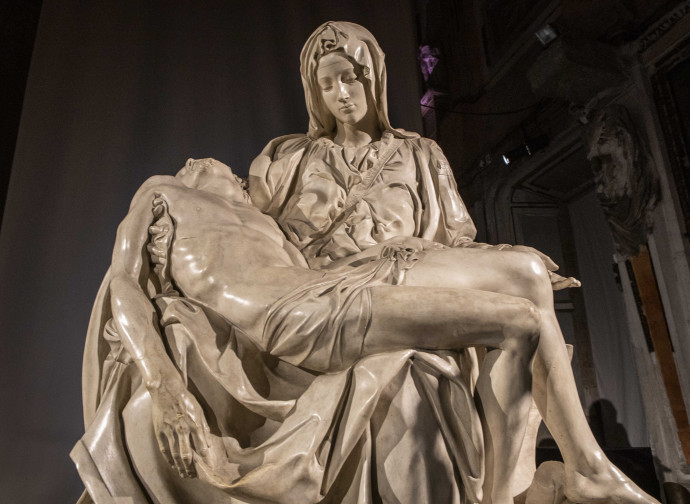
‘When, therefore, Mary is called “Co-Redemptrix” in Catholic piety and theology, this is neither a misleading attribution nor an enthusiastic exaggeration, but a truth objectively contained within revelation. This title must not be silenced, but rather explained within the context of the divine-human work of redemption carried out by Christ, the Son of God, and Mary.’ This is the crux of His Eminence Cardinal Gerhard L. Müller’s address at the international conference De Maria numquam satis, which is drawing to a close in Rome. Following the important opening address by Cardinal Raymond L. Burke, the former Prefect of the Congregation for the Doctrine of the Faith also fully vindicates the Marian title of ‘Co-Redemptrix’ and the truth that this title expresses. He clearly affirms that this truth is objectively contained within the revelation that God has made to humankind. He grounds it doctrinally in the Catholic understanding of Redemption, which, unlike the Protestant view, restores grace and heals nature, enabling true cooperation.
Quoting St Thomas Aquinas, he states that the ability of human beings to be co-causes of redemption 'does not stem from a lack of divine power, but from the fact that God makes use of intermediate causes to preserve the beauty of order in things, and also to communicate to creatures the dignity of causality' (Summa Theologiae, I, q. 23, a. 8, ad 2). Understanding that the use of intermediate causes – true causes! – is not a sign of any deficiency in God and that the participation of dignitas causalitatis in creatures is rooted in divine wisdom and omnipotence unravels the objections at the root of many Marian titles, including Co-Redemptrix.
As the Cardinal explained, precisely because 'Mariology is the culmination of Catholic anthropology and the criterion of Catholic orthodoxy', and 'since the entire Redemption depends on the fact that God communicated the dignitas causalitatis to Mary in fulfilling his universal salvific will', Mary's cooperation in the work of Redemption appears as the perfect and unsurpassable summit of this shared causality. The Blessed Virgin receives and enacts this causality in a manner befitting a woman who was pre-emptively freed from original sin, filled with grace and predestined to be the Mother of God. 'For this reason,' the Cardinal continues, 'Mary is uniquely and intrinsically linked to Christ's salvific work through her fiat, which, alongside the Incarnation, encompasses her collaboration in the redemption of humanity through the crucifixion of her Son, alongside whom she stood and whose death pierced her soul.'
However, Mary was also predestined to be the new Eve, 'companion and helper of Christ (socia Christi)', the new Adam. This does not mean that she supports Christ's work, but rather that she receives salvation and cooperates so that the Church and its members may be united to Christ their Head in faith and love.
To those who take offence at the idea of a creature being given the title of ‘Co-Redemptrix’, the Cardinal replies that ‘Christological titles are also applied to us by analogy’, just as when we are called children of God. He adds that anyone familiar with the rules of Catholic theology can therefore find no cause for scandal in the analogical use of Christological and soteriological titles. The analogy is not univocal! – use of these titles should lead not to mistrust, but to 'a deeper understanding'. The author concludes that the drafters of the Mater populi fidelium note are evidently not well-versed in these rules or the meaning of analogy.
Furthermore, Müller points out that the principle of the hierarchy of truths, affirmed in particular by the last ecumenical council, does not mean 'a mechanical division between important and less important doctrines', as if the latter could be neglected or passed over in silence, but rather 'their analogy in relation to the foundation of the Christian faith'. Marian co-redemption is therefore not a peripheral truth that can be omitted for the sake of ecumenism; rather, it is an analogical truth that must be understood and explained in connection with the principal dogmas of the faith. Nor does the objection hold water that the title only emerged in the late Middle Ages. Indeed, the fact that a truth of faith is contained in Revelation must not be confused with its conceptual formulation, which takes shape and becomes more precise over time.'
Cardinal Müller sends a clear and strong message: Mary's co-redemption is a truth contained in Revelation and the title 'Co-Redemptrix' must be explained, not silenced. We would also like to point out that a dogmatic definition is the most appropriate means of clarifying the content, demonstrating its connection with the other dogmas of the faith and avoiding misunderstandings and ambiguities.
This is also a response to the attempt to classify the Cardinal as a proponent of Mariological minimalism, an attempt made in bad faith just a few days before the conference in an article that recalled Müller's remarks from 2017. The cardinal rejects the labels of maximalism and minimalism, explaining that 'the principle "numquam satis de Maria" has nothing to do with Mariological maximalism, which one would have to balance diplomatically and pedagogically with Mariological minimalism'. This principle affirms the fundamental truth of the Catholic faith in opposition to Gnosticism. According to the Catholic faith, the greater a person’s thoughts and actions, the more they allow themselves to be sustained by grace and led to the heights of God. Mary is the one who, through her docility, has been raised to such heights that they appear unattainable to human understanding.
