

Amoris Laetitia – Vatican marks tenth anniversary of moral U-turn
Today marks the start of the bishops’ meeting, ten years on from Pope Francis’ controversial apostolic exhortation which dismissed Veritatis Splendor and imposed the criteria of the new synodality. This shift compels us to question the document and its outcomes, beginning with the refusal to proclaim the entirety of the Gospel on the family.

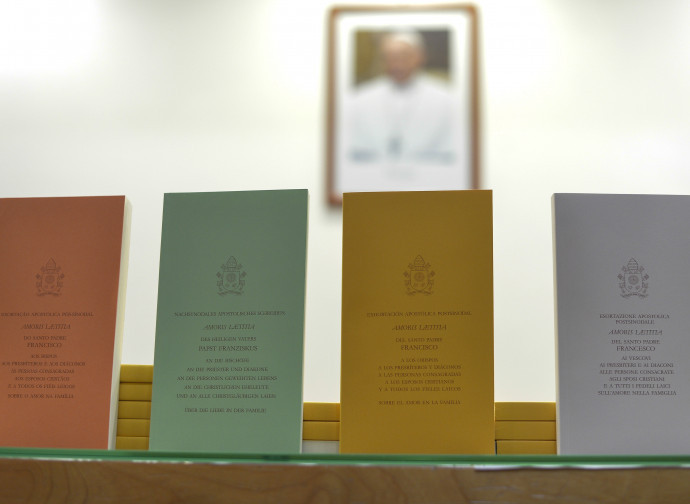
Today, 7 October, the international meeting convened by Leo XIV, entitled 'Ten Years After Amoris Laetitia: Proclaiming the Gospel to Families Today', begins at the Vatican. The presidents of the Episcopal Conferences from around the world have been invited, together with the leaders of the Eastern Churches. The assembly aims to assess what has happened and what has been done over the past ten years regarding the proclamation of the Gospel to families. From the title alone, it is clear that the Apostolic Exhortation Amoris Laetitia will not be evaluated, but will instead be taken as an indisputable starting point. This has also been explicitly confirmed by the General Secretariat of the Synod through its adviser and head of organisation, Jesuit Father Giacomo Costa. The meeting will continue until 14 October, will be held behind closed doors and conducted using the synodal method. A final report will be published at the end of the meeting.
There is no denying that this is a much-anticipated event. Amoris Laetitia is undoubtedly the most significant event of Pope Francis’s pontificate. It best sums up his intentions and his approach to governing the Church. It has sparked both hope and bitter disappointment. It is a turning point compared to the past on issues vital to faith and morals. It is a sharp departure from tradition — not merely the beginning of 'an era of change', but a genuine 'change of era'. This raises the question that everyone has certainly asked themselves: what stance will Pope Leo take? It is not a matter of 'lying in wait for him', as the saying goes, but the issues at stake for the faith are many and profound. In this case, the anticipation is not merely partisan curiosity, but sincere and well-founded.
The apostolic exhortation Amoris Laetitia has effectively dismissed Veritatis Splendor by John Paul II, along with the moral theological framework it set out — not only with regard to marriage and the family, but also with regard to the entire moral life of the Christian. The moral norm has been deemed insufficient and in need of supplementation by the circumstances of life. Adultery must not be regarded as an intrinsically evil act in absolute terms because a moral and religious judgement of it must consider the specific circumstances of those involved. This gives rise to the concept of 'discernment'. After a period of discernment, remarried divorcees may decide whether to receive Holy Communion. Clearly, at this point, their decision becomes normative in itself and takes on an authoritative status alongside Church doctrine.
This change has far-reaching consequences, which this meeting, beginning today, aims to assess without referring to it. Indeed, it is here that the openness — not only pastoral, but also doctrinal — towards all forms of cohabitation originates, including pre-marital arrangements, relationships involving remarried divorcees or same-sex couples, and other types of families referred to as 'complex' or 'fragile'.
It is difficult to argue that these new attitudes have served the good of our families or helped proclaim the Gospel of salvation to them. The bishops who submitted their Dubia to Francis foresaw these problematic developments and asked the Supreme Magisterium to clarify whether sexual activity outside marriage is lawful and whether adultery ceases to be an intrinsically evil act according to Catholic doctrine. But they received no reply. It remains to be seen whether the bishops invited to the meeting beginning today will also address the Magisterium’s failure to teach over the past ten years. If they were to do so, however, they would also have to assess the changes brought about by Amoris Laetitia, and not merely its 'aftermath'.
Amoris Laetitia, together with the 2014 and 2015 Synod on the Family that preceded it, also marked the inauguration of the new synodality. Pope Francis insisted that the final document of the synod retain positions rejected by the assembly as doctrinally erroneous and pastorally harmful, as recently happened with Leo XIV and Group 9's report at the conclusion of the Synod on Synodality. The openness to existential situations as normative, as set out in the unprecedented criteria of Amoris Laetitia, has become the main criterion of the agenda for the new synodality. Participation in assembly sessions and 'conversations in the Spirit' must embrace the new ideas emerging from the ground up rather than focusing on abstract doctrinal truths; the aim should be to achieve conformitas mentis et vitae.
On this issue, too, one might wonder whether the bishops attending the Vatican meeting will be able to assess the past decade without also evaluating the underlying Exhortation, not just as a starting point, but as a guiding principle. As mentioned above, the organisers have assured us that the meeting will be conducted using the synodal method, including 'conversations in the Spirit'. It has also been noted that the Pope has invited certain cardinals and bishops who have been at the forefront of the new synodality to lead the event — individuals whose mere mention immediately evokes the most extreme and disruptive aspirations of the synodal process.
If the past decade is examined from the perspective of the new synodality, it seems logical that Amoris Laetitia will be implicitly confirmed and evaluated without this being explicitly stated. Claiming to wish to examine the decade that has emerged from Amoris Laetitia while refraining from evaluating it is an impossible play on words.
