

Gambetti leaves behind ‘eco-friendly’ St Peter’s that has lost its sacredness
Now is the moment to restore a sense of the sacred to St Peter’s which under Gambetti’s management, bowed to climate neutrality and high energy efficiency. The chaotic and disrespectful transformation from the Pope’s church into a museum favoured desecrations by tourists and distractions for the faithful.

The replacement of Cardinal Mauro Gambetti as archpriest at the helm of St Peter’s Basilica will only make full sense if his successor departs from the path he traced during his five-year term. In took only Five years to tip the delicate balance, the failure of which is now fully evident in public perception of the Pope’s church. This is especially true when considering the reform of the Chapter of St Peter’s statutes, which has distorted this precious institution — indispensable for ensuring the decorum and dignity of the Church’s most important basilica.
Therefore, if the name that Pope Leo XIV has in mind does not bring about a turning point in the management of the Chapter, the ‘demotion’ of the Franciscan engineer to Bishop of Chieti will be a missed opportunity.
Under Gambetti’s management, the upheavals experienced by those who frequent Bernini’s colonnade daily accelerated and led to repercussions for the faithful's perception of the Basilica itself.
The crux of the matter is the revision of the Chapter's statutes, which have reduced the number of canons to a few dozen. They have been humiliated in their ancient role of overseeing the liturgy and the running of St Peter's Basilica, and have sometimes been replaced by novices incapable of grasping the weight of the task.
Gambetti is also known for the famous and controversial rooftop bistro at St Peter’s, which was completed, but not inaugurated at least until this month. He has linked his name to a style of Basilica management which, according to some, reflects Bergoglian ideology. He has reduced the canons’ term of office to just five years and forced them into retirement at 80. He has also removed their stalls from the presbytery area, a move that some monsignors in the Curia have described as 'vulgar', and capped their salary and pension at 1,800 euros. Most significantly, he has placed the Chapter of St Peter under the authority of the Fabbrica di San Pietro, effectively impoverishing its ministry.
This rather arbitrary exercise in pastoral decluttering has repercussions for the Basilica's liturgical life and, by extension, for the sensibilities of the faithful and tourists, who today struggle to perceive the Basilica's sacred nature. It has also encouraged the transformation of the basilica into a museum.
In order to align with Pope Leo’s review, we must therefore have the courage to revoke the ad experimentum statutes and reinstate the validity of Saint John Paul II's statutes, at the very least. Not out of nostalgia, but out of necessity.
Under Gambetti, the number of Masses in the Basilica was significantly reduced, and private celebrations in the side chapels were abolished. These celebrations had the great merit of conferring an aura of solemn sacredness upon the Basilica from early morning onwards, an aura that has now been lost.
Moreover, Gambetti abolished the Latin liturgy because he does not know Latin. As we documented in our report from last spring, spending a day in St Peter’s revealed that the introduction of a dedicated lane for those entering the church solely to pray creates a disconnect which, in the long run, highlights a major 'supermarket-style dissection' (to quote the same monsignor): a practically empty lane, whilst swarms of tourists throng behind it.
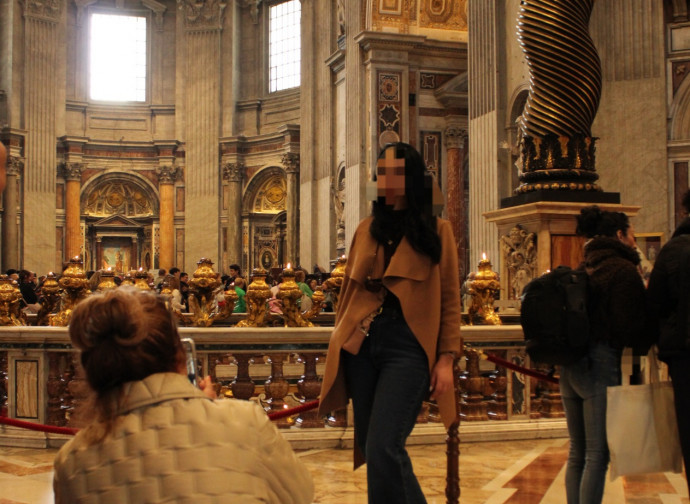
These tourists, as we also reported, adopt every possible behaviour once they have stepped through Filarete’s door, except realising that they have just entered a place of worship. No one makes the sign of the cross or genuflects upon entering. The constant stream of tourists busy taking improbable selfies, posing for photos, and making phone calls as if strolling down the road has reduced St Peter’s to a huge souk where one can find everything. Even the sacred is relegated solely to those who seek it out.
During Gambetti’s tenure, improvements were made to the building’s energy efficiency and to achieve climate ‘neutrality’ by 2030. However, during his tenure, acts of desecration multiplied – some extremely serious, such as the ‘madman’ urinating beside Bernini’s columns, and others less visible but no less significant, such as the careless handling of Holy Communion during crowded Masses. Even the subsequent act of reparation was not without difficulty.
For this reason, restoring St Peter’s to its status as a sacred place — which even non-Catholic tourists must learn to recognise — is one of the key conditions for restoring dignity to a church that is much more than just a church. Today, it acts as a mirror reflecting the terrible crisis of the sacred that the Catholic Church is experiencing in many of its dynamics. To do this, we must have the courage to restore decorum and respect to the place, which even a dean with a clear mandate can achieve, though not without effort and goodwill. As Pope Pius XIII of Sorrentino would say, the liturgy must once again become hard work.
