

October, the Month of the Queen of the Rosary
Why is October dedicated to Our Lady of the Rosary? It all began with the Battle of Lepanto, which gave rise to the feast day now celebrated throughout the Church on the 7th of the month. But it was Leo XIII who consecrated the entire month of October to her, urging the faithful to fight evil with the rosary in hand.

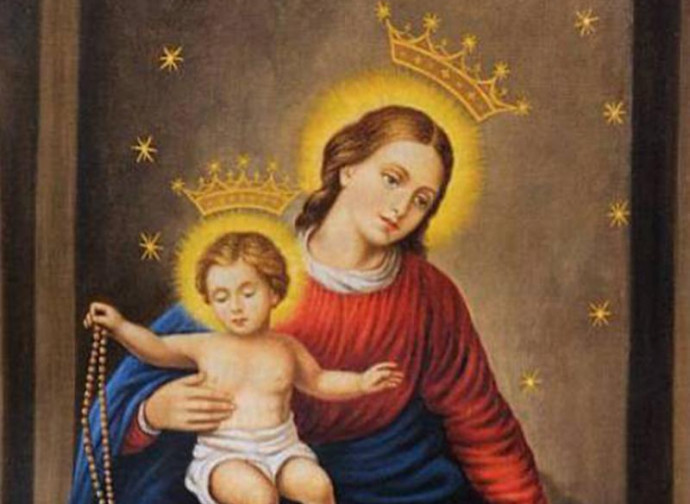
October is, par excellence, the month of Our Lady of the Rosary, the month in which—more than any other—we are especially called to cultivate this Marian devotion, take up the rosary, and meditate on the mysteries of our salvation. But why October? There are essentially two reasons, which are interconnected. The credit for choosing and consecrating this entire month to Our Lady of the Rosary goes to Leo XIII (1810–1903). At the root of his choice is the feast of the same name instituted by St. Pius V in the 16th century and celebrated by the Church on October 7 (or, for a certain period, the first Sunday of the month), originally dedicated to “Saint Mary of Victory,” in thanksgiving for the intercession of the Mother of God in the Battle of Lepanto (October 7, 1571), when the Christian fleet of the Holy League defeated the Ottoman Empire’s fleet, halting the Muslim advance into Europe.
But let us return to Leo XIII, the successor of Peter who has rightly been called “the Pope of the Rosary,” having dedicated several encyclicals and other magisterial documents to promoting this powerful prayer as a means of eternal salvation and a remedy for the evils afflicting the Church and the entire world. The encyclical in which Pope Pecci first decreed that the entire month of October be dedicated to Our Lady of the Rosary is Supremi Apostolatus, published on September 1, 1883. Thirteen years had passed since the Fall of Porta Pia, but the long period of anticlericalism that had led to that event was certainly not over.
The Bride of Christ continued to be threatened in her rights and, as Leo wrote, “plagued by grave calamities.” Hence the need to urge the bishops—and, through them, all the faithful—to seek the help of Our Lady with greater fervor. The Pope explained: “It has always been a most praiseworthy and inviolable custom of the Catholic people to turn to Mary in times of anxiety and uncertainty and to take refuge in her maternal goodness. This demonstrates the unwavering hope—indeed, the complete trust—that the Catholic Church has always, and with good reason, placed in the Mother of God. In fact, the Immaculate Virgin, chosen to be the Mother of God, and thereby made a co-redemptrix of the human race, enjoys such great power and grace with her Son that no creature, whether human or angelic, has ever been able to attain—nor will ever be able to attain—a greater measure of it.”
Regarding the reasons behind the encyclical, Leo XIII cited the dangers to which “Christian piety, public morality, and the faith itself” were increasingly exposed. He then added his greatest concern: “The most painful and saddest fact of all is that so many souls, redeemed by the blood of Jesus Christ, as if swept up by the whirlwind of this aberrant age, are plunging into ever-worse behavior and falling into eternal ruin.” In light of this disastrous situation, the Pope therefore urged the faithful to pray the Rosary constantly and, furthermore, decreed: “The entire month of October of this year [1883] shall be dedicated and consecrated to the heavenly Queen of the Rosary.” Ever since Supremi Apostolatus, Leo XIII had enriched the practice of this devotion by linking it to various indulgences, which were later confirmed in subsequent encyclicals.
Similarly, as early as one of the encyclicals of the following year, Superiore Anno (August 30, 1884), Pope Pecci confirmed the consecration of the entire month of October to Our Lady of the Rosary, noting with joy the fervor with which the faithful had responded to his exhortations contained in Supremi Apostolatus and urging them to persevere in prayer so as to obtain heavenly help and not to be outdone, in terms of resolve, by the “enemies of the Christian name” who “show such great obstinacy in their designs.” On several occasions during his long pontificate, Leo XIII returned to the subject, renewing the prescriptions he had previously established. He did so even in addresses not directly focused on the Holy Rosary, but which nonetheless highlighted its importance: see Quamquam Pluries (August 15, 1889), the first encyclical presenting a systematic doctrine on St. Joseph, in which the Pope requested, among other things, that the prayer A te, o beato Giuseppe be added to the recitation of the Rosary for the month of October (“which we have already decreed in the past to be sacred to the Virgin Mary of the Rosary”).
We conclude, among various other documents on the subject, with a mention of the encyclical Octobri mense (September 22, 1891), in which Leo XIII, in addition to affirming the truth that the Most Holy Mary is the mediatrix of all graces, once again invites Christians to be constant in reciting the Rosary, which—through the “devout meditation” on its mysteries—nourishes the faith, protects it from ignorance, and strengthens moral values. Prayer must never be abandoned, nor should one become discouraged if it seems that evil is prevailing over good, because it is precisely supplication to God—combined with penance, as Leo reminds us by recalling the teaching of the saints—that changes the course of events for the better: “The human mind cannot, for now, comprehend the higher designs of divine Providence, but at the appropriate time, when the reasons and interconnections of things are graciously revealed by God Himself, it will become clear just how great the effectiveness and usefulness of prayer have been in this regard.”
