
A Canonical Revolution: The New Synodality Calls for a New Code
Laypeople presiding over liturgical celebrations and an emphasis on participatory bodies are among the proposals in the Final Report of the Canon Law Commission released by the General Secretariat of the Synod. The goal is to rewrite canon law to consolidate the “achievements” already attained in practice.
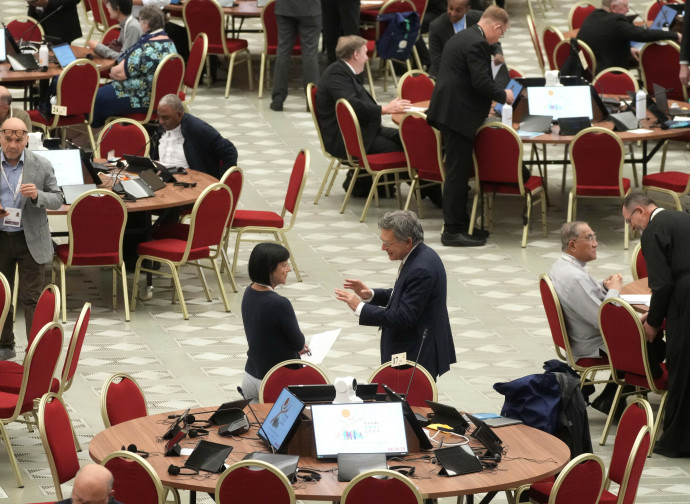
On September 30, the General Secretariat of the Synod released the Final Report of the Canon Law Commission, containing several proposals for revising the Code of Canon Law in response to the requests that emerged from the work of the lengthy synodal phase on “new synodality,” which began in 2021 and concluded in 2024. For the time being, these are amendments that do not require the establishment of new ministries but are limited to confirming existing forms of lay participation and strengthening those already provided for in the current Code. The Report, however, also calls for a genuine and comprehensive revision of both the Latin and Eastern Codes of Canon Law in the near future. Nothing less.
The new provisions concern, for example, the possibility for laypeople to exercise the ministry of the Word, preside over liturgical prayers, administer baptism, officiate at weddings, distribute Holy Communion, carry out a mission by delegation (the role of the “episcopal delegate”), that the establishment and convening of diocesan and parish pastoral councils be mandatory, that diocesan synods and provincial councils be held regularly and as a matter of obligation, and that financial management be public, transparent, and audited.
This latter emphasis on participatory bodies is based on the new paragraph to be added to canon 212: “Pastors have the duty to listen to the opinions of the faithful regarding matters pertaining to the good of the Church, by fostering processes of communal discernment.” While it is confirmed that the bishop’s authority remains untouched, it is also stipulated that lay members shall constitute a majority on diocesan councils and that, for certain decisions, the bishop must obtain the consent of the presbyteral council.
The new synodality, therefore, moves forward. Cardinal Grech, in declaring the synod closed, added that synodality will continue as the findings of the synodal assemblies are implemented, leading up to the Great Universal Assembly of 2028. It proceeds, but how? On the one hand, it continues in a haphazard and adventurous manner; on the other, it continues by moving toward legal consolidation in a new Code of Canon Law. These two approaches are not in conflict with one another, as one might think, if one considers the very nature of this new synodality: namely, listening to diverse demands from the grassroots that are not yet assimilated into a defined theological framework, and a practice that progressively implements first some of the lighter and more acceptable aspects, before moving on to those with a greater revolutionary impact.
In an “unregulated and adventurous” manner, as we were saying. In the name of synodality, the bishop of Antwerp has announced that he will ordain married priests by 2028. The Spanish Episcopal Conference has officially embarked on a path to implement the new synodality—with unpredictable outcomes—without waiting for the report from the Canon Law Commission we are currently discussing. At the international symposium “Shaping Synodality in Europe: From Vision to Roadmap,” held in Austria from September 14 to 17, it was stated that local Churches should not wait for Rome.
The German bishops are awaiting the Holy See’s decisions regarding their “Synodal Conference” (with an equal number of priests and laypersons), which is intended to govern the entire Church in Germany and is currently on hold. Cardinal Walter Brandmüller interpreted Pope Leo XIV’s “we’ll see” as a desire to halt the process, but it can also be understood the other way around—as waiting for the right time to promote it. Also in the spirit of synodality, the German bishops had requested a dispensation allowing laypeople to deliver the homily during Mass; they did not receive it from Rome, and many of them have declared they will proceed regardless—such as Bishop Peter Kohlgraf of Mainz.
This is what the new synodality is all about: a constant flurry of leaps forward, of new practices, of adventurous initiatives, of changes decided upon before being adequately thought through, of creative pastoral innovations, and of processes that anticipate their legal framework. This will come, sooner or later, but it will always be too late—just like the reforms now proposed by the Canon Law Commission, which are far too timid compared to the levels already reached by the synodal process in practice. The new Prefect of the Dicastery for Legislative Texts, Australian Archbishop Anthony Randazzo, in a recent interview with Vox canonica, stated that synodality is not a means of undermining canonical tradition and is not a new reality in the Church. We trust in his first assertion, but we have some doubts regarding the second assessment.
There is, in our view, something new here, because in the new synodality, practice systematically tends to anticipate the evolution of doctrine—which must then scramble to adapt to it—fostering a widespread sense of openness to the new, along with a corresponding spirit opposed to the old. This spirit drives things forward nonetheless, because it is believed to conform to the unspecified demands of participation expressed by the “signs of the times,” and without a clear sense of where it is headed, since it lacks a doctrine that could illuminate the path rather than emerging from it.
