

Ceuta in turmoil: chaos, rapes and Sánchez under fire from his own party
One month after the Moroccan invasion, Ceuta is still in chaos. Crime and rape are on the rise, and Spanish Prime Minister Pedro Sánchez is facing criticism, even from local Socialists. In this situation, suspending the Schengen Agreement is essential

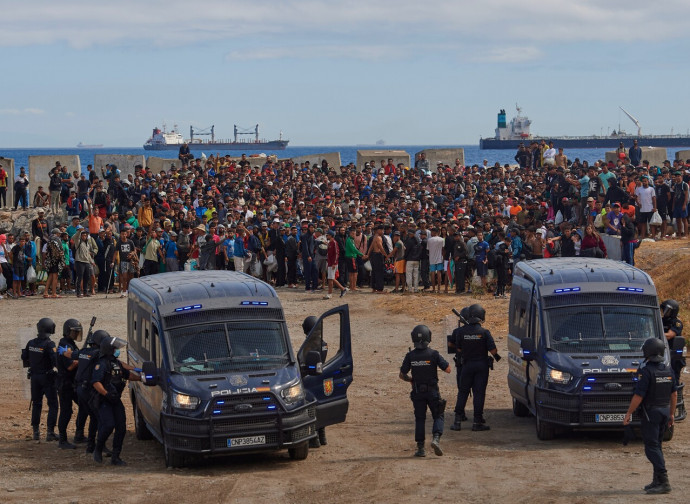
One month after the invasion of Ceuta, which we have already described in detail in August, Pedro Sánchez has returned from his holiday to find a country that is by no means reassured by the events of the past month. According to Spanish government data, up to 80,000 people poured into a city of 84,000 residents, with at least 86 confirmed deaths.
The Spanish prime minister spent August happily holed up in a state residence in Lanzarote, where he went scuba diving, watched the solar eclipse and enjoyed the sunshine until 24 August. Meanwhile, the situation in Ceuta has worsened: according to local authorities, up to 10,000 undocumented migrants are still in the city, and only one-third have been identified. Interior Minister Marlaska has only recently requested assistance from Frontex, despite the significant delay. Rapes and other crimes are on the rise, and the State Attorney General’s Office has confirmed 21 sexual assaults reported by minors since the start of the crisis. The Ceuta Medical Association has warned of epidemic risks, while hospital management, which reports to the Ministry of Health, is threatening to sanction doctors who speak to journalists. The courts and emergency services are overwhelmed, and residents and local authorities feel powerless.
Even the local Socialist Party has criticised Sánchez for his passivity. Yesterday, the national PSOE banned its members and local representatives from participating in demonstrations by Spanish citizens in Ceuta against the government. So is everything okay? Not really. The invasion of Ceuta has exposed issues that are both crucial and overlooked by European public opinion: the vulnerability of Spain’s borders after eight years of Sánchez’s government, and his subservience towards the Kingdom of Morocco.
Regarding Ceuta, beyond the empty rhetoric and attacks on Italy's decision to activate Schengen controls, and the silence that followed the letter from 22 European heads of government — promoted by Meloni and Frederiksen — Pedro Sánchez only convened the first National Security Council meeting after returning from holiday on 25 August, despite the citizens of the Spanish enclave and all opposition parties demanding an immediate meeting. Of course, the Spanish prime minister has had to deal with dozens of scandals and trials involving his family and other PSOE leaders.
Another alarming aspect — perhaps even more so than the carelessness and superficiality demonstrated thus far — is the Spanish prime minister’s subservience towards Morocco. Following a violation of territorial sovereignty that the Moroccan authorities allowed to occur, and while Rabat is exploiting the crisis to advance its expansionist agenda — with at least three ministers calling on King Muhammad VI to declare Ceuta and Melilla territories of his kingdom — Sánchez and his government are praising Morocco’s 'loyalty and reliability', thanking it for its cooperation and downplaying the incident.
This position was reiterated on Monday in a radio interview by the Spanish prime minister, who also found a way to criticise King Felipe VI of Spain — whom the government has prevented from visiting Ceuta — and who was publicly snubbed by the Socialist prime minister yesterday. Sánchez has once again demonstrated his subservience to Morocco by denying any involvement by the Alawite kingdom in the entry of 70,000 migrants (14,000 fewer than the figure provided by border police), and by reiterating that 'the crisis can only be resolved through cooperation, not a lack of trust in Morocco... If there is no cooperation with Morocco, this crisis will not be resolved. On the contrary, it will worsen”. A nod to Muhammad VI and a snub to Felipe VI.
But is everything okay in Ceuta? No, not at all. Residents have reached breaking point with the start of the school year scheduled for September. The situation has reached a stalemate, tensions are running high, and the government is content to make mere gestures while speaking of 'normality'. In recent days, 2,000 people once again gathered in the central Plaza de los Reyes for a demonstration against Pedro Sánchez’s government. Led by firefighters, Civil Guard officers and National Police officers, they chanted “Invaders, get out!” Meanwhile, the National Police were forced to intervene in Loma Colmenar, Ceuta yesterday, after hundreds of migrants attempted to storm the reception centre set up in the area. And what about Sánchez? He has just left — again — for another holiday, this time in Andorra, before he has to provide official explanations for all the dramatic events of the summer to Congress on 3 September.
