
Trump's attack on Pope Leo raises suspicions among Catholics
Trump’s unwarranted attack on the Pope—who responded with equal clarity—is eroding the support many Catholics once had for the U.S. president and is raising suspicions, while the prospect of wiping out Iran’s entire civilization smacks of alignment with Zionist ideology.


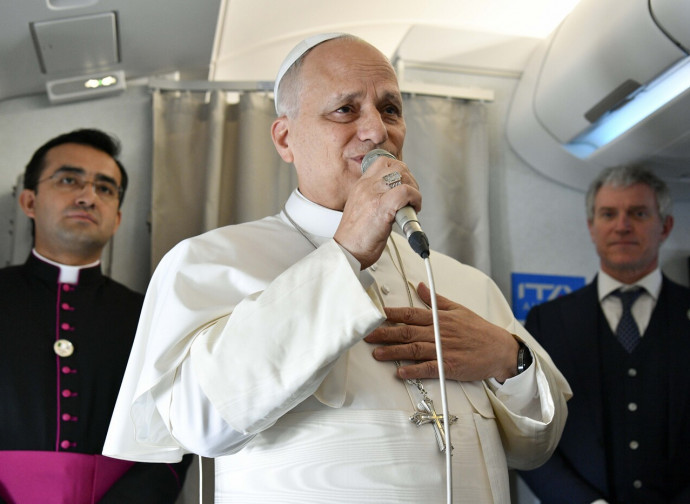
“I have no intention of getting into a debate with him,” Pope Leo said, bringing to a close the sad chapter of the American president’s personal attacks against him. And the remark smacks more of contempt than of reconciliation.
After the prayer vigil at the Vatican on Saturday, April 11, Donald Trump had described the Pope as “weak on crime and terrible at foreign policy,” adding even more pointedly: “Without me, he wouldn’t be in the Vatican.” Pope Leo, on the plane en route to Africa yesterday, April 13, and as if responding to a threat, said: “I am not afraid of the Trump administration,” “I speak of the Gospel,” and “I will continue to speak out loudly against war.” Leone then concluded by saying: “I do not think the Gospel can be abused in the way some people are doing.”
This is certainly something unheard of, and many are wondering about the possible motivations behind such blatantly disorderly behavior, assuming any exist.
The political sphere has refused to acknowledge its own distinctiveness from the religious sphere. Trump has effectively viewed the Pope as a political actor meddling in others’ affairs rather than as the Pontiff of the Catholic Church. In this regard, criticism has been appearing in the press from various quarters, not only from American bishops but also from institutions and political figures of various stripes.
Usually, the language of politics tends to be evasive to safeguard the “arcana imperii,” that is, the dark secrets of power. When power wants to say something, it does so through allusions and in code; it speaks in whispers rather than openly. Not so for the American president, who in fact speaks directly on his Truth platform, considered an apolitical space where anything can be published.
Pope Leo’s words stood in opposition to this type of communication with equal clarity. The two communication systems thus collided because both intended to speak clearly, even though their concepts of “clarity” differed.
Speaking of clarity, it should be noted that some of Pope Leo’s recent statements were not limited to a general and generic discourse on war, but referred specifically to the American administration. A characteristic of Leo’s statements on war is their precision. From the very first days of 2026, the U.S. government has shown many signs of irritation, to the point of summoning the Apostolic Nuncio to the United States on January 22. Even the circulation of a statement regarding a “transfer of the pope to Avignon”—which was initially spread and then downplayed—had marked an increase in tension in relations.
The crisis then erupted, as is well known, on April 7 when President Trump threatened that “an entire civilization will die tonight, never to be revived. I don’t want that to happen, but it will likely happen,” and issued an ultimatum to Iran for the next 48 hours. When immediately questioned, Pope Leo called the threat “against the people of Iran” “unacceptable,” specifying that “there are issues here, certainly of international law, but much more… a moral issue.” The White House likely did not even appreciate an appeal to the U.S. Congress contained in a Vatican statement.
Now, the president’s statement about the destruction of a civilization was truly unacceptable, like so many other remarks made by him and his staff, particularly Secretary of War Hegseth, with his various crude promises: “We will kill them,” “We will exterminate them.” What Trump said about the destruction of a civilization—which would have entailed the destruction of a people—whether he intended it as a real promise or an intimidating warning, fully deserved the Pope’s moral condemnation.
Before that statement, Pope Leo’s remarks on the war had been balanced and addressed all parties involved, given that in that complex conflict responsibilities are manifold; but after the threat to destroy an entire civilization, general appeals were no longer sufficient. A specific plan had to be condemned. And specific was also the phrase uttered yesterday on the flight to Algeria and already recalled: “I don’t think one can abuse the Gospel in the way some people are doing.” Here the reference was to Secretary Pete Hegseth’s numerous invocations of God and to the famous prayer of the presidential staff in the Oval Office of the White House, with their hands raised over Trump’s head.
As for the motivations behind this attack on the Vatican, it is very difficult to venture any hypotheses, given the style of the person who launched it. It is easier to note the negative effects on its author. Many Catholics had valid reasons to hope in Trump, not only among his American base but also throughout the world. The gratuitous attack on the Pope squanders this capital of goodwill and arouses suspicion, while the prospect of wiping out the entire civilization of Iran smacks of alignment with Zionist ideology. More generally, it reveals a stubborn arrogance that arrogant politicians usually conceal. It seems that Trump’s relentless quest to find ever-new opponents continues in this vein.
