
Popes and university, a comparison between Benedict and Leo
Compared to Prevost’s pastoral visit to the Roman university, Ratzinger’s ‘missed’ address set out precise demands on the academic world, touching on the crux of the relationship between reason, faith and truth. Rereading the two texts helps to understand why the current Pontiff was welcomed whilst his predecessor was not

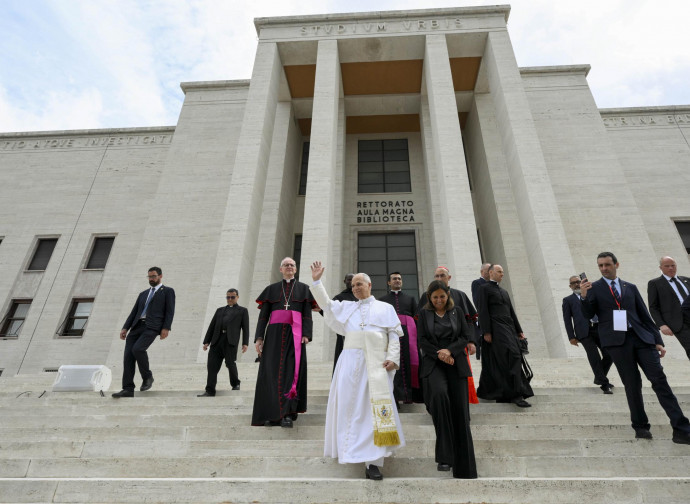
On Thursday 14 May, Pope Leo XIV visited La Sapienza University in Rome, where he delivered a speech to the students. On 17 January 2008, Pope Benedict XVI was due to visit the Roman university but was prevented from doing so. The text of the speech that was never delivered was subsequently made public. La Bussola has already reported on the visit, outlining the main points of the Pope’s speech and highlighting the contrast between the protests of 2008 and the warm reception of 2026. It may also be useful to compare the content of the two speeches to understand whether anything has changed not only in the context but also in the ‘text’.
Firstly, it should be noted that, as scheduled, Benedict XVI was due to inaugurate the academic year. However, it was made clear from the outset that, for Leo XIV, this would merely be a pastoral visit. The difference is significant. A pastor provides support, but does not delve into the specifics of a university's activities. He does not intervene in the realm of knowledge or engage with the disciplines. In other words, he does not deliver a 'scientific' speech, or rather, an epistemic one. Indeed, Leo primarily addressed the students, portraying the university as a place for personal growth and maturation. He described the hardships and rewards of study and highlighted how many young students today are struggling. He also pointed to certain areas of social engagement in the service of others.
Having to inaugurate the academic year, Benedict XVI, however, did not stop at this level, but delivered a proper “lecture”, of the sort he gave in Regensburg in 2006, despite never having been a professor at La Sapienza, unlike in Bavaria. Although he was unable to draw on his personal experience, he nevertheless felt compelled to speak about knowledge, its structure, and the place occupied by theology and faith within it. In both Regensburg and at La Sapienza, Benedict addressed “colleagues”, speaking to an “academic community” and presenting his ideas in a way that was both scientifically and linguistically appropriate.
These aspects are worth emphasising because, in Benedict’s case, the issue of the epistemological demands—that is, those relating to knowledge as ‘science’—of the Christian faith and theology had been raised, whereas in Leo’s address this theme was only touched upon in passing. Benedict was convinced that Christian revelation would only have a structural place within the university if it carried an appeal to scientific reason. Otherwise, it would merely be the personal stance of a few professors and not recognised as having a role of its own within the realm of knowledge. Its presence in the university would be merely incidental. For Benedict, only if faith in revelation makes specific demands on scientific reason — demands that are scientific in their own right — and challenges reason on the specific plane of truth, understood in an analogical sense, and expresses a unique, truth-based way of understanding reason itself, would it be 'at home' in the university.
In Benedict’s address at La Sapienza, the call of the Christian faith for reason not to become positivist emerges: ‘There is a danger that philosophy, no longer feeling capable of its true task, may degenerate into positivism’. He wrote that from Socrates came the separation of reason from mythical religion in order to reach the true God, and that on this path reason encountered the demands of the Christian faith. The latter helps reason not to lose faith in its own capabilities. A mistaken conception of the 'secularity' of knowledge, according to which it would construct itself solely 'on the basis of the circle of its own arguments', would lead to its fragmentation. Faith is committed to saving true reason and defending it from false reason; it possesses the criteria to do so within itself, namely its own implicit epistemology.
Benedict XVI set certain conditions for the university, starting from his faith and his claim to provide pastoral guidance to the university community and contribute to establishing the status of knowledge sought and taught within the university. Pope Leo's address contains only a few hints in this regard, as he chose to deliver a pastoral address rather than a scientific one. He invited young people to work for peace and to protect the environment. He urged them not to succumb to consumerism and to cultivate a sense of justice in their consciences. He also expressed his satisfaction with the collaboration between the university and the diocese of Rome in opening a humanitarian corridor for aid to Gaza.
Ultimately, this difference in approach may also explain the different reception given to the two popes. Benedict questioned a certain type of university; Leo did so far less.
