
Far from being unwell, Sinner is a victim of our society
Sinner can’t be unwell. He cannot give in. He cannot fail. This is the world we live in. Our society of constant action and performance breeds excessive fatigue and burnout. The relentless drive for higher performance can lead to a breakdown of the spirit.

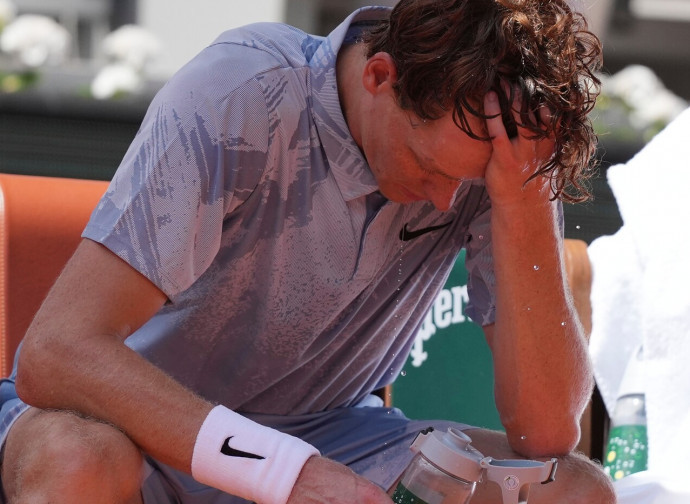
Jannik Sinner was knocked out in the second round of Roland Garros 2026. He suffered a sudden and inexplicable physical collapse just as he seemed to have won the match. Alarm bells immediately rang in the Italian media: what happened? It’s a case that merits further investigation and study.
Some attribute it to Sinner's red hair, while others blame stress: too many matches, too many commitments, too much pressure.
The problem is that these health issues seem to have become quite common in tennis (but not only there): last year, there was reportedly a spike in withdrawals due to illness. Other hypotheses that do not concern individual tennis players include vaccines or the usual suspect, global warming.
But what is the real cause, if there is only one? I don't know, and all things considered, it isn’t the point. What is striking is that a tennis player’s illness immediately becomes a national issue, an anomaly to be explained and almost a scandal. Sinner cannot be unwell. He cannot give in. He cannot fail. This is the world we live in.
Until a few years ago, it was normal to make mistakes and experience ups and downs, successes and failures. Now, this is no longer permitted. Losing or feeling unwell is no longer considered a natural part of life; it is an anomaly to be resolved.
The South Korean-German philosopher Byung-Chul Han discusses this in his short (and famous) essay The Society of Fatigue (Nottetempo, 2010). Han argues that contemporary society has moved away from the paradigm of prohibition and repression described by Foucault, instead embracing a paradigm of performance and positive power. Rather than 'you must obey' or 'you cannot do', as we boomers were brought up, it is now 'you can [must] make it' and 'you must perform'. Convinced they are free, human beings voluntarily exploit themselves, working themselves to exhaustion in the belief that they are fulfilling their potential. The new illnesses (depression, burnout syndrome, ADHD and borderline personality disorder, among others) are all pathologies of excess: too much positivity, too many demands and too many expectations.
As Han writes, 'If doping were permitted in sport, it would be reduced to a pharmacological competition'. Simply banning the use of such substances does not prevent the evolution that transforms the human body and the human being as a whole into performance machines that must function without hindrance and maximise performance.' Doping is merely a consequence of an evolution in which being alive — an infinitely more complex phenomenon — is reduced to vital functions and performance. Conversely, a society based on action and performance generates excessive fatigue and exhaustion. The excessive increase in performance leads to a 'heart attack of the soul'.
According to Han, man is reduced to his performance. He is worth as much as he performs and produces.
No one is forcing him at gunpoint; he is simply embedded in a culture — the contemporary one — in which he cannot do anything else.
Han calls this exhaustion the 'heart attack of the soul'. It is a metaphor: something breaks inside, not through weakness, but through excess. Sinner's bent-kneed body on the Paris court at 5–1 down in the third set is perhaps the most honest image tennis has given us this year. Not of defeat, but of a system.
Shouldn't we be questioning this system? Do we accept it? And how will it evolve in the near future?
