
Maaloula: the nightmare of the jihadists’ return, thirteen years after the martyrdom
Maaloula, an ancient Christian village in the Syrian mountains, was occupied by jihadists between 2013 and 2014. Now that the jihadists are in power across the country, the population is reliving the nightmare of the massacres and abductions of that time. Father Fadi’s account.

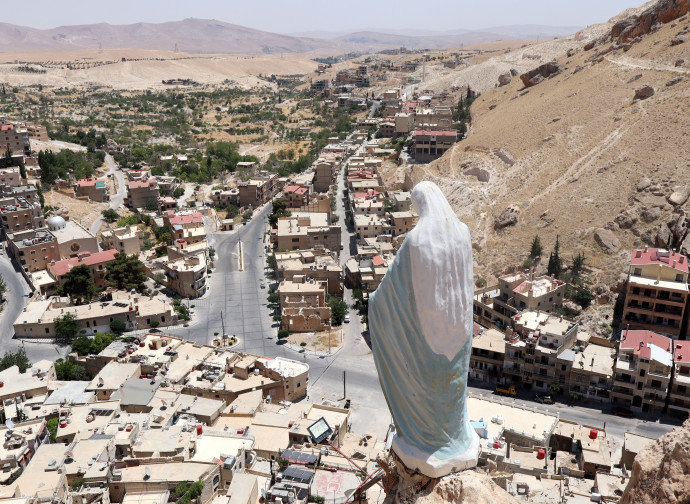
On the day of the meeting between UN Secretary-General António Guterres and the President of the “new Syria” Ahmed al Shaara in a heavily guarded Damascus – just three weeks earlier, during French President Macron’s visit, the explosion of two bombs near his hotel had left one person dead and dozens injured – we leave the capital for Maaloula, in the Qalamoun Mountains north-east of Damascus, near the border with Lebanon.
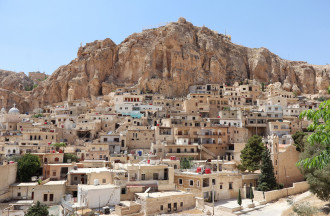 Maaloula is an ancient Christian village made up of houses clinging to the rock face at 1,400 metres above sea level, known for being one of the few places in the world – across Syria, Iraq and Turkey – where Aramaic, the language spoken in Jesus’s time, is still spoken. Beyond its picture-postcard image, however, Maaloula is perhaps also the place that best illustrates the violence, the atrocities and the contradictions of nearly fifteen years of the Syrian war. Between September 2013 and April 2014, the village was caught up in violent clashes between Assad’s army and al-Nusra jihadists, for which dozens of civilian residents paid the price (between twenty and seventy deaths according to sources, of whom three were executed in odium fidei by the extremists for refusing to convert to Islam).
Maaloula tells the story of twelve Orthodox nuns from the convent of Mar Takla who were abducted in December 2013 by the same jihadists and released the following March as part of a prisoner exchange with the Syrian government; it tells the story of the liberation of the village from al-Nusra affiliates by the Syrian regular army, with the assistance of Hezbollah militiamen and the Syrian Social Nationalist Party (SSNP), allies of Assad. Maaloula also tells another story, a more recent one that would have been unimaginable until a few years ago: that of the return of jihadist extremists to threaten the Christian inhabitants. As is well known – though perhaps not widely enough – the armed group that seized power in Syria in late 2024, Hayat Tahrir al-Sham (HTS), is a direct offshoot of al-Nusra; officially disbanded in early 2025, HTS forms the bedrock of the current ‘transitional government’ in Damascus and controls its civil and military institutions.
At the end of 2024, amidst the euphoria following the formation of the new HTS government, groups of armed Islamists, mainly young people, reached Maaloula, eager to ‘recapture’ the Christian stronghold from which they had been driven out. The local population, accused of collaborating with the old regime – a charge currently very much in vogue in Syria, and one levelled against all manner of opponents, whether political, religious or personal – found themselves reliving the nightmares of the past; the killing of a Muslim during a shootout at a Christian’s farm, which he had broken into to steal, reignited sectarian hatred and caused numerous Christian families to flee the village for fear of reprisals.
Now the situation seems calmer, and it is precisely the present situation that we will be discussing with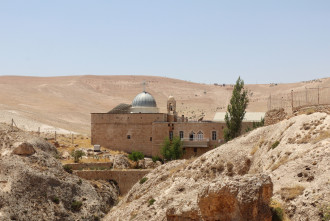 Father Fadi Barghil, a priest of the Basilian Order of the Most Holy Saviour and parish priest of the Melkite Catholic church-monastery of Saints Sarkis and Bakhos (Sergius and Bacchus) in Maaloula. We reach the village in a rickety minibus through the spectacular Qalamoun Mountains; at the entrance to the village, of the ten passengers, only we are asked by the police to show our passports to “check who is entering”. The church-monastery of Saints Sergius and Bacchus, with 1,700 years of history, is the highest building in the whole village; it stands on a small plateau overlooking the village and the valley below. The rocks that encircle Maaloula in their limestone embrace are marked by symbols of Christianity: crosses carved into the walls, a statue of the Lebanese saint Mar Charbel, and a ‘larger-than-life’ statue of the Virgin Mary blessing the village (it is a replica of the one destroyed in 2013 by jihadists). As we make our way up the slope, we come across numerous bell towers, but also two mosques – one looking abandoned, the other undergoing extensive renovation. On the roof of a building, in stark contrast to the surrounding area, flutter the flag of the new Syria and that of the shahada – the Islamic profession of faith – in the version featuring black lettering on a white background.
We find Father Fadi busy working in the vegetable garden – the church produces and sells preserves, jams, syrups and liqueurs, as well as religious articles and handicrafts. Despite his low-key manner and the sly smile with which he welcomes us, Father Fadi is a well-kn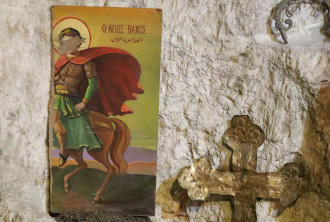 own figure in the Qalamoun: during the tense months following the fall of Bashar al-Assad he mediated on several occasions between Christians and Islamists to prevent further bloodshed, in Maaloula and elsewhere. Father Fadi accompanies us into the church – a marvel carved out of the rock almost two thousand years ago – and shows us the icons that survived the jihadists, albeit with the faces of the Virgin and the Saints erased by the fanatics of al-Nusra; the others, stolen by the militiamen, have been replaced by prints so that their memory is not lost. We then move on to the monastery complex, now without a monastic community, where perfect order reigns and every person we meet is engaged in some activity: some are laying fruit out to dry in the sun, others are keeping the small museum-cum-souvenir shop open, some are running the café, and others are maintaining the grounds.
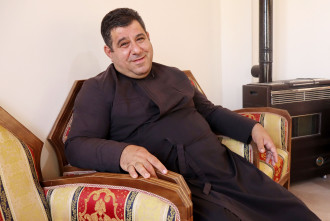 Father Fadi invites us to take a seat in the reception room and agrees to answer a few of our questions, albeit briefly – perhaps out of modesty, certainly not out of fear: he has publicly asserted on several occasions the right of Maaloula’s Christians to live in peace in the land they have inhabited for almost two millennia.
Father Fadi, how many Christians remain in Maaloula today?
There are currently around three hundred families living in the village, totalling almost a thousand people. Before 2013, however, there were around nine hundred families.
Are there any Muslims living permanently in Maaloula?
After 2014 there were none left, but now there are; some have returned. Let me be clear: we have nothing against them. We love Muslims, but we do not love jihadists.
In your view, how is it possible that people in Syria are poorer than ever, now that economic sanctions have been lifted and the country’s government has been officially welcomed back into the international community?
Ask Ahmed al Shaara.
Where have the millions in humanitarian aid allocated to Syria by Western countries and institutions gone?
Ask him that too.
Have you ever seen him in person?
Only in photographs.
Wasn’t he the one who kidnapped the nuns from Mar Takla in 2013?
No, it was Abu Malik, who at the time was al-Nusra’s commander for the Qalamoun area.
Father Fadi shows us a photo on his mobile of Abu Malik al-Talli, whose real name is Jamal Zeini, one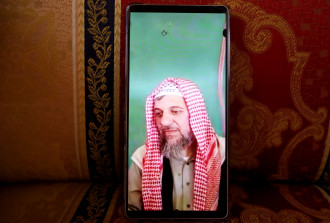 of the group’s leading figures during the years of the war in Syria, who retired to private life in Idlib after al-Nusra was driven out of the Qalamoun region. After years of absence, Zeini suddenly reappeared in the area just over a month ago with a retinue of supporters in tow, on an ‘exploratory tour’ of the villages on the border with Lebanon. Coincidentally – or perhaps not, we are unable to determine – his return coincided with Donald Trump’s repeated calls for al-Sharaa to intervene in the Land of the Cedars to fight Hezbollah. As we speak, Father Fadi smiles with the air of someone who has much to say but remains silent out of Christian charity. Let us turn back to him.
In your view, how is it possible that the Western institutions which have legitimised al-Shaara’s new government – the UN foremost among them – are not addressing the issue of the renewed persecution of Christians in Syria? After all, they are made up of a group of countries with a high or very high percentage of Christian population.
In my view, the responsibility for this lies with the leaders of our Syrian churches – all of them, without exception – who do not wish to draw attention to the Christians here.
Why do you think that is? Out of fear?
I don’t think so: rather, because they want to strike deals, or rather ‘collaborate’ with the new government.
Let us continue to reflect on these final words of Father Fadi whilst, having taken our leave of Saints Sergius and Bacchus, we hurry towards the coach for the return journey – if possible even more ramshackle than the first – encountering several veiled women along the way.
There is no shortage of courageous prelates in Syria such as Monsignor Yacoub Murad, the influential Syriac Catholic Archbishop of Homs, who, no more than a week ago, called on the international community to protect Syria’s Christians, advising Syrians living abroad not to return to their homeland due to the danger and the conditions of extreme poverty in the country. Yet in our part of the world, we do not want to listen.
