
Hamburg, pro-gender archdiocese ignores Rome and insults families
Two letters from the diocesan leadership, and seen by the Daily Compass, discredit families who are protesting against controversial sex education guidelines imposed on their children in Catholic schools. The letters order these families to ignore the guidelines and the Vatican's warnings.

The mask has slipped for the Archdiocese of Hamburg, which has imposed on its fifteen schools sex education guidelines that conflict with Catholic morality. These guidelines, as we previously explained, stem from another document produced as part of the German synodal process. However, despite all the fine words spent on synodality, which is about listening and dialogue, the leadership of the Archdiocese of Hamburg has now ordered that the opinions of the parents against the pro-gender guidelines should be ignored.
This is what has come to light from an email sent to the archdiocese's staff by the Vicar General, Father Sascha-Philipp Geissler, which the Daily Compass has seen. In the email, the right-hand man of Archbishop Stefan Heße warns his colleagues about the activities of the Parents' Network for Child Protection and Prevention, which unites around a hundred parents concerned about the introduction of the guidelines. Far from the involvement of the laity advocated at the German Synod, Geissler 'expressly recommends not replying to or engaging in debate' regarding the parents' emails. He brands the families’ legitimate concern about the risk of premature sexualisation of children and the imposition of a sex education programme contrary to Christian anthropology as 'an attempt to spread insecurity and discord' within school groups.
Furthermore, the cleric also mocks the Holy See, which - in a letter from the Dicastery for Culture and Education, which we revealed, implicitly agreed with the parents by referring to the position set out in the 2019 document Male and Female He Created Them: Towards a Path of Dialogue on the Question of Gender in Education, signed by the then Prefect Giuseppe Versaldi. This text condemns the approach introduced by the Archdiocese of Hamburg's guidelines. Cardinal Versaldi revisited the subject in the book Chiesa e identità di genere. Un metodo per il dialogo tra fede e ragione, San Paolo Edizioni, (Church and Gender Identity: A Method for Dialogue between Faith and Reason), he reiterated the Holy See’s position against gender ideology, which 'denies the difference and natural reciprocity between men and women, envisages a society without sexual difference, and undermines the anthropological foundation of the family'.
Geissler informed his colleagues that the Dicastery ‘had responded to the parents' network, but not the Archdiocese of Hamburg, with an acknowledgement of receipt and a reference to a relevant Vatican document. In short, the Vicar General is aware that the Vatican has officially replied to the families and provided a specific normative reference. However, he disregards this information and emphasises that no communication has reached the Archdiocese. This attitude appears to reflect the German Church's arrogance in the face of Rome's warnings and reprimands. Furthermore, the prelate openly attacks the parents’ association, arbitrarily accusing it of being linked to the ‘right-wing conservative camp’ and of ‘receiving support from there’.
The archdiocese's disregard for the dicastery for culture and education's reference to the document is hardly surprising: according to what we have learnt, during a meeting the parents asked Christopher Haep, director of the archdiocese's 'Schools and Universities' department, whether he would be willing to revise the guidelines to incorporate the principles of 'Male and Female He Created Them'. The aim was to foster dialogue on the issue of gender in education. The response? Nothing but silence. How can the archdiocese ignore the Holy See's document, which was produced specifically to provide guidance on sexual education in Catholic schools? This document is not outdated; it was cited specifically by the relevant dicastery in relation to this case. However, it seems that the archdiocese has decided to ignore Rome and attack the parents who are protesting.
It is not just the Vicar General’s email that proves this. In an email to parents’ representatives, the diocesan official responsible for HAEP schools distinguished himself with his outbursts against the Parents’ Network. In that instance, the official took issue with the group’s leader, Varinia Arauco Vera, who was linked in the communication to the ‘Totus Tuus’ movement, which was dissolved by the former Bishop of Münster, Felix Genn. In reality, Ms Arauco Vera, a Peruvian migrant, has no connection to the association; she had simply used a photo on WhatsApp featuring John Paul II’s apostolic motto. This was a glaring error on the part of Haep, who perhaps ought to brush up on his Church history, as he associates 'Totus Tuus' solely with an association rather than with an expression dear to Karol Wojtyla. However, this error is rather indicative of the hostility with which the Archdiocese of Hamburg is treating the families' protest.
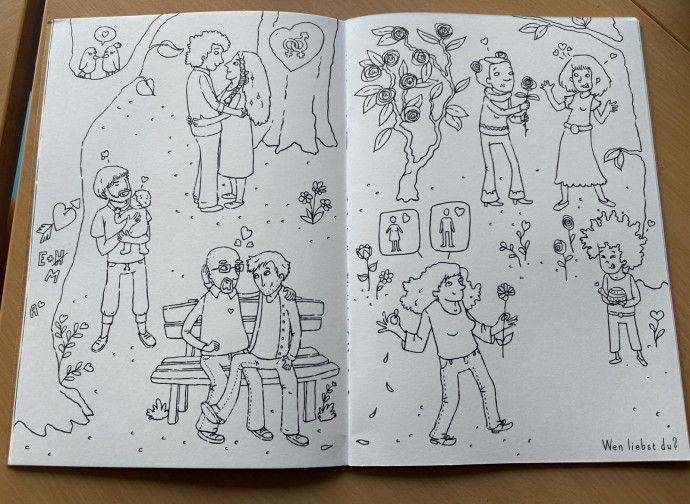
Both Geissler and Haep seem intent on portraying the concerned parents as extremists, claiming that families were properly informed about the introduction of the guidelines. Nonetheless, there is one incident that contradicts this: on 24 March, a day against discrimination was organised in a nursery class as part of the preparatory process for the adoption of the sex education document. Children under the age of six were about to be given teaching materials, including a drawing depicting two men – one older, the other younger – exchanging affection on a bench amidst little hearts. 'Who do you love?' it read, alongside another drawing of an all-female couple exchanging a rose amidst little hearts. It appears that, at a meeting with parents’ representatives a few days earlier, the headteacher had mentioned the initiative but denied having the material to show.
The distribution was only averted thanks to one determined mother who insisted that her son’s teacher show her the drawings before handing them out to the children. Faced with complaints, the headteacher withdrew the materials but did not rule out reintroducing them in the future. This could happen from this school year onwards, now that the guidelines have come into effect.
The Hamburg case has caused a global scandal, but Monsignor Stefan Heße, the archbishop who made the shortest resignation record in history in 2021 after mishandling the abuse case in Cologne (a resignation that was promptly rejected by Pope Francis), does not seem concerned. Does the archbishop agree with his two aides' attempts to discredit a group of parents (and in particular a mother and migrant woman), as documented in the two emails whose existence we revealed? Does he agree with the indifference displayed by his Vicar General regarding the letter from the Dicastery for Culture and Education concerning the policy on sex education in schools within his diocese? The situation is becoming increasingly untenable. In light of Father Geissler's 'snub' to an official initiative by the Dicastery, it is worth asking whether the Vatican should make its voice heard. It is now up to the Dicastery for Bishops to restore the Church's presence at the heart of the community in Hamburg.

Tepid reply from Rome to Hamburg bishop’s 'diversity' guidelines for Catholic schools
The Dicastery for Culture and Education has sided with parents who oppose the sexual 'diversity' guidelines imposed by Bishop Hesse on Catholic schools in the German archdiocese. It is just a few lines long, due but necessary. The project must be stopped before it becomes operational.
Church in Germany collapses but cure is worse than the disease
Defections among the Teutonic faithful are reaching alarming peaks, but even more alarming is the remedy proposed by the local Catholic leadership: synodality. The data shows the failure of the remedy, which seems to be designed to kill the 'patient'.
Germany, 10 May: the schism begins with gay unions
Already 2,500 German parish priests and deacons have signed up for the day of the blessing of all lovers, including homosexual couples. And some bishops have already made known that do not intend to impose any sanctions on the "rebel" priests. This is the gauntlet that the German Church has thrown down to Rome after its "No" to the blessing of gay unions.