U.S. Bombing of Iranian School: The AI's First Crime
The case of the bombing of the school in Minab, Iran, is far from closed and was raised again by the Iranian president at the UN General Assembly. Tracing the error back to its origins, Bloomberg discovered that it was a case of the Pentagon’s misuse of artificial intelligence. The (human) military placed too much trust in the AI’s recommendations, forgetting that it is humans who must provide it with accurate data.

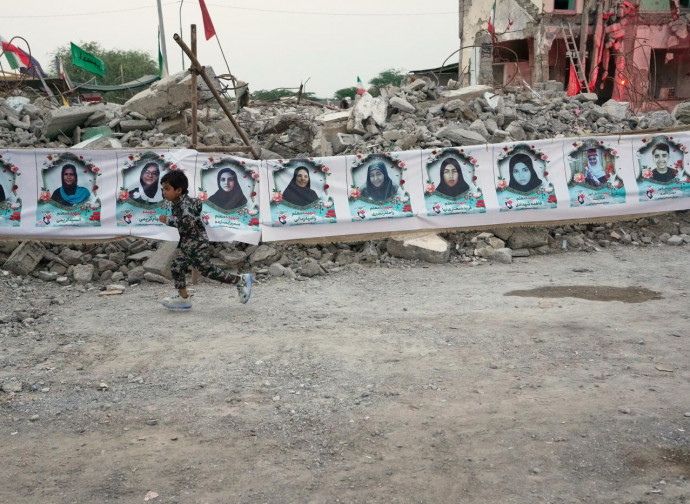
Iran-U.S. War. February 28. Two American missiles level the Shajareh Tayyebeh elementary school in Minab, in southern Iran. More than 150 people are killed. Of these, 123 are children. Seven months later, on September 18, 2026, a Bloomberg investigation reconstructs what went wrong. And in doing so, it confirms the fears expressed by Pope Leo XIV in Magnifica Humanitas. It was not an isolated error that led to the tragedy, but a chain of small logical lapses that no one was able to stop—simply because no one realized what was happening until it was already too late.
Confirming just how far from over this affair remains, on September 23, Iranian President Masoud Pezeshkian addressed the 81st UN General Assembly, showing photographs of the children killed in the February airstrikes, including the students from the school in Minab. Pezeshkian used those images to portray Iran as a victim of American terrorism rather than as its perpetrator. The U.S. delegation walked out of the chamber as soon as Pezeshkian began speaking.
Before being converted back into an elementary school, the Minab site had been used as a military facility by the Pasdaran. This was several years earlier: over time, the former military activity had been discontinued, and the facility had been converted into an elementary school. Satellite images show separate entrances and a courtyard with signs of a playground as early as 2017. Some analysts had noticed this, but the note had ended up in a secondary archive, never linked to the main database on which target selection is based.
At that time, the Maven Smart System—an artificial intelligence software provided by Palantir that merges satellite imagery, radar data, and intercepts into a single dashboard—was the system responsible for compiling lists of potential targets for U.S. attacks. Several military officials, however, expected the system to flag the outdated information on its own. In practice, however, this expectation could not be met: the tool operated based on the information it was fed. Consequently, the elementary school remained, in the system’s view, a stronghold of the Revolutionary Guard. After the tragedy, Palantir rejected all responsibility, noting that the quality of the uploaded data remains the military’s responsibility. Here we see another of the pontiff’s sad predictions come true: the shifting of responsibility for a decision made by software.
In the days leading up to the attack, the Trump administration had called for an offensive capable of striking over a thousand targets in the first 24 hours of action, drastically cutting the time available to verify each target. During the same period, Defense Secretary Pete Hegseth had almost entirely dismantled the Pentagon’s civilian risk assessment units dedicated to evaluating the risk to civilians. In practice, no one from that team—now reduced to a skeleton crew—examined the Minab site before launching the missiles.
This is not the first time the U.S. military has missed its target. From the Chinese embassy in Belgrade in 1999 to the hospital in Kunduz in 2015, the history of these errors is long, and if we were to expand it to include other countries, the pages (albeit virtual) of this newspaper would not be enough. What is new about Minab, however, is the role assigned to AI software as an implicit guarantee of reliability.
The system was relied upon without the necessary checks, as if its response were prophetic. It didn’t quite turn out that way.
It’s not hard to recall how much the Magisterium has already written on the military use of artificial intelligence. In January 2025, in the Vatican document Antiqua et Nova, Pope Francis warned against autonomous military systems lacking the capacity for moral judgment. What happened in Minab is, at the same time, the story of a weapon that decides on its own, and of a man who no longer has any control—except in name—over what it can and cannot do, even though he remains the ultimate arbiter of a moral judgment that AI is still far from possessing.
All things considered, we might once again find in this incident the tug-of-war between efficiency and safety, between speed and data verification. The Maven Smart System’s promise to evaluate thousands of targets in just a few minutes turned into a tragedy that could have been averted with a few simple checks. Humans placed too much trust in AI; AI carried out what was requested; and thus, a school became a military target. Meanwhile, Washington is expected to release the findings of its internal investigation into the Minab tragedy.
