
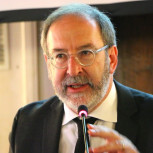
Mauro Marabini, a champion of Italian genius
Entrepreneur, publisher, cultural patron and promoter of Italian culture abroad. Mauro Marabini, who passed away on Monday in the Principality of Monaco, was all this and more. But above all, he was a great friend of the Daily Compass.


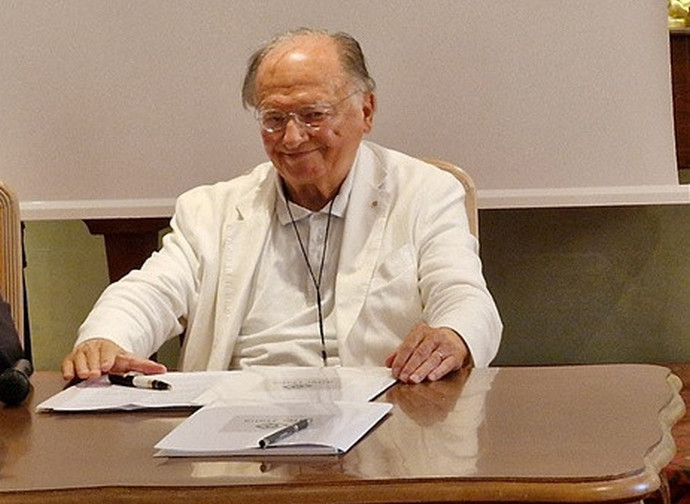
When someone we know dies, an image, gesture or action that characterised them immediately springs to mind. I can still picture Mauro Marabini, who died on 27 July aged 89, sitting in an armchair in the lobby of the Grand Hôtel des Ambassadeurs in Menton, which he owned with his wife Liana. He would be sitting there, absorbed in his reading, waiting for us whenever my wife and I went to Menton. He and Liana (who edited a popular cookery column for the Daily Compass for a long time) welcomed us with open arms. He was always there in the morning after breakfast, inviting us to chat, especially about the situation in Italy and France. These were very pleasant moments.
Mauro came across as a very unassuming man, always dressed with understated elegance, yet he was a man of great culture and experience. Born an entrepreneur in his native Bologna, he was co-owner of the Bruno Magli shoe factory, an Italian luxury brand to whose global expansion he had made a major contribution. However, he also possessed great cultural sensitivity. Whilst still in Bologna, he founded a publishing house (Il Fenicottero) and opened a bookshop that stood out for its contrarian stance, offering an alternative to the cultural monopoly of the left. In the 1990s, he gathered a fine group of young intellectuals around the bimonthly magazine Federalismo e Libertà.
In the 1990s, he married Liana and left the family business. They moved to Milan, where he purchased the Grand Hotel Duomo, and then to the Principality of Monaco, which he officially stated was chosen for 'the quality of life'. He once explained to us that behind this phrase lay Italy’s shift to the left, particularly under the leadership of his fellow citizen, Romano Prodi, who became Prime Minister in 1996. His publishing house had also published an 'unauthorised biography' of Prodi (Prodeide, written by Antonio Salvatici) which was not exactly flattering, to put it mildly.
In Monaco, Marabini began a new life with Liana, continuing to work in publishing and opening a second-hand bookshop. He also launched multimedia ventures, such as the publishing house Liamar and the production company Condor Pictures, as well as cultural initiatives. The Marabinis are patrons of the Vatican Museums, among other things. The luxury hotel purchased in Menton, the Grand Hôtel des Ambassadeurs, was initially used as a venue for a biennale of contemporary sacred and spiritual art. Since last year, it has been transformed into the Museo Marabini-Martac, a fully-fledged art museum covering a range from antiquity to contemporary art and hosting various events.
However, two passions have characterised Mauro Marabini throughout these years: his love for the Principality of Monaco, which led him to become a historian of the region, and his work to promote Italy’s cultural heritage around the world, which he referred to as the ‘Italic civilisation’.
For the Principality, he wrote a guide for Italian visitors, and more recently (in 2020), he published Monaco, le principauté par la grâce de Dieu, a fascinating historical account of the small Catholic state (recognised as such by Pope Leo XIV during his recent visit), as well as a precise, stereotype-free guide to understanding its current social and economic landscape. This book opens a window onto a reality that is far more complex and interesting than we normally imagine (Monte Carlo, the casino, the jet set, etc.), highlighting its importance to Italians, who also contribute significantly to its development.
Italians who have not only enriched the Principality, but the whole world with their genius: Marabini also established the Alter-Italia Foundation to raise awareness of, and promote the study of, the so-called 'Italic civilisation': a community of 200 million people comprising Italian expatriates, foreigners with Italian roots, and those fascinated by Italian art, culture, and music, as well as those who study the Italian language. At the conference he organised in Menton in 2022, he said that there is 'a widespread Italy, which is a true cultural power', influencing distant peoples and cultures not only through companies and workers building infrastructure abroad, but above all through the cultural appeal it exerts as a driving force behind the arts, sciences, literature and spirituality.
He was concerned that this great heritage, which should be promoted, is overlooked at home and left to the generous but insufficient efforts of Italian associations abroad. For this reason, he aimed to create a network of these associations to raise awareness amongst our institutions.
It was all these passions, shared with Liana, that led him to cross paths with the Daily Compass, which he greatly appreciated and supported. Those rare chats in the lobby of his hotel in Menton will certainly be remembered, as will his suggestions and opinions, which were always offered with humility and that unmistakable Bolognese accent of his. They are now part of our personal history, the history of the Bussola and Daily Compass, and, it is no exaggeration to say, we shall miss him greatly. We shall continue to remember him in our prayers and commend his soul to God.
The funeral took place on 30 July, at 10.00 am in Monaco Cathedral.
