

“The people know that the EU’s pressure on Hungary is unjust”
Pressure from the EU and powerful interest groups, efforts to undermine the Orbán government, and family policies as a cornerstone. La Bussola interviews Zsolt Nemeth, Chair of the ‘Conservatives & Patriots’ Group at the Council of Europe.

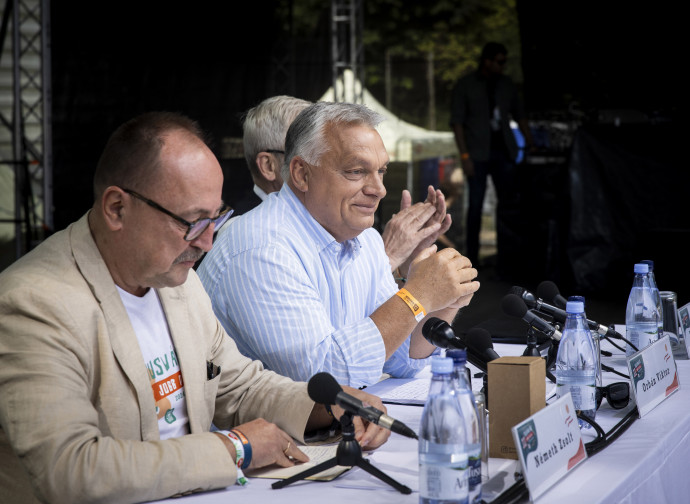
Interview with Zsolt Nemeth, Chair of the Foreign Affairs Committee of the Hungarian Parliament and Chair of the “Conservatives, Patriots and European Affiliates” at the Parliamentary Assembly of the Council of Europe, former Chair of the Foreign Affairs Committee of the Hungarian Parliament and State Secretary at the Ministry of Foreign Affairs, has been a member of the Hungarian Parliament since the country’s first free elections in 1990 (25 March–9 April). A long-standing close associate of Viktor Orbán, he is an active member of the Fidesz party.
Over the years, following the 2010 Constitutional reform, there has been a growing hostility from the European Commission toward the Christian-conservative executive led by Orbán. Why is there this prejudice from Brussels against Budapest?
Hungary represents a Christian-conservative, sovereigntist, democratic alternative within the European Union. We insist that the Union must respect the treaties, the competencies of member states, and the right of nations to decide on issues such as family, migration, education, and cultural identity. For many in the present European elite, that is already unacceptable.
This is where the accusation of double standards becomes understandable. The same institutions that preach tolerance are often intolerant toward governments that do not subscribe to the prevailing federalist-liberal orthodoxy. Hungary is criticized not because it has opinions, but because it has the courage to act on them. When we defend the family, reject illegal migration, protect children, or insist on peace instead of escalation, we are told that we are deviating from the European mainstream. But Europe was never meant to be an ideological empire. It was meant to be a community of nations.
The use of financial pressure has therefore become political. It is designed to discipline, isolate, and, if possible, reshape the will of a member state. That is why many Hungarians rightly feel that this is not only a dispute with the government but also an injustice toward the Hungarian people. In my view, the answer must be calm but firm. Hungary should remain committed to Europe, but equally committed to self-respect. Cooperation is necessary, compromise is often useful, but submission is neither required by the treaties nor acceptable in a democracy.
Over the last 10 years, organizations linked to and funded by George Soros, as well as USAID and other secularist and globalist organizations, have tried in every way to influence the social and civil life of your country. Today, it appears that European and Western liberal actors intend to distort and influence the elections. How is the government defending the freedom of the vote and Hungarian democracy in view of the April 12 elections?
Hungary has learned from experience that democratic sovereignty must be defended not only against visible external pressure but also against indirect networks of influence. In the modern world, elections are not challenged only by ballot fraud or open coercion. They are also challenged by financial influence operations, political activism disguised as civil society, coordinated media pressure, foreign-funded campaigning, and attempts to shape the moral and cultural atmosphere of a nation from abroad. A responsible government cannot be naïve about this.
Our duty is therefore very clear: transparency, legality, and the protection of national decision-making. The state must ensure that Hungarian voters know who is trying to influence public life, with what resources, and in whose interest. That is why questions of foreign financing, pressure networks, disinformation, and politically motivated activism cannot be treated as marginal matters. They go to the heart of sovereignty.
At the same time, one must proceed with sobriety. Hungary is a member of NATO and the European Union, and we are committed to legal order, pluralism, and constitutional democracy. We do not defend democracy by abandoning democratic norms; we defend it by enforcing them equally. In the end, the most important safeguard is political maturity among citizens. If Hungarians understand what is at stake—peace or war, sovereignty or tutelage, family-centred nationhood or ideological experimentation—then the freedom of the vote will also be defended by the electorate itself.
To what extent have the Hungarian government’s family and social policies, as well as its economic support for vulnerable sectors and businesses, been appreciated by the public?
Family policy in Hungary is not a secondary chapter of governance. It is one of the central pillars of our national strategy. We made a conscious decision that, instead of managing demographic decline through migration, we would strengthen Hungarian families, encourage childbearing, and honour the work of parents—especially mothers. That philosophy has been understood by society because it is rooted in common sense and in the moral structure of our nation. The public response has been broad precisely because people can see concrete results.
Tax reductions for families, support for home creation, targeted assistance for mothers, and measures to shield households in times of crisis all speak a language that citizens understand: the state stands with those who build the future. The same applies to the economy. When vulnerable sectors, small enterprises, farmers, and strategic businesses came under pressure—whether from the pandemic, inflation, energy shocks, or the war economy—the Hungarian government did not retreat into ideology. It intervened. Naturally, no policy is beyond debate. In a difficult European environment, every government measure is tested. But the lasting political significance of these programmes is that they created a social alliance between the national government, families, workers, and productive businesses. That is why these policies continue to command respect. People know that behind them there is not a technocratic formula but a national commitment: to preserve security, social continuity, and the dignity of Hungarian life.
Do you believe that your decision to focus on family policies over these past 15 years—as a measure to counter the demographic crisis and as an alternative to the ethnic-religious and cultural replacement sought by Brussels—is one of the primary reasons for the conflict within the country?
I believe family policy has been one of the principal fault lines of the debate because it expresses a fundamentally different view of man, society, and the future of Europe. We decided that the family must again become the centre of public policy. That was not merely an economic programme. It was a civilizational statement.
Why did this provoke such intense opposition? Because family policy is never only about subsidies. It also implies a hierarchy of values. It means that marriage, children, intergenerational solidarity, local communities, and national continuity deserve public recognition. In much of Western Europe, however, public policy has increasingly been detached from cultural and moral christian inheritance. A post-national, post-Christian, and highly individualistic political language has become dominant. In that context, Hungary’s approach is seen not simply as different, but as a challenge.
I would add, however, that this conflict should not be exaggerated into a domestic culture war detached from reality. Many people who may disagree with the government on other issues still understand the legitimacy of helping families and addressing demographic decline. The real controversy lies among ideological actors who believe the state must be neutral even toward its own civilizational foundations. I reject that. A nation that does not defend the family will sooner or later lose the human basis of its freedom. So yes, the family agenda has certainly been one of the reasons for the attacks—but precisely because it touches the deepest questions about Europe’s identity and survival.
In your opinion, why has the farsighted and prophetic stance of your Orbán government on the issues of competitiveness and peace—especially as promoted during your presidency of the Council of the European Union—annoyed so many other European leaders and embittered the Commission?
Because the present European leadership has too often confused moral posturing with strategic clarity. Hungary’s position on competitiveness and peace was not an act of obstruction; it was an effort to recall Europe to reality. On competitiveness, the argument was straightforward: if Europe overregulates, overburdens its industries, drives up energy prices, and allows ideological goals to override economic rationality, then it will lose ground to the United States and Asia. That is not a theoretical concern; it is already happening. Raising this issue during the Hungarian presidency was therefore not a provocation but a service to Europe.
The same applies to peace. Hungary has consistently argued that the war in our neighbourhood must not be approached through rhetorical escalation alone. We condemned aggression and support Ukraine’s sovereignty. But we also insist that diplomacy, de-escalation, and the prevention of wider war are not signs of weakness. They are responsibilities of leadership. In times of war fever, such a position irritates those who have invested their prestige in a politics of constant hardening.
Considering the courageous decision by Orbán and other political leaders to create a new and coherent political group in the European Parliament, Patriots for Europe, and a political family on the continent, what future do you foresee for it in the event of a victory or a defeat for your coalition in Hungary?
Patriots for Europe is not a temporary parliamentary manoeuvre; it is the institutional expression of a wider European realignment. Across the continent, more and more citizens feel that the old centrist formula has exhausted itself. They see mass migration, weakening competitiveness, cultural uncertainty, democratic alienation, and a growing distance between Brussels and ordinary Europeans. Patriots for Europe speaks to that dissatisfaction, but it also offers something more positive: a Europe of nations, democratic accountability, secure borders, freedom of expression, and respect for civilizational inheritance.
A victory would obviously strengthen the movement morally and politically. It would confirm that national, sovereign, Christian-democratic politics remains viable in the heart of Europe, even under immense external pressure.
But even in the event of a defeat, the underlying European process would not disappear. Patriots for Europe has already become a major force, with broad representation in the European Parliament and with a clear identity.
