
Co-redemption: Pope clarifies his stance at general audience
In St Peter’s Square, Pope Leo XIV emphasises the 'unique place reserved for the Virgin Mary in the work of Redemption'. This brief address does not delve into the issues raised by Mater Populi Fidelis, but reaffirms the truth regarding the unique role of the Mother of God.


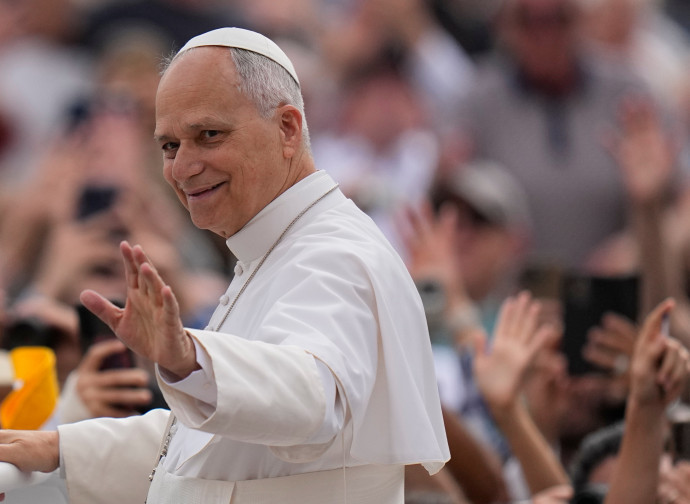
Perhaps the most evident direction of Leo XIV's pontificate is his attempt to restore order within the Church and unite the diverse voices of the Catholic world. At least up to now.
Yesterday’s General Audience, on Wednesday 13 May and entirely dedicated to the Blessed Virgin Mary, is an example of this. On the occasion of the Feast of Our Lady of Fátima, the Pope recalled the teaching of the eighth chapter of the Dogmatic Constitution Lumen Gentium (nos. 52–69), presenting the Virgin as 'the model [...] pre-eminent and singular member and the mother of the members of Christ’, 'the woman who is the icon of the Mystery'.
In his address, the Pope presented Our Lady as an outstanding member of the Church and the 'believer par excellence'. She is the most perfect example of the dynamic of faith, particularly in her receptive openness to divine action and His will. Therefore, she is also the model 'of what the whole Church is called to be'. Thus, the Pope recognises that the Blessed Virgin is the archetype of the Church; it is by looking to her that the Church sees its own mystery and authentic vocation to spousal and maternal virginity reflected.
However, Mary transcends the Church, not only as its most excellent member and model, but also as its mother, Mater Ecclesiae, as she “begets children in the Son, beloved in the eternal Beloved who came among us”, as Leo XIII explains. While acknowledging Mary’s exemplary role for all believers, the Pope clarifies that she is the sole Mother of the Church because she was chosen from eternity to bear the members of Christ; she bore Christ the Head in her womb.
It is clear to all Christians that Mary conceived and gave birth to Christ virginal, but when did she conceive and give birth to the members of Christ? And how does she fulfil her maternal care towards them? The Pope provides the answer by inviting us to revisit the ‘unique place reserved for the Virgin Mary in the work of Redemption’ as set out in Lumen Gentium (LG) 60–62. There, the Church teaches that the Blessed Virgin cooperated in the Redemption in a unique way by being associated with the work of the Redeemer 'in a wholly unique way', primarily through suffering with Him on Calvary, thereby becoming 'our mother in the order of grace' (LG 61).
The Pope has previously emphasised Mary's fruitful participation in the sacrifice of the Cross in his message to the Plenary Assembly of the Pontifical Biblical Commission: Let us contemplate in particular the Sorrowful Mother together with Jesus at the foot of the Cross: as Mother, she suffers on Calvary the sufferings of her Son and shares in them with a heart full of faith, offering her piercing sorrow for the good of all'. This emphasis on Mary's active sacrifice for the benefit of all reflects what LG 58 had already clearly taught: 'Mary stood unto the Cross, in keeping with the divine plan, grieving exceedingly with her only begotten Son, uniting herself with a maternal heart with His sacrifice, and lovingly consenting to the immolation of this Victim which she herself had brought forth’. He now returns to this, taking care not to use the title “Co-redemptrix”, which has once again become the subject of heated controversy. Yet he reaffirms the truth of Mary’s active and immediate cooperation in the Redemption, which is not confined to her role as Mother of the Son of God, but emphasises its sacrificial dimension. In other words, the substance of co-redemption.
The Pope also recalled that, in the light of the Council, 'the sole Mediator of salvation is Jesus Christ' (cf. 1 Tim 2:5–6), and that 'his Most Holy Mother "in no wise obscures or diminishes this unique mediation of Christ, but rather shows His power.' (LG 60). LG teaches that Mary’s mediation does not depend ‘from some inner necessity’, as if Christ's mediation were insufficient, ‘but from the divine pleasure’; likewise, it takes nothing away from the mediation of the Lord Jesus because it springs from 'the superabundance of the merits of Christ’.
This General Audience appears to correct the course of Mater Populi Fidelis on several points, bringing the teaching of the Magisterium back into line with the texts of Vatican II, from which the Declaration had dangerously strayed. The Congregation for the Doctrine of the Faith's document was silent on Our Lady’s active and sacrificial contribution to the Redemption. Pope Leo emphasises this once again. In the former document, the Blessed Virgin was 'squeezed' into the ecclesiological framework as a member of the Church and a model of faith and docility. Here, however, Leo restores her unique role in cooperating with the Redemption, rightly making her the Mother of the Church and the true spiritual mother of souls. In the former document, every paragraph aimed to dispel a supposed rivalry between the Virgin and Christ. This led the document to dilute the authentic content of Mary’s mediation. Here, the Pope calmly recalls that Mary’s mediation is founded upon, and does not obscure, the mediation of Christ.
However, it is a short text which reveals Pope Leo's choice not to address the many issues raised by Mater Populi Fidelis directly. Nevertheless, it is an intervention that timidly re-acknowledges the truth of Mary's co-redemption. Even if the Dicastery does not want it to be discussed.
