

Copts resume dialogue with Rome after gay blessings cancelled
Tawadros II has announced the resumption of theological talks following reassurances from Pope Leo XIV. This brings an end to the crisis triggered by Fiducia Supplicans, which was unwelcome to both Catholics and non-Catholics alike. It proves once again that conforming to the world seriously undermines ecumenical dialogue


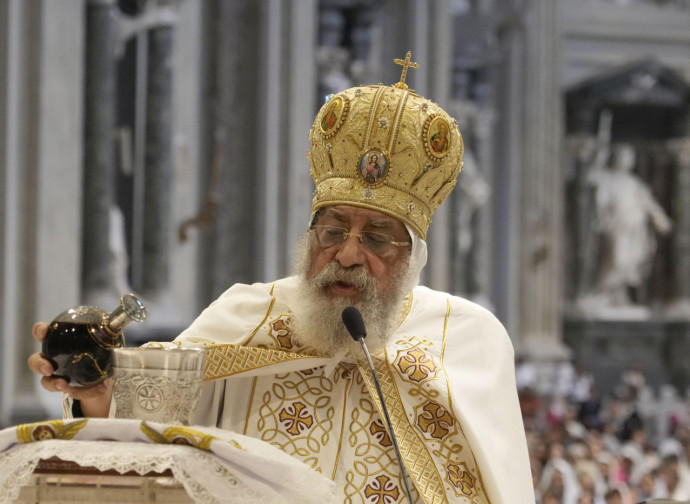
‘The members of the Holy Synod have decided to resume theological dialogue with the Catholic Church following assurances regarding the non-blessing of same-sex couples, expressed during the telephone conversation between His Holiness Pope Tawadros II and His Holiness Pope Leo XIV on Friday, 15 May this year.’ A terse statement, just a few lines long, yet one that carries significant weight in today's Catholic context. On 22 May, the Synod of the Coptic Orthodox Church – one of the non-Chalcedonian churches – met and, in a statement setting out the deliberations reached during the assembly, gave the green light for the resumption of theological dialogue with the Catholic Church. This was prompted by a telephone call from Pope Leo XIV to Tawadros II, who has been head of the Coptic Church since 2012.
The creation of Francesco and Tucho Fernández’s Fiducia Supplicans not only provoked an outcry from Catholic episcopal conferences worldwide, it also cooled relations with the Orthodox and led to the interruption of ecumenical dialogue with the Copts. A disaster on all fronts. However, thanks to Pope Leo’s change of course, this dialogue has now been resumed. In order to appease the powerful gay lobby within the Church, Bergoglio and Fernández were willing to sacrifice the idol of ecumenism. This idol is then brandished once more when it comes to dismantling Catholic doctrine and discipline. The Coptic Church’s reaction to Pope Leo’s reassurance is further proof that the most significant ecumenical dialogue since Vatican II, namely that with the Orthodox and non-Catholic Eastern Churches, is undermined whenever the Catholic Church signals accommodation to the world and a departure from Apostolic Tradition.
On the return flight from Africa, the Pope stated that he did not agree with the formalised blessing of couples, including homosexual couples or those in irregular situations. Some uncertainty remains regarding the use of the adjective 'formalised', which seems to leave the door open to non-formalised blessings and thus to those 'whose form must not be subject to any ritual fixation by ecclesiastical authorities', as set out in Fiducia Supplicans.
Cardinal Fernández also expressed his opposition to the vademecum that would allow the blessing of gay couples in Germany. He published the letter that the Prefect had sent to the Bishop of Trier, Monsignor Stephan Ackermann, on the website of the Congregation for the Doctrine of the Faith on 18 November 2024.
Problem solved? I would say not. While it is clear that the Pope is trying to reunite the Church and improve ecumenical relations on the thorny issue of blessings for same-sex couples, ambiguity remains for at least two reasons. Firstly, the Pope's statements were unofficial remarks and not strictly acts of the Magisterium. In the case of the phone call to Tawadros II, we do not even know the details of what was said, although the Copts' desire to resume theological dialogue with the Holy See suggests a distancing from Fiducia Supplicans.
Secondly, during Francis’s lifetime, the aspect deliberately kept ambiguous by the Pope and Fernández concerned the recipients of these blessings: individuals or couples? – the ambiguity now shifts to the formalisation of these blessings. In his favourite sport of grasping at straws, Fernández had previously attempted an unlikely distinction between 'liturgical or ritualised' blessings and 'spontaneous or pastoral' blessings — those famous 10- or 15-second ones. Pope Leo's response on the plane last April does indeed seem to keep this type of blessing alive, while the blessing given to the Coptic Pope remains unknown.
Once again, the Holy See has failed to take a clear and unambiguous stance. The problem of blessings authorised by Fiducia Supplicans therefore remains because an 'unformalised' blessing is still a blessing and therefore a sacramental. The logic of sacramentals, as expressed in the 2021 Responsum, is that 'that which is blessed is objectively and positively ordered to receive and express grace'. As couples, homosexual and irregular couples are not ordered to God's plan and therefore cannot be blessed in any way. This truth flows from the nature of the blessing and the Creator's plan. Everything else is nonsense.
There is not yet sufficient evidence to determine whether Pope Leo is unable or unwilling to provide an official clarification worthy of the name. What we can hope for, and earnestly pray for, is that this commendable, timely and long-awaited attempt to reunite the various factions of the Catholic world will be built upon the solid foundation of Peter and truth.
