
Lebanon: Israel chooses feast of Assumption for new attacks
Despite the ceasefire contained in the June agreement, Israeli forces launched a new offensive against Lebanon on 15 and 16 August. This was in retaliation for the wounding of three IDF soldiers, and caused several deaths.


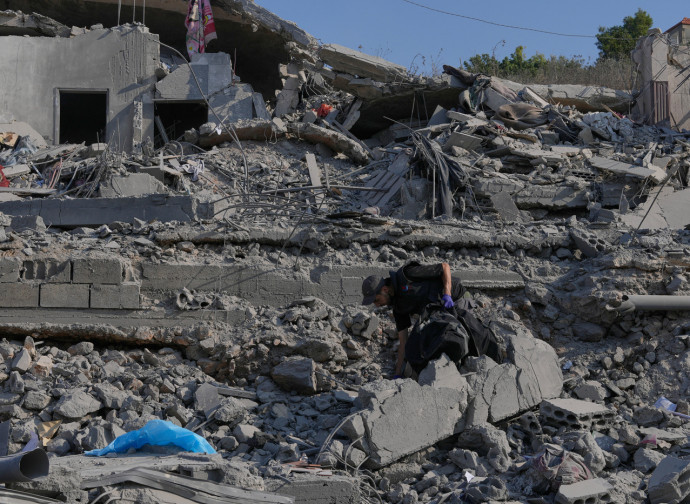
The Israeli army chose the solemn feast of the Assumption of Mary – a particularly cherished feast in the Eastern Churches – to launch a new offensive in southern Lebanon. This was reminiscent of their actions on the Christian feasts of Epiphany and Easter, and on the Islamic festival of Eid al-Adha.
Israeli forces marred the festive Saturday dedicated to the Dormitio Virginis – the passing of the Mother of Jesus into eternal life – with their bombardment. On 15 and 16 August, the Israeli air force attacked the towns of Ansar, Deir al-Zahrani, Ali al-Taher, Bint Jbeil and Taybeh in the Nabatiyeh district, killing at least eleven people, including women and children, and wounding at least twenty more. Tel Aviv announced that two Hezbollah commanders had been killed in two separate raids, one of whom was killed in his own home alongside his wife and four children under the age of 18. According to the office of Israeli Prime Minister Netanyahu, the attacks were ordered in retaliation for the wounding of three IDF soldiers by the Shia militia in the ‘forward defence zone’, unilaterally established in Lebanon by the State of Israel, on the morning of 15 August.
Sara (not her real name), a 60-year-old Lebanese woman who has lived in Italy since the 1980s, was an unwitting witness to the attacks on the Feast of the Assumption. She recently left her husband and children in Milan to be at the bedside of her elderly father, who is hospitalised in Nabatyie. Her home village is near Ali Taher, which the Israeli army continues to bomb relentlessly as we write. “My brothers and I have been trapped in the hospital since the attacks began. We don’t dare go out; we’re afraid to go home,' she says over the phone. “The most shocking moment was when they brought the victims’ bodies here – it was truly traumatic. But the worst thing is that we can’t sleep because of the noise of the bombardments. We haven't had a proper rest for days. Unfortunately, we haven’t managed to transfer my father to another hospital yet, and now they’re asking us to leave because the wards are full of people who have taken refuge there for fear of further attacks. They claim to need the space to care for hospitalised relatives, but it's just an excuse. I left Italy when my father’s condition deteriorated – he is now in a vegetative state – but I didn’t expect the Israeli forces to attack so violently, especially since an agreement had been signed and negotiations were underway.’ Indeed, the agreement signed on 26 June in Washington by Lebanon and Israel, and brokered by the United States, has remained unimplemented, along with the ceasefire it contains.
Despite the two countries’ diplomatic representatives announcing it during two separate rounds of negotiations in Rome, the withdrawal of Israeli troops from certain peripheral ‘pilot zones’ – a prelude to the IDF’s definitive withdrawal from Lebanese territory – has not been completed.
Meanwhile, Tel Aviv’s ‘military operations’ against Hezbollah are continuing – operations which, incidentally, are permitted by the agreement, which gives the Jewish state ‘all the necessary freedom of action’ to ‘eliminate the Shia militia’ from Lebanon. Following the deadly attacks on the Feast of the Assumption, Benjamin Netanyahu’s spokesperson stated that the aim of these attacks was ‘to relaunch negotiations with Lebanon and ensure they are taken more seriously, not the opposite’.
It is paradoxical to force a country such as present-day Lebanon, which is inerme and incapable of defending itself, to negotiate under a barrage of bombs. Beyond the stated aim of physically eliminating Hezbollah, the IDF’s systematic demolition of villages along the border with Israel seems to reveal a more ambitious objective: depopulating the area in preparation for a possible future annexation and subsequent repopulation with Israeli citizens. According to a recent field investigation by The National, the few villages in the area that remain unscathed and inhabited are currently subject to 'unwritten laws' imposed by Israeli troops, as if they were exclaves of Tel Aviv within Lebanese territory. It is reasonable to wonder whether this is the fate that awaits Lebanon in the not-too-distant future. Netanyahu claims that some Christian villages in southern Lebanon have asked to be annexed to Israel. However, fifteen villages in the area have denied this in a joint statement, declaring themselves ‘determined to remain’ on their own land, ‘loyal to their national identity’ and ‘devoted to the Lebanese flag’.
While the international community is hailing the 'historic agreement' between the two countries, the US Ambassador to Lebanon, Michael Issa, described the atmosphere at the Rome negotiations as 'positive' in a meeting with the Lebanese Prime Minister, Nawaf Salam, and the Speaker of the House, Nabih Berri. He promised that Israeli aggression would cease 'when Hezbollah surrenders its weapons'. In Lebanon, daily life continues amid a mix of normality and terror, with people torn between a desire to leave the conflict behind and the impossibility of ignoring the reality of the ongoing war. On the beaches and in the restaurants north of Beirut, from Junie to Byblos and as far as Batroun, affluent Lebanese people, including many wealthy Shias, are trying to forget the situation in the south of the country by enjoying summer activities.
Meanwhile, Parliament has approved two controversial measures: a general amnesty law aimed at resolving the issue of prison overcrowding but intended to heal old wounds from the civil war, and the abolition of the death penalty.
Additionally, Parliament approved several amendments to the 'Banking Reform Act' requested by the International Monetary Fund as a prerequisite for Lebanon's access to international funding.
