

Hantavirus: Gavi’s ‘prophecy’ about the next pandemic
To date, no one has contracted Hantavirus from the nine people infected on the Hondius cruise ship. However, a massive alert and tracing operation is underway. This is the same virus found in mice that the Gavi Alliance predicted would cause the next pandemic in 2021.

It is not an epidemic yet, and probably never will be, but Hantavirus is set to become a new health emergency in the coming months. This is not based on the facts at hand, but on the insistence with which various parties — the media, Western health institutions, and the already well-fed crowd of TV-contracted virologists — are discussing it in peremptory and drastic terms.
The Italian Ministry of Health, for example, has already issued a 27-page circular in which it issues an alert that, while it is downplayed due to the very low risk, is amplified by events. For instance, a British tourist was placed in compulsory isolation after being on the same flight as the Dutch woman who had come from the Hondius cruise ship and died two days later from the rat virus.
The man had nothing to do with the trip to Argentina taken by the key figures in the outbreak and had no contact with them whatsoever. However, he was unfortunate enough to be sitting in the aeroplane seat next to the deceased woman. From that moment on, he endured a veritable ordeal, if not a full-blown one. He was tracked down in Rome and dubbed 'the English patient' – as the narrative demanded – and is now hospitalised at Sacco Hospital in Milan, where he is simply being monitored.
Despite showing no symptoms or signs of developing the disease, he is being kept under close observation due to irrational fears, which align with the attitude of the health authorities who are already issuing warnings and 'keywords' such as contact tracing, FFP2 masks and six-week quarantines. Essentially, the entire arsenal deployed against the Coronavirus is being used against a virus which, as the Daily Compass discussed with Juan Bertoglio, one of the leading experts on Hantavirus Andes, has a very low viral load. Moreover, there is absolutely no evidence that it can be transmitted from person to person.
Apart from the nine people who contracted the virus on the ship, three of whom have died, none of those subsequently traced have tested positive. This gives even more cause for concern.
It seems as though an artificial fear is being created to justify future interventions. For example, a vaccine. Recently, it emerged that the pharmaceutical giant Moderna, a key player in the latest mass anti-Covid vaccination campaign, had developed a vaccine specifically against Hantaviruses as early as 2024.
However, further research reveals that the idea of Hantavirus vaccines in relation to a future pandemic is by no means far-fetched; in fact, it is being considered by those promoting the global vaccination agenda.
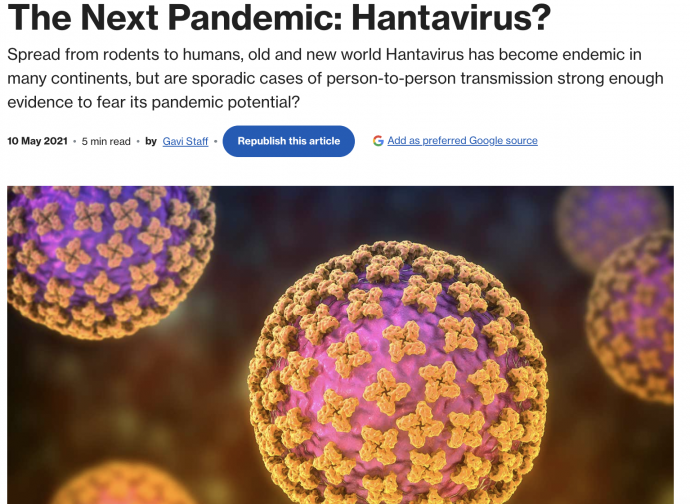
In May 2021, the Gavi Alliance — a powerful public-private network that promotes vaccination strategies worldwide and is funded by Bill Gates, who has been involved in vaccines and global health policies for the past ten years — published an article on its website with the telling — or rather disturbing — title: The next pandemic: Hantavirus?
Curiously, it is worth noting the date: 10 May 2021. This was in the midst of the mass vaccination campaign against Covid-19, in which Gavi was also a key player. Yet there was already talk of the next pandemic. The article stated that Hantavirus could potentially cause a future pandemic, based on a 2005 study which hypothesised person-to-person transmission. 'Human-to-human transmission of Hantavirus is very rare, but despite this, outbreaks remain a public health concern, mainly due to the risk of domestic infections and nosocomial spread, when transmission occurs within hospitals and clinics,' it stated.
However, the cited study, which was conducted on an Argentine case of Hantavirus spread and published in the US National Library of Medicine, attempted to explain suspected human-to-human transmission without definitively proving it. The article concluded that further studies were needed to better understand this rare mechanism of viral spread. However, as explained by Bertoglio, others followed, suggesting an environmental cause rather than direct human-to-human transmission.
In the meantime, there were already reports of vaccines being trialled, albeit of Chinese origin and unsuccessful. At least for the time being. But now that Moderna has entered the fray, could everything change?
One thing is certain: while we were preoccupied with the threat of the novel Coronavirus, someone with a vested interest had already identified a potential risk from the rat virus. So, when the opportunity arose — namely, an outbreak on a cruise ship coming from an endemic area and heading west — the authorities were immediately alerted, not because of a concrete risk, but because those in a position to decide what we should fear had conditioned them to respond in this way.
In short, the scientific community is not yet in agreement on this point; the available evidence suggesting a risk of human-to-human transmission of the Hantavirus is insufficient to draw firm conclusions. Above all, however, the alarm over those few cases, which can be traced and treated medically, is unjustified.
This is all the more pertinent given that we still do not know what epidemiological hypotheses have been put forward regarding the other seven cruise passengers who contracted the virus. The Dutch couple appear to have contracted the virus outside the ship, specifically while visiting the Usuhaya landfill site for birdwatching, according to initial findings.
What about the others? If it has not been scientifically proven that the virus is transmitted from person to person, is it not more plausible that they contracted the virus in environments outside the ship, or on the vessel itself, in circumstances that suggest a lack of hygiene and sanitary conditions designed to avert the risk, rather than from other people? Wouldn't it be better to pursue this line of inquiry than to start painting panic-inducing scenarios, such as those we are currently witnessing?
