
Mullally at the Vatican: the pseudo-blessing should have been avoided
Upon receiving the Anglican Primate, Leo XIV mentioned the ‘new problems’ that had arisen between Rome and Canterbury, one of which was right before his eyes: the self-styled archbishop, fresh from her theatrical ‘blessing’, a stone’s throw from Peter’s tomb, whilst a bishop made the sign of the cross, in defiance of sacramental truth.


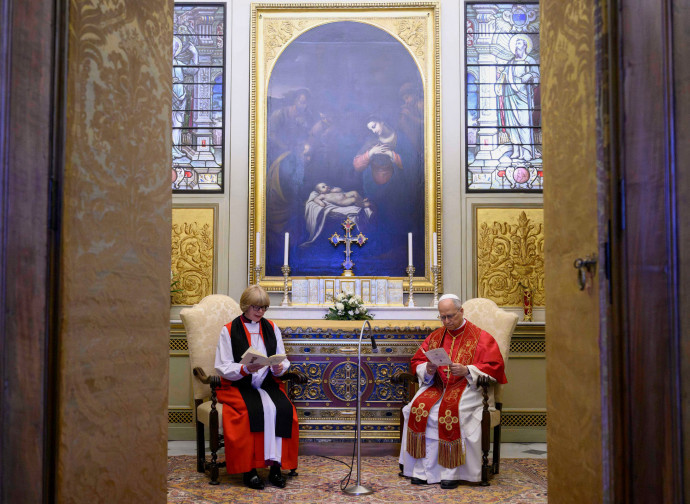
Today, Tuesday 28 April, marks the end of Sarah Mullally’s visit to Rome. She was appointed Archbishop of Canterbury and Primate of the Anglican Church last October, and was officially installed on 25 March. Yesterday, the most significant stage of the pilgrimage was marked by a meeting with Pope Leo, followed by a joint prayer in the Chapel of Urban VIII.
Recalling the sixtieth anniversary of the Joint Declaration between Paul VI and Michael Ramsey, which launched ecumenical dialogue between the Catholic Church and the Anglican Communion, the Pope urged us to 'be steadfast in our prayers and in our efforts to remove any stumbling block that hinders the proclamation of the Gospel'. However, Leo XIV did not hide the difficulty and complexity of this dialogue: 'Although much progress has been made on historically divisive issues, new problems have arisen in recent decades, making the path towards full communion more difficult to discern. I know that the Anglican Communion is also facing many of the same issues at present.'
One of these 'new problems' that has arisen in recent decades and is dividing the Anglican Communion was standing before the Pope in the flesh. This is not a matter of Ms Mullally’s moral qualities, but an objective fact: her appointment represents a significant point of rupture in the recent history of ecumenical dialogue between the Catholic Church and the Anglicans. This rupture concerns the possibility of conferring the holy orders of the diaconate, the priesthood and the episcopate on women.
The first 'opening' on the Anglican side towards the ordination of women as priests came with the 1987 Synod, whose decision was confirmed again in 1992. However, it was not until 2008 that the green light was given for the ordination of women as bishops. This development led the Anglican Church, for the first time in its history, to have a female primate in less than twenty years. Ironically, the 'Archbishop' found herself dealing with a Pope who shares the same name as the Pope who, in the 1896 Apostolic Letter Apostolicæ Curæ, definitively declared Anglican ordinations to be null and void.
However, it seems that the Vatican has not properly grasped the consequences of this declaration, nor of John Paul II’s equally definitive teaching on the impossibility of conferring holy orders on women. A photograph of the 'archbishop' blessing the tomb of St Peter alongside Monsignor Flavio Pace, who has been Secretary of the Dicastery for Promoting Christian Unity since 2024, has caused quite a stir. And rightly so.
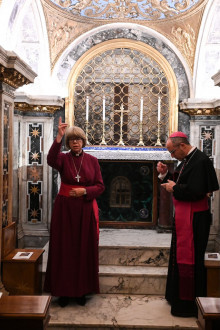 There must be a communications problem in the Vatican, as well as a problem with blessings. And a rather serious one at that. With the declaration Fiducia Supplicans, the Congregation for the Doctrine of the Faith sought to bless that which cannot be blessed (i.e. same-sex couples); now, the Dicastery for Promoting Christian Unity is allowing the unordained to bless. Pope Leo XIV had only just re-established the requirement that the person imparting the blessing must be ordained, clarifying that same-sex couples could not be blessed as a couple, but only individuals. Yet the Vatican has already caused another stir regarding who may impart blessings.
Of course, anyone can invoke God's blessing, for example when a parent makes the sign of the cross over their children before they go to sleep or leave the house. However, there is no indication that Mrs Mullally is the mother of Monsignor Pace, and the 'archbishop's' blessing appears decidedly priestly. The image speaks louder than words. A bishop who bows to receive a blessing from Mrs Mullally creates confusion regarding sacramentals and holy orders because, for an ordinary Catholic, that gesture signifies a priestly blessing. Moreover, Mrs Mullally is neither a priest nor a bishop for two reasons of the utmost importance: firstly, the ordination of a woman is null and void; and secondly, Anglican ordinations are invalid. This is not a matter of mutual respect or liturgical hospitality, but of respecting and safeguarding the truth of the sacramental sign. What message does it convey when a 'female bishop' is permitted to bless within the heart of the Catholic Church, and when a Catholic bishop bows to receive that blessing?
The answer is obvious; however, it is difficult to believe in the good faith of those who orchestrated this charade. It is also hard to believe that the secretary of the relevant dicastery, which claims to be guided by the Second Vatican Council's decree Unitatis Redintegratio, has not read its conclusion: 'This Sacred Council exhorts the faithful to refrain from superficiality and imprudent zeal, which can hinder real progress toward unity. Their ecumenical action must be fully and sincerely Catholic, that is to say, faithful to the truth which we have received from the apostles and the Fathers, in harmony with the faith which the Catholic Church has always professed.'

Newman Doctor of the Church: “His condemnation of religious liberalism speaks to us today.”
St John Henry Newman is to be proclaimed a Doctor of the Church. The Daily Compass interviewed Bishop Edoardo Cerrato, an Oratorian like the English saint. 'He believed that a doctrine shows its true vitality when it becomes an active principle that translates into action. The 'note speech' in which he condemns religious liberalism is the aspect I have chosen for our times.