
At the consistory, Müller breaks his silence on the ‘Écône affair’
The former Prefect of the Congregation for the Doctrine of the Faith is shaking up the Sacred College in the face of an imminent new schismatic act. His two proposals are: to respond to the accusation that the Apostolic See has lost the faith, levelled by the Society of St Pius X, and to prepare to welcome those who will not continue in the schism, as happened in 1988 with the Ecclesia Dei Commission.


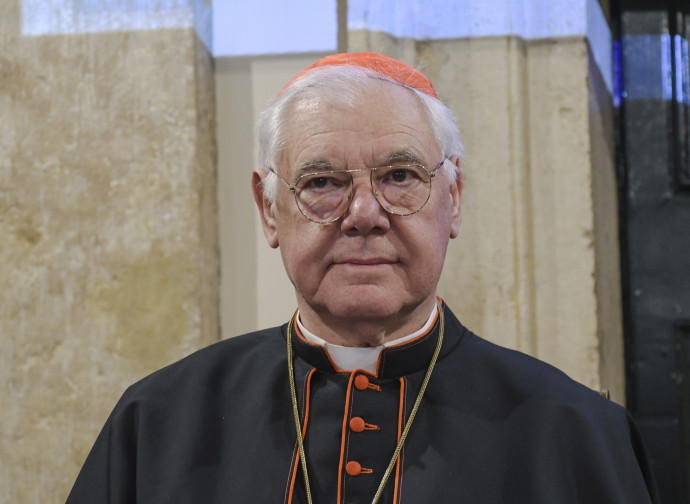
It was not on the agenda of the current consistory, but Cardinal Gerhard Müller, former Prefect of the Congregation for the Doctrine of the Faith and ex officio President of the then Pontifical Commission Ecclesia Dei, did not think twice: according to a report published by Il Giornale, the cardinal took the floor to ask his fellow cardinals and the Pope to respond to the open accusation by the Priestly Fraternity of St Pius X that Rome, from and including the Second Vatican Council, had lost the faith.
We had reported on the ‘profession of faith’ which the FSSPX, certainly not without a degree of provocation, had sent on 24 June to all the cardinals gathered in consistory. That Rome has lost the faith, and that the Catholic Church has now been reduced to a decadent ‘conciliar church’, is certainly not a new conviction within Lefebvrian circles; but the imminent episcopal consecrations and the defiant tone of the Superior General, Fr Davide Pagliarani, could certainly not go unnoticed.
The cardinal had the frankness required to rouse his confreres from a rather embarrassing silence, as though an imminent new act of schism were something the Church need not concern itself with. There appear to be two points that Müller wished to bring to the Holy Father’s attention. The first concerns the fact that the time has come to respond substantively to the Fraternity’s accusations, without leaving this task to impromptu interviews with a few prelates or to theological debate alone. Not least because the faithful have a right to clarity from their own shepherds.
It is certainly not reassuring that such a task might be assigned to the current prefect of the Congregation for the Doctrine of the Faith, Cardinal Victor Manuel Fernández, and not only because of his problematic theological training, but also because such a delicate matter must be handled by someone who knows it thoroughly, drawing on the input of those bodies that have a clear understanding of the Fraternity’s positions and have devoted years of study to them. Never before has it seemed so necessary to re-establish the Ecclesia Dei, following its forced closure ordered by Francis, which has the advantage of building on forty years of experience, whilst enriching it with new collaborators who have explored, from a theological perspective, one or other of the issues raised by the FSSPX. For if there is to be a response – and there must be one – it must be characterised by completeness, clarity and thoroughness.
Among the issues that will need to be addressed are certainly those texts of the Second Vatican Council which the Fraternity continues to misinterpret and which a current diametrically opposed to the FSSPX interprets as representing a break with tradition: ecumenism, religious freedom, collegiality, supreme power and primacy, interreligious dialogue; a clarification of these and other points will serve the truth of the whole Church, and not just the traditionalist world.
But the Fraternity must also be confronted once and for all with its errors regarding its understanding of sacramental intention, the episcopate, the Petrine primacy, the unity of the Church and other ‘minor’ issues—to which the FSSPX nevertheless continually appeals—such as supplementary jurisdiction and the principle of Ecclesia supplet, et alia.
The re-establishment of theEcclesia Dei may also meet the other requirement raised by Cardinal Müller, namely that of having a structure in place to welcome priests, religious and laity who may leave the FSSPX following the consecrations. It is no secret that not everyone within the Fraternity is particularly happy with the line of open defiance advocated by Fr Pagliarani. Whether this, however, is sufficient to take a step such as leaving Ecône to join the untrustworthy ‘modernist Rome’ is another matter entirely. It should in fact be remembered that in 2003–2004, the representative of the ‘soft’ line, Monsignor Bernard Fellay (who co-consecrated on 1 July), had no qualms about expelling from the Fraternity certain priests who had defended the agreement between the community of Campos and the Holy See.
An even clearer and stronger signal is expected from the Holy See. For decades now, all priests and the faithful attached to the traditional rite and to what we, for convenience’s sake, refer to as the “traditional pedagogy of the faith” – in their firm determination not to tear the mystical body of Christ apart through schism – have been living in a state of constant precariousness and, not infrequently, facing enormous difficulties in gaining access to places where they might find this priceless treasure of the traditional rite. They are often met with suspicion, if not outright hostility, from bishops and diocesan curias. Finding a solution that would spare these faithful from such instability would be the greatest gesture the Pope could make, extended also to all those who attend the chapels of the FSSPX without wishing to join the schism. These faithful and priests, often referred to as ‘Ecclesia Dei’, constitute a very much living and ever-growing community. One need only consider the staggering numbers at the Chartres pilgrimage.
In this context, Fr Nicola Bux, in a recent open letter published by Edward Pentin, asked Pope Leo to consider ‘the reality of so many bishops who, with balance, have achieved liturgical harmony in their own dioceses’ and to grant once again ‘to the whole Church the possibility of celebrating, alongside the new rite, the ancient Roman rite, whilst reaffirming the validity of the liturgical reform and the inviolability of the Second Vatican Council, as of every other Ecumenical Council’.
Also of great interest is the proposal championed by Father Louis-Marie de Blignières, namely that of establishing circumscriptions or ordinariates, led by bishops chosen from within the traditionalist movement, modelled on those established following the motu proprio Anglicanorum coetibus. This structure would finally make it possible to fully integrate the traditionalist movement into the Church’s hierarchy, to achieve greater stability, and thus to promote more decisively that much-desired liturgical reconciliation.
In the United States, where the presence of the FSSPX is particularly widespread, the authorities and theologians of the Franciscan University of Steubenville have addressed an open letter to the Superior General, the Council and the faithful of the FSSPX, asking them to desist from the schismatic act planned for 1 July, ‘which would consolidate and deepen the existing separation’, and to return to the path of dialogue with the Holy See. Prominent among the signatories are Scott Hahn, author of numerous publications also translated into Italian; Mark Miravalle, a theologian consistently active in promoting the dogma of Mary’s mediation and co-redemption; John Bergsma, a former Protestant pastor and specialist in the Old Testament and the Dead Sea Scrolls; and Stephen Hildebrand, vice-chancellor of the University.
A commendable appeal, which we hope will make an impression on at least some members of the FSSPX; a fraternal yet also extremely frank letter: ‘The treasures of the Catholic Tradition do not belong to those who are outside communion with Peter; they belong to the heart of the Church. A new episcopal ordination outside the ecclesial hierarchy and without the apostolic mandate would inflict a new wound on the Body of Christ and place the gifts that God has entrusted to the Fraternity [...] outside her maternal embrace.”
