
From the Lefebvrians: a profession of faith that is both comprehensive and inconsistent
In the letter sent on 24 June to the cardinals and the Pope, the Fraternity emphasises orthodoxy, but only to a certain extent. The crux of the matter is its claim to proclaim Catholic doctrine whilst remaining outside Catholic unity; to recognise the Pope whilst at the same time consecrating bishops against his will; and to declare itself faithful to the Church whilst rejecting its sacraments.


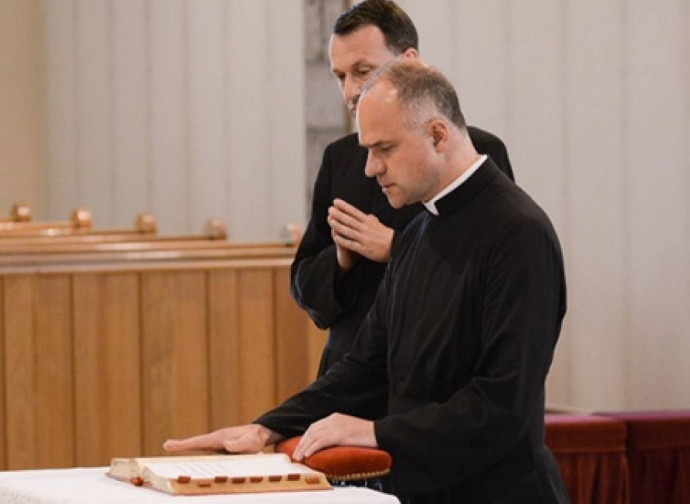
And following the Declaration of Faith of 14 May, on Wednesday 24 June, the eve of the consistory, the Priestly Fraternity of St Pius X (FSSPX) sent the Holy Father and the cardinals a ‘comprehensive profession of the Catholic faith’, comprising 154 points, as ‘the best contribution that can be offered to the universal Church’, in the hope that this text might one day ‘serve as a basis for a frank discussion with the Holy See, in a peaceful, fraternal and charitable atmosphere’. This profession is not only a manifestation of the Fraternity’s attachment to the Catholic faith, but also of its members’ unwillingness ever to address their own structural problem.
For forty years, talks with the Holy See have been characterised by this ‘strategy’: putting forward a purported profession of the integral Catholic faith, with the aim of ‘passing the buck’ to Rome (an expression I have heard verbatim on several occasions from the mouths of the superiors of the FSSPX, including the current one) and warding off the danger of having to defend their own (indefensible) position of rigour. And so, for four decades, the Holy See has been offering a canonical solution, whilst the Fraternity has been putting it off, raising the issue of ‘faith’ and presenting the criterion of sound doctrine as the sole indispensable requirement for membership of the Catholic Church, contrary to the entire tradition of the Church. A sound doctrine which the Fraternity, in the case of the primacy of the Pope, affirms in words but contradicts in deeds.
It is quite evident that the Fraternity’s problem is not professing the Catholic faith, but professing it outside Catholic unity. And this is precisely the crux of the matter—not even a particularly Gordian knot—which the FSSPX refuses to address, and which renders its position schismatic, despite certain justifications it puts forward. For, in theory, one can be perfectly orthodox and perfectly schismatic, and thus find oneself dramatically and dangerously outside the Church. One is reminded of what St Augustine wrote about the Donatist schismatics: ‘whilst we do not forbid the things in which they agree with us, as regards those in which they do not agree with us, we urge them to come and obtain them or to return and regain them, and by every possible means we endeavour with great charity, so that, having amended and corrected themselves, they may make this choice’. And he added: ‘We do not say to them [the Donatists]: “Do not administer baptism”, but: “Do not administer it whilst in schism”; and to those whom they are about to baptise, we do not say: “Do not receive baptism”, but: “Do not receive it whilst in schism”’ (On the Baptism of the Donatists, I.2.3). We do not say to the Fraternity: ‘Do not profess the faith’, but ‘Do not do so whilst in schism’.
For this is precisely the crux of the matter, and it is the point on which the Fraternity continues to beat about the bush, clinging to an interpretation of the state of necessity that is incompatible with the divine constitution of the Church. Indeed, there is no such thing as a Catholic episcopate that arises against the will of the Pope, to whom it belongs, by divine right, to select, consecrate and send out bishops. There is no such thing as a Catholic episcopate that exists independently of membership of the episcopal college, which can be exercised—even if only from the point of view of the power of order—autonomously, or indeed in opposition to the other bishops and the Pope. There is no such thing as a purely ‘sacramental’ episcopate—that is, one which is not ordered towards the governance of the Church—which is why an episcopal ordination without a mandate constitutes a schismatic act.
If a suggestion may be offered to the Holy See, it is certainly to meet with the leadership of the Fraternity and resolve these issues once and for all. And others, which the current leadership under Fr Pagliarani has the ‘merit’ of no longer being able to sweep under the carpet of its much-vaunted fidelity to the Church, and which point towards regarding almost all the novus ordo sacraments as suspect. Two priests who left the FSSPX a few years ago have confirmed (see here) what I already knew (though not the general public), namely that ‘the Society of St Pius X re-confirms confirmations conferred using the rite reformed by Paul VI’, and ‘as recently as in Bordeaux, confirmation was once again conferred on a young man who had already been confirmed by Cardinal Ricard using the traditional rite’. This is yet another worrying sign – alongside the failure to use consecrated hosts in Masses celebrated according to the rite of Paul VI – confirming that the thesis put forward by Fr Jean-Michel Gleize, a theologian of the FSSPX and lecturer in dogmatic theology at Ecône, regarding the dubious validity of four Novus Ordo sacraments, no longer concerns merely a minority view. ‘Precisely – writes Fr Gleize – their [the “conciliar” bishops’] intentions are doubtful to the exact same extent that the new rites reformed by Paul VI are doubtful. We know that a doubt persists regarding the validity of the two sacraments of Extreme Unction and Confirmation, due to the matter. There is also doubt regarding the sacrament of the Eucharist, the Mass, due to the ambiguity of the new rite, which may distort the celebrant’s intention. As for the sacrament of Holy Orders, the issue—if indeed there is one—is analogous to that of the Mass: validity cannot be judged except on a case-by-case basis, according to the actual celebrations.”
In essence, the Fraternity regards itself as the only community in which these sacraments are certainly valid. Even in communities that celebrate the sacraments according to the ancient rite, doubt is far from absent, owing to a possible invalidity underlying the episcopal ordination of the person who conferred the major orders. And so, Cardinal Jean-Pierre Ricard, Archbishop Emeritus of Bordeaux, may have conferred invalid confirmations (in the eyes of the FSSPX) for at least two reasons: the possible invalidity of the sacred oils (as regards the matter) and the possible invalidity of his own ordination.
Not to mention the ever-active St Charles Borromeo Commission for the nullity of marriage (and other such matters), where the Fraternity effectively exercises the very jurisdiction which it then proclaims it does not wish to pass on through its ‘own’ episcopal ordinations. May the Holy See therefore receive them, put questions directly to its interlocutors that will clarify these ambiguities once and for all, and adopt a clear and definitive position that may guide the faithful and confirm them in the faith.
