

Here's why the Lefebvrian case merits attention
Many wonder why we devote so much space to the Lefebvrian issue when there are various other problems within the Church. Two aspects are worth highlighting: the nature of the Church and the danger posed by a schism, and the gravity of the Fraternity’s positions and Lefebvre’s judgement of Saint John Paul II.


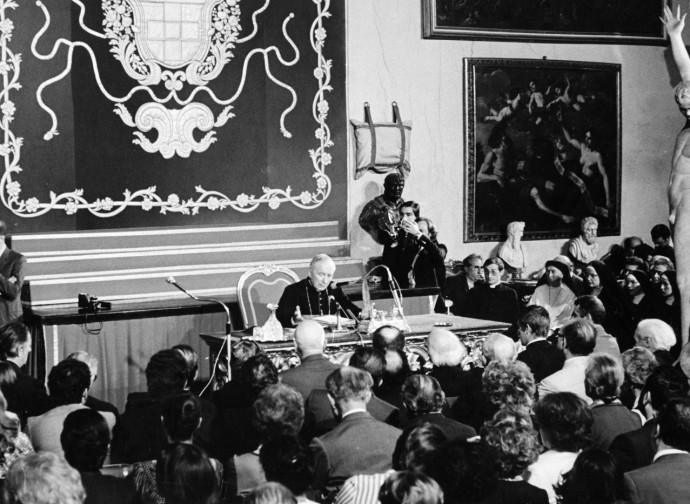
Why has the Daily Compass decided to devote so much space to the Lefebvrian issue? This is an understandable question that many have asked themselves. It is usually accompanied by the observation that, given the deluge of deviations within the Catholic Church in the areas of morality, liturgy, and doctrine, the Lefebvrian issue is, all things considered, a marginal danger — if it can be regarded as a danger at all.
However, this perception of the situation is problematic; indeed, it is the serious problem that has made us realise just how important it is to remain focused on the Lefebvrian issue. Many people have clearly understood the impossibility of accepting deviations 'to the left', but have not grasped to the same extent the impossibility of following deviations 'to the right'. In my view, there are at least two factors contributing to an inadequate understanding of the FSSPX (Priestly Fraternity of St Pius X) phenomenon. The first is that we no longer understand what the Catholic Church is or recognise its hierarchical and visible dimension. In reaction to an absolutist conception of the papacy and an arbitrary view of the law — exacerbated during Francis's pontificate — the pendulum has swung to the opposite extreme. This has resulted in the de facto devaluation of the primacy of Peter, as well as a failure to understand the juridical dimension of the Church’s communion.
Adherence to the Lefebvrian schism poses a very real threat to our eternal salvation, no less than adherence to homoheresy, desecrating liturgical farces or conforming to the new wave of situational morality that is eroding the foundations laid by St John Paul II and the late Cardinal Carlo Caffarra. Being saved from the flames of a bonfire only to end up drowning is little consolation. We are writing not to express opinions or provoke debate, but because genuine membership of the Church is necessary for salvation and schism is a sin that separates us from this salvation.
Secondly, many people have failed to grasp the gravity of the positions of the FSSPX, believing that the issue boils down to the Fraternity raising legitimate objections that Rome refuses to listen to. Nothing could be more superficial or misleading. This is not the case at all. As we shall see, in truth, Archbishop Marcel Lefebvre has gradually built up a position that effectively severs ties with the Catholic Church as it exists today. Ultimately, he transfers Christ’s promises regarding the indefectibility and inerrancy of his Church to the Fraternity itself.
The result is that the FSSPX presents itself not only as the ultimate arbiter of the Catholic Church's positions and decisions, and even of the Pope's catholicity, but also as the continuation of Christ's true Church.
The FSSPX has defended and reiterated Lefebvre’s erroneous teachings, effectively constructing a closed system based on unproven and unprovable premises which cannot be substantiated and are therefore impervious to any external objection. This theological construct is the framework within which Lefebvre confined the FSSPX, and the FSSPX is unwilling to question anything within it, for fear that the walls which have 'protected' it for fifty years will collapse, resulting in separation from the Catholic Church. For this reason, the FSSPX has never sought genuine dialogue with the Holy See or its representatives, but has instead used these meetings to demonstrate its own 'Romanity' and to bear witness to Rome of the faith it claims Rome has lost.
The FSSPX's position in the current crisis of faith is founded in the 21 November 1974 declaration. In this document, Archbishop Lefebvre set out an ecclesiology that is incompatible with that of the Catholic Church. The contrast between 'Eternal Rome' (also known as the 'Church of All Time') and 'Rome with its modernist and neo-Protestant tendencies, which manifested itself clearly at the Second Vatican Council and, after the Council, in all the reforms that followed' (or the 'conciliar Church'), is not merely rhetorical; it asserts that the Church of Christ is no longer the visible Catholic Church, founded upon the living successor of Peter and upon the bishops in communion with him. For Lefebvre and the FSSPX, 'Eternal Rome' effectively becomes an abstraction — something that does not exist in today's concrete reality, but which is identified with the Church prior to Vatican II: its documents, its Roman liturgy and its popes. This is a Church that no longer exists today (except, as we shall see, within the FSSPX). Paradoxically, therefore, the 'Church of all time' becomes the 'Church of yesterday', hence the need for a new definition of obedience that applies to the popes of yesterday and is also sufficient for considering oneself obedient to today's pope: 'We are convinced that by remaining faithful to all the popes and councils of yesterday, we are faithful to today's pope and council, and to tomorrow's pope and council' (homily of 2 September 1977, Poitiers). Disobedience to the current pope is therefore only apparent if one remains faithful to the popes of the past.
Cardinals Garrone, Wright and Tabera, who were appointed by Paul VI to address the critical situation within the Fraternity, asked Lefebvre to revise certain passages of the 1974 declaration, but he refused. This obstinacy would become ingrained in the DNA of the FSSPX. Although the Fraternity complains when accused of being schismatic today, it must be remembered that it was Lefebvre himself who used the word 'schism', clearly implying that 'conciliar Rome' was schismatic: 'We believe we can affirm [...] that this [Vatican II], by turning its back on Tradition and breaking with the Church of the past, is a schismatic Council' (2 August 1976, Le Figaro). Hence the ‘conciliar Church’ is schismatic.
Another important piece of the puzzle is the homily from the famous Lille Mass, celebrated before more than six thousand people on 29 August 1976: 'If the Pope were no longer the servant of the truth, he would no longer be the Pope. I am not saying that he is no longer so […] but if it were true, we could not follow someone who leads us into error.' Therefore, Archbishop Lefebvre recognised the Successor of Peter in theory, but in practice he proclaimed that it would no longer be possible to follow him, acting in complete independence from him. It should be noted that the issue here is not specific acts of a pontiff, which might be open to debate, but rather the regular refusal to follow a pope because he is not Catholic.
One might object that, for Lefebvre, this was merely hypothetical; however, this was not the case. A decisive text from 1983 entitled À propos des décisions éventuelles futures (Regarding possible future decisions) demonstrates this. It is Lefebvre's response to an important study commissioned by him and conducted by the Second Assistant General of the FSSPX, Fr Josef Bisig. Bisig would later leave the Fraternity to found the Fraternity of St Peter, which is in communion with the Apostolic See. The study concluded that it was impossible to ordain bishops against the Pope's will. Lefebvre's response reveals the true reason that drove him to the consecrations of 1988 and led to the repetition of this schismatic act a few days ago.
Lefebvre begins with some telling questions: ‘Is this Church still apostolic and Catholic? To what extent can the Pope go astray whilst remaining Catholic? Without embracing sedevacantism, must we not ask whether we should consider this Pope to be Catholic?” Sadly, the answer is clear. Without wishing to address the question of a heretical and schismatic pope, the French bishop proclaimed that ‘we can and must, in good conscience, affirm today that, following the promulgation of the new law which clearly affirms the new Church, and following the scandalous acts and declarations concerning Luther, Pope John Paul II is not a Catholic’.
After declaring that the Pope is not Catholic, Lefebvre developed a whole new 'theological arsenal' (so much for obedience to the Church of yesteryear...), which is incompatible with Catholic doctrine. As we shall see.
1. To be continued
