
Lefebvre and the refusal to submit to the reigning Pope
For the founder of the Society of St Pius X, St John Paul II was not a Catholic. Lefebvre theorised about communion with past popes whilst effectively disobeying the current one. This is by no means a Catholic theory because only the reigning pope holds the power of the keys.


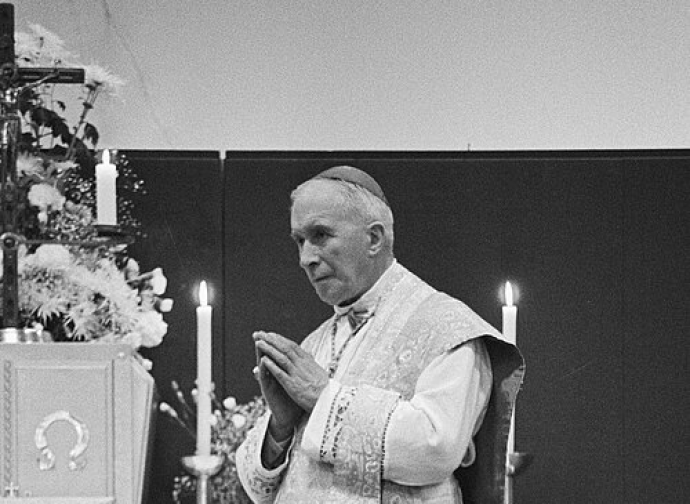
In the view of Monsignor Marcel Lefebvre, John Paul II was a non-Catholic pope, Vatican II was a schismatic council and all the subsequent reforms were a contradiction of the 'Magisterium of all time'. In his sermon on the occasion of the episcopal consecrations on 30 June 1988, Lefebvre imagined he could hear the voices of popes from Gregory XVI to Pius XII imploring him to continue their teachings. If he did not, he said, tradition and the Church itself would disappear. ‘Do not abandon the faithful! Do not abandon the Church! Carry on the Church! For in the end, after the Council, behold, the Roman authorities are embracing and professing what we have condemned—how is this possible? If you do not do something to carry on this tradition of the Church that we have given you, everything will disappear. The Church will disappear and souls will be lost.’
In the previous article, we saw that Archbishop Lefebvre believed that submission to the popes prior to Vatican II was sufficient for communion with the Catholic Church, whilst explicitly refusing submission to the pope who occupied the Chair of Peter at the time. The apostolic mandate devised by the Society on the occasion of the episcopal consecrations of 1988 further emphasises this non-Catholic idea of obedience to a 'Church of all time', which is not the concrete, visible Catholic Church whose centre of unity lies in the Roman Pontiff. By asserting that 'We have [the mandate] from the Roman Church, ever faithful to the holy traditions received from the Apostles', despite the head of the visible Church expressly denying it to them, Lefebvre went so far as to sever the substantial identity of the one Church of Christ throughout history. He theorised that the Church of Christ is no longer to be found where the successor of Peter and the bishops in communion with him are today. Consequently, it becomes the responsibility of others to 'continue the Church', by withdrawing from the authority of legitimate shepherds and breaking visible unity with the Church.
This is no longer a matter of legitimately resisting a Pope who errs or speaks ambiguously, but of habitually withdrawing from his authority and refusing to submit to him, even when he commands in accordance with the power he has received from Christ (e.g. in the case of choosing, consecrating and sending out bishops).
From this perspective, it is possible to be a Catholic without being in juridical communion with the present-day Pope, provided one agrees with the teachings of past popes. There is nothing traditional or Catholic about this. Lefebvre and the FSSPX reduce communion with the Apostolic See to adherence to the teachings of past popes on matters of faith, thereby disregarding the necessary hierarchical communion. Thus, contrary to Catholic doctrine, the mandatum is transformed into merely transmitting true doctrine and true sacraments. This effectively denies that it is primarily the sign of the necessary delegation conferred by the Pope, who is the guarantor of unity and apostolicity. It is this apostolic mandate, or other forms recognised by the Apostolic See, that ensures a consecrated bishop is Catholic, and not a usurper. Lefebvre has thus divided what God united: the transmission and safeguarding of the faith, and hierarchical communion.
This makes it possible to theorise a communion with past popes, but not with the current one. However, the problem lies in the fact that communion with the Church requires submission to the reigning Pope, the sole holder of the power of the keys. The popes of the past no longer hold this power because it is given to govern the Church militant, not the Church triumphant. It is only the reigning pope who can grant or refuse the apostolic mandate for the consecration of a bishop and admit or refuse a bishop into hierarchical communion by virtue of the power of the keys. Bishops of the past (and those of the future) cannot do this.
Another crucial point is that Archbishop Lefebvre declared it impossible to submit to the Roman authorities due to the 'conciliar spirit' and the spirit of Assisi that guided them. Therefore, it is vital to withdraw from their authority in order to 'continue in the tradition, preserve the tradition, whilst waiting for this tradition to regain its rightful place [...] within the Roman authorities, in the spirit of the Roman authorities'. Episcopal consecrations are therefore seen as necessary to ensure the continuity of the Church and of Tradition, which Lefebvre believed would otherwise be lost forever, whilst remaining beyond the reach of the hierarchical Church’s authority. The survival of the Church and the dogma of its indefectibility are only made possible by what the French bishop came to call the 'survival operation'; Lefebvre repeated this expression several times in his homily on 30 June 1988, contrasting it with the 'suicide operation' that would have occurred had he accepted the agreement with the Holy See.
In this homily, the 1974 dichotomy is radicalised: 'Conciliar Rome' is definitively deemed a foreign body that has nothing to do with the Catholic Church. To ensure the Church's survival, true Catholic bishops must be consecrated (those of the FSSPX), who will uphold the true tradition. Despite repeatedly assuring his listeners that he did not want any schism or break with Rome, Lefebvre intended to form a community separate from the Catholic Church, which he now referred to as a 'conciliar Church' following a schismatic council. This community would carry on the Tradition and the Church. Lefebvre even went so far as to attribute to the FSSPX the characteristics that define the Church of Jesus Christ: 'I am not saying that we are the Catholic Church. I have never said that. No one can accuse me of ever wishing to be regarded as a pope. But we truly represent the Catholic Church as it once was, since we continue what the Church has always done. It is we who possess the marks of the visible Church: unity, catholicity, apostolicity and holiness.’ This is what constitutes the visible Church' (Fideliter, July–August 1989, p. 6, p. 70). Clearly, there is an inadequate understanding of these marks. However, it is even more evident that Lefebvre contradicts his initial assurance that he does not consider the FSSPX to be the Catholic Church. Similarly, he contradicts his declaration that he does not wish for a schism at the very moment he brings it about. If the Pope is no longer Catholic; if the conciliar Church is schismatic; if, without the 'survival operation', the Church would have come to an end; if it is necessary to withdraw from the Church's hierarchy in order to remain Catholic; if, even as it breaks off communion with the Apostolic See, the FSSPX claims the hallmarks of the Church for itself; then it is abundantly clear that we are now faced with a veritable 'ecclesiology of substitution', as Father Albert Jacquemin rightly defined it (cf. Le Choix de la rupture. Mgr Lefebvre, Rome, the consecrations 1974–2026, Paris, 2026).
The Fraternity's well-known theological arguments for justification are equally divorced from the 'perpetual' Magisterium (to use a Lefebvrian expression). These arguments stem from a new ecclesiology which has no foundation in Tradition, but rather directly contradicts it. This new redefinition of schism is understood as the non-recognition of the Pope rather than the habitual refusal to submit to his authority. Other arguments include the idea of a 'state of necessity' that would make it possible to go against the divine constitution of the Church, the idea of a 'halved' episcopate which has nothing to do with the governance of the Church but only with the fullness of sacramental power, and the application of the principle of epicheia to divine law rather than merely to human and ecclesiastical law of schism; and the theorisation of an implicit or habitual will of the Pope — that is, the Catholic will — which the FSSPX would follow, as opposed to an explicit, non-Catholic will which must not be followed.
However, another aspect of extraordinary importance emerges in the 1988 consecration sermon, which will be the subject of the next article: the dubious validity of the 'new sacraments'.
2. To be continued.
