
Irregular migration: the EU remains out of touch with reality
Another social media campaign has been launched in Morocco in preparation for a new attempt to storm Ceuta. The president of the Spanish Bishops' Conference has lucidly denounced the use of migration as a political weapon. Yet the extraordinary EU summit has produced no concrete results apart from the intention to tackle the problem together.

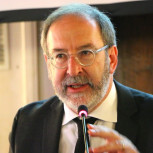
The most disconcerting thing to emerge from yesterday's extraordinary video conference meeting of the European Union's interior ministers was the statement by the European Commissioner for Home Affairs and Migration, Magnus Brunner. According to Brunner, the Ceuta crisis is already over and Europe 'has passed the test with flying colours'.
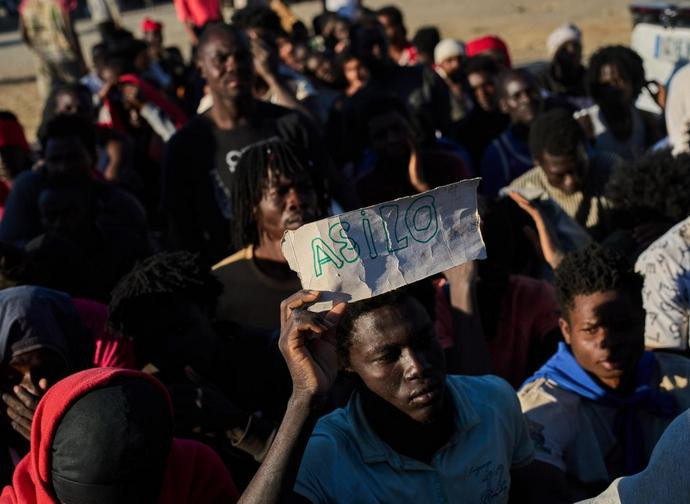
According to Brunner, what justifies this assertion is the fact that none of the 72,000 migrants (official figures) who crossed the border from Morocco into the Spanish enclave of Ceuta between 30 and 31 July reached the European mainland. Therefore, he argues, there is no risk to the Schengen Area, i.e. the free movement of people between its 29 member states.
Apart from the fact that the Spanish press has revealed that people have arrived in Spain, the situation in Ceuta is far from calm and the crisis is far from over. According to official figures, there are still 2,000 irregular migrants remaining, around half of whom are minors. However, they have no chance of being accommodated in the already overcrowded reception centres. Among those remaining in Ceuta are reportedly Palestinians from Gaza and Afghans.
As if that were not enough, just as Brunner was displaying his optimism, alarm was spreading over a new social media campaign in Morocco calling for another assault on Ceuta on 15 August. Given the ample warning, it is unlikely that the Spanish authorities will be caught off guard this time, but the message is clear and there is little cause for complacency.
The President of the Spanish Bishops’ Conference, Monsignor Luis Argüello, made this clear in a brief post on X; he, too, referred to the invasion of Ceuta as a test, but with a meaning entirely different from that put forward by European Commissioner Brunner. ‘Biopolitics,’ wrote Monsignor Argüello, ‘is the key to the current structure of power in the world. Life is being toyed with, and people – their dreams, their hunger, their sexuality and their data – are being exploited to generate profit and power. Migration is part of this strategy. The invasion of Ceuta is a test. Demography is a weapon.”
The hundred or so people who drowned whilst trying to reach Ceuta, and the thousands of accounts from people who, in good faith, had deluded themselves into thinking that crossing the border would easily lead to a better future, are proof that Monsignor Argüello has hit the nail on the head.
Unfortunately, there is not the same clarity in Brussels. At the final press conference of the extraordinary summit, the focus was on projecting an image of unity within the European Union: in solidarity with Spain, in the intention to strengthen repatriation policy, in the decision to continue the fight against human traffickers, and in the desire to build solid partnerships with third countries.
There was nothing new in reality, but above all, there was zero awareness that migration is being used as a weapon.
Moreover, beneath this apparent unity of purpose lies a certain unease amongst European countries. Yesterday, the Spanish government once again took aim at Italy, demanding that it revoke the reintroduction of border controls for travellers arriving from Spain by air or sea. Interior Minister Matteo Piantedosi responded by saying that this was not a measure directed against Spain, but rather a measure ‘intended to safeguard national security’. However on the eve of yesterday’s summit, 23 other countries joined Italy in calling for an extraordinary meeting to discuss Ceuta – a sign that Spain’s stance is causing some concern. Piantedosi himself, expressed solidarity with Spain but was quick to point out that Italy should have received the same level of solidarity during the 2023 crisis in Lampedusa.
Above all, however, what is fuelling the concerns of so many European governments is the Spanish government’s attitude towards irregular migrants. As we have noted recently , in February Pedro Sánchez’s Socialist government regularised half a million migrants who had entered Spain illegally – all of whom can now move freely within Europe. Indeed, European Commissioner Brunner also criticised the Sánchez government on this very subject at a press conference yesterday, stating that the regularisations ‘are not a good sign for the rest of Europe – absolutely not’. I understand that this is a matter of national competence and that they were carried out because the migrants are mainly from Latin America, speaking the same language and sharing the same culture, but the message for the rest of Europe is not a positive one. Absolutely not.’
Moreover, as far as Ceuta is concerned, the situation is far from calm in Spain either: precisely to provide assistance to the thousand or so minors wandering around Ceuta, the government has allocated 25 million euros, but the opposition fears that they will all be brought into Spain. Consequently, the regions governed by the People’s Party and Vox have already refused to take in minors from Ceuta: ‘Those who created the problem are the ones who must solve it, namely the Spanish government,’ said the PP’s general secretary, Miguel Tellado, pointing to the repatriation of those who have entered illegally as the only possible solution. ‘This is not a migration crisis,’ he added, ‘it is a national security crisis.’

Schneider: ‘Mass immigration is a plan to Islamise Europe’
Politicians and international organisations have orchestrated a resettlement of Muslim citizens in Christian European countries, with the aim of changing their identity. The term ‘refugee’ is being misused. Many in the Church are exploiting the Bible to justify mass immigration instead of proclaiming Christ. The Daily Compass interviews Monsignor Athanasius Schneider.
France, immigration strengthens Muslim presence
According to the Ined-Insee surveys, 91 percent of immigrants raised in Muslim families claim the religion of their parents, compared to 67 percent of Catholics. And children with a Muslim name account for 21.73 percent while 57 percent of Muslims consider shari'a more important than the law of the republic.