
The Trump and Pope clash is between power and Truth
Pope Leo XIV responded on a metaphysical level to the American president’s contemptuous remarks. It is a symbolic episode and a sign of a politics that claims to legitimise itself and accepts no higher authority.


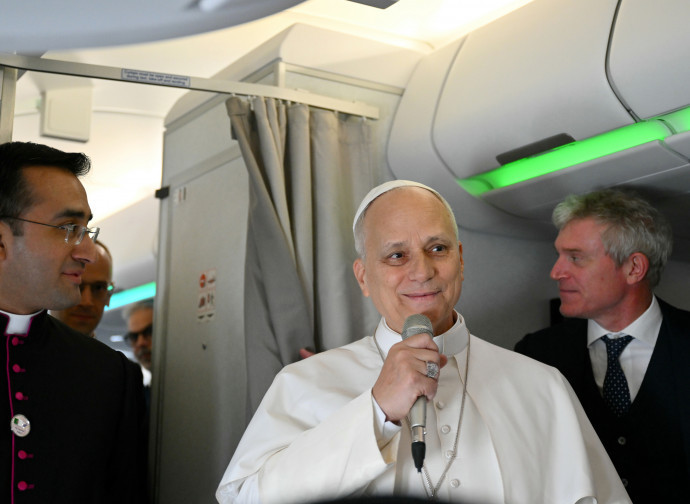
It is not the account of a personal clash that makes the confrontation between Donald Trump, President of the United States of America, and Pope Leo XIV significant. Its meaning is deeper because it touches on the relationship between power and truth. Trump publicly attacked the Pope with scornful words, calling him ‘terrible’, ‘weak on crime’ and ‘terrible for foreign policy’, after Leo XIV had condemned the war against Iran, the idolatry of power, and the abuse of religious language in support of violence.
The Pope responded without stooping to Trump's level, declaring that he did not fear the American administration and that he wished to continue speaking in the name of the Gospel and peace. In Algiers, he defined peace not merely as the absence of conflict, but as an 'expression of justice and dignity', adding that 'the future belongs to men and women of peace'. This reveals a difference that is political, anthropological and metaphysical.
In Trump's view, power tends to present itself as the basis of its own legitimacy: what prevails is valid, what succeeds is convincing and what is successful is just. Force is no longer seen as a means subordinate to the greater good, but as an implicit criterion of the greater good. For this reason, any reference to a higher authority is perceived as unbearable. The Pope is a source of discomfort not because he intervenes in international affairs, but because he reminds us that power does not coincide with truth, effectiveness does not generate justice in itself, and no victory absolves arbitrariness. His very public existence is a testament to the existence of an authority that does not derive from consensus, does not bow to threats and does not seek to prove its legitimacy through force.
In this context, Leo XIV’s Augustinian reference takes on particular significance. In his address to the Diplomatic Corps on 9 January 2026, he denounced the weakness of multilateralism and the return of a ‘diplomacy of force’, as well as the idea of seeking peace ‘through arms’ as a means of achieving domination.
In particular, the Pope referred to peace as tranquillitas ordinis: the just order of the soul, the city, and peoples.
This is a decisive point. Peace, in the classical sense, is not merely the technical freezing of conflict, the balance of mutual fears or the truce produced by deterrence. Rather, it is the political manifestation of a moral order: it exists where everyone receives their due, and where coexistence recognises a good that precedes the will of the contracting parties. Peace does not arise from the pact as an absolute source; rather, the pact should serve it.
This differs radically from the modern imagination. Political modernity often conceives of order as the result of a combination of equal and mutually limited sovereign wills. Within this framework, law tends to be reduced to procedure, and peace to the stabilisation of conflict. The essential task then becomes preventing conflict from escalating beyond a certain threshold. However, if there is no objective measure of justice, procedure achieves nothing; it merely administers disorder.
An agreement may suspend war, but it does not establish peace. Deterrence may produce silence, but not harmony. Equilibrium may delay ruin, but it does not transform it into order. However, for Augustine, the decisive question is not how to make the collision of wills tolerable, but how to restore a just hierarchy of goods. Where amor sui reigns, peace is merely an armed truce. However, where order is judged by the good, even politics rediscovers a non-idolatrous form. Peace is thus the earthly name for a justice that is never fully attained, yet which is always normatively demanding, and which is superior to victory precisely for this reason.
Peace is therefore not the weak opposite of force, but the highest form of redeemed force. Only a force that renounces absolute power can be just. Only a sovereignty that accepts being measured by something it does not produce can avoid becoming domination.
When Leo XIV insists on justice, dignity, dialogue and international law, he is not canonising contemporary proceduralism. Rather, he is seeking to rescue public discourse from technical neutralisation and reopen it to the question of the good. In other words, he does not sanctify institutions; he judges them. He does not deify multilateralism; he subordinates it. He does not bless just any peace; he distinguishes true peace from its caricature. He defends not diplomatic inertia, but the primacy of moderation over command, limits over the will to power and truth over propaganda. In this sense, peace is not just a sentimental truce; it is an ontological category of the political.
The episode thus takes on a symbolic value. This is not only because a president insulted a pope, which is a serious matter in itself, but also because the empire reacted with irritation to the mere idea of not being absolute. Even the pseudo-Christological image circulated by Trump and then withdrawn reveals this temptation: not to worship the symbol, but to embody it; not to submit to judgement by the sacred, but to exploit it as a backdrop for the sovereign self. This is a sign of politics that, having lost its connection with truth, seeks transcendence through theatricality. The sacred is not denied, but degraded to an iconographic repertoire of power.
Leo XIV, on the other hand, reintroduces a seriousness to public discourse that has become rare. By stating that peace is justice and dignity, he reminds us that political order does not arise from whimsical will, but from the recognition of a measure. In this sense, the Pope does not oppose force with moral fragility; he opposes the idolatry of force with the freedom of truth. It is precisely this freedom that power fears most: the freedom to calmly tell power that it is not God.
In April, La Bussola Mensile will feature the following theme: What is international law? It will take an in-depth look at the attempts, not always successful throughout history, to ensure coexistence among peoples, as well as examining the Church’s teaching on the principles underpinning authentic and lasting peace.
