

The moral dilemma facing Trump and Netanyahu
Who is winning the war in the Middle East? Opinions vary, but before conducting any further analysis, it is important to clearly state what the Pope has said: that threats to wipe out an entire people are morally unacceptable.


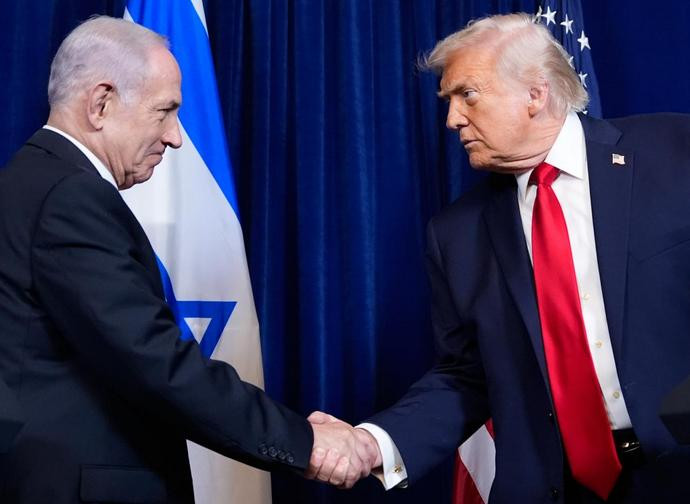
After the announcement of the two-week ceasefire agreement between Iran and the United States, which came 90 minutes before the ultimatum issued by US President Donald Trump was due to expire, the debate over who won and who lost began immediately. Both the US President and Iranian leaders immediately claimed victory, and commentators were also divided, often descending into partisanship.
While these analyses are legitimate and necessary, there is one consideration that takes precedence and provides the proper perspective for any other judgement. On 7 April, Pope Leo XIV commented on the words with which Trump announced the ultimatum to Iran. Trump had said, 'An entire civilisation will die tonight, never to be brought back to life. I do not want that to happen, but it will probably happen”. These words raised fears of apocalyptic scenarios, and the Pope said that this 'threat against the entire Iranian people is unacceptable; it is a moral issue'. Similarly, Paul Coakley, the president of the US Conference of Catholic Bishops, stated that 'the threat to destroy an entire civilisation cannot be morally justified'.
The key point is that, regardless of political and strategic considerations, the threat is immoral and cannot be justified. No amount of military or political success could ever make it acceptable or justifiable to threaten to 'send an entire people back to the Stone Age' and wipe out a civilisation overnight. Similarly, there can be no moral justification for the carnage carried out yesterday by the Israeli army in Lebanon, under the pretext that it does not fall within the ceasefire agreement, as reported separately. The provisional death toll is already in the hundreds, with thousands more wounded, mostly civilians. This seems to be an operation aimed more at spreading terror than at achieving military objectives.
This is not a matter of dwelling on aspects that are, all things considered, secondary to what is deemed essential: winning the war. On the contrary, contempt for civilians and entire peoples, and above all ignoring God's will, will sooner or later take its toll.
This also includes basing one’s security exclusively on force and the military capacity to prevail over enemies. When one feels strong, one often overestimates one's capabilities. This seems to be precisely the case with Israel and the United States on this occasion, as demonstrated by the reconstruction of the meetings and analyses that led Trump and Netanyahu to declare war on Iran on 28 February.
The New York Times has published an extract from the book Regime Change: Inside the Imperial Presidency of Donald Trump, by Jonathan Swan and Maggie Haberman. It recounts how, on 11 February at the White House, Netanyahu convinced Trump with a four-point analysis. The preceding months had been characterised by mass protests and repression, demonstrating that the time was ripe for regime change in Tehran and a transition that would put an end to the Islamic theocracy. The ballistic missile programme could be wiped out in a matter of weeks, leaving the regime unable to block the Strait of Hormuz. Street protests would resume, fuelled in part by Israeli secret services, facilitating the regime’s downfall.
Despite being advised against it by intelligence, his deputy J.D. Vance, and Secretary of State Marco Rubio, the US president decided two weeks later to take action, supported only by Defence Secretary Pete Hegseth.
Trump's statements at the start of the war lend credibility to this account. He spoke insistently of regime change and 3–4 weeks of bombing to achieve total victory, calling on the population to rise up against the ayatollahs.
Forty days after the start of the Israeli-American attacks, it is clear how things have turned out: the regime is still firmly in place, even after the killing of Supreme Leader Ali Khamenei and other key leaders; Iran controls the Strait of Hormuz (and the ceasefire agreement effectively recognises this); missile capabilities have certainly been weakened, but not eliminated; and there has been no popular uprising. Conversely, the war against Iran is causing a global energy crisis and plunging Sunni Arab countries hosting American military bases into serious economic and political difficulties.
Trump is now finding it very difficult to achieve his initial war goals whilst also finding an exit strategy that allows him to save face. For his part, Netanyahu has no intention of stopping, and if he reluctantly accepts the suspension of operations in Iran, he is taking liberties in Lebanon, Syria and the West Bank. The Tehran regime, on the other hand, is feeling emboldened by the situation, even though it has had to accept a temporary truce, which it had categorically ruled out until two days ago, under pressure from China and Pakistan.
This illustrates just how fragile the ceasefire is. Direct talks between the US and Iran are due to begin on Friday or Saturday in Islamabad, Pakistan. With discreet support from China, Pakistan has acted as mediator to reach a lasting agreement. However, as early as last night, everything seemed to be back in question. The Speaker of the Iranian Parliament, Mohammad Baqer Qalibaf, issued a statement denouncing the violation of three of the ten key clauses Iran set as conditions for the negotiations: the breach of the ceasefire in Lebanon; the entry of an 'intruding drone' into Iranian airspace; and the denial of Iran's right to enrich uranium. 'In this situation,' the statement concludes, 'neither a bilateral ceasefire nor negotiations make any sense.'
It remains to be seen whether the passage of ships through the Strait of Hormuz will resume from today, albeit 'in coordination with the Iranian Armed Forces', as provided for in the agreement. That would at least be a positive first step.
