
The key point of Leone's speech to the ambassadors is realism
Speaking to the Diplomatic Corps, the Pope proposed a holistic vision of the world based on the Church's social doctrine. Peace, he said, is based on the order willed by God, ‘transcendent and objective'. Realism is also at the heart of reflections on language and freedom of expression.


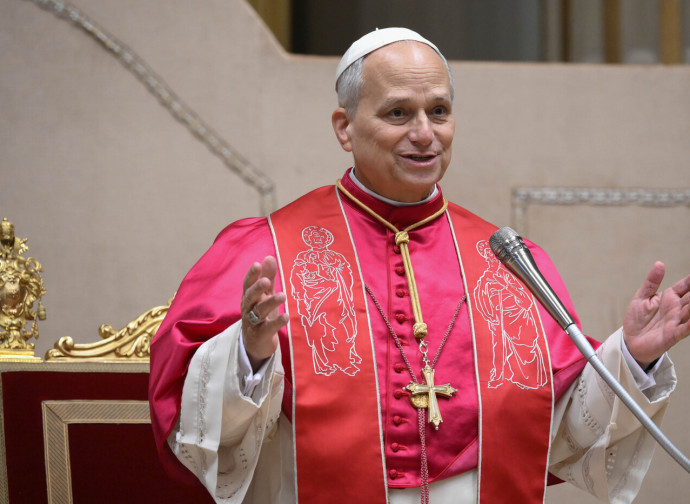
Pope Leo XIV's address to the Diplomatic Corps, which the Daily Compass has already presented, deserves special attention given its richness. As is customary on such occasions, the text recalls the situations of conflict and injustice present in the world today. However, it does not limit itself to this, but also proposes a systematic and organic vision of the need for a peaceful world according to the Social Doctrine of the Church. The 'short treatise' nature of the speech is striking: it provides a framework for understanding current events based on important principles and criteria of judgement. With the help of St. Augustine and Benedict XVI, Leo not only proposes an ethical agenda of initiatives to be undertaken, but also a framework of thought supported by faith.
The central aspect of this framework is 'realism': peace is based on the order willed by God, “transcendent and objective”; the rule of law must be respected when based on objective law, not subjective rights; humanitarian law must not be denied because it is based on the principle of justice applied to the dignity of civilians; the language of international politics must return to expressing certain truths; and freedom of expression depends not on subjective ideological requirements, but 'on the certainty of language and the fact that every term is anchored in the truth'. With regard to 'new rights', Leo states that 'each right becomes self-referential when it becomes disconnected from reality, nature, and truth'.
The key expressions are: 'truth', 'reality of things', 'order willed by God', from which the words 'nature', 'essence', 'objectivity' and 'certainty' derive. This discourse provides the foundations of freedom, political power, and relations between states. It offers a vision of thought that is not only relevant today, but also provides guidance for the future. Furthermore, it assigns the Catholic Church a unique and special role in addressing these issues: not to express an opinion, but to bear witness to truths unavailable to all. In this way, the danger of becoming entangled in worldly ideological dynamics and being unable to escape, as experienced in the past, is overcome.
This realism also sheds light on many social issues that are in the spotlight today. Leone condemns the ‘peace’ sought through rearmament and the persecution of Christians. He defends the family and unequivocally condemns abortion, including ‘projects aimed at financing cross-border mobility for the purpose of accessing the so-called right to safe abortion’, as well as surrogacy and euthanasia.
Of particular interest are the two reflections on language and freedom of expression contained in the speech to the Diplomatic Corps. While reflection on the importance of language and communication has developed enormously in Western societies, there has also been a detachment of words from reality and an increase in their artificiality. Postmodern language replaces the sequence 'thing-concept-word' with 'word-concept-thing'. Pope Leo is therefore right to say that 'when words lose their adherence to reality and reality itself becomes debatable and ultimately incommunicable, we become like those two people mentioned by St Augustine, who are forced to remain together without either of them knowing the other's language'. Today, war is also fought with words.
The second reflection concerns freedom of expression. Currently, this freedom is based on the subjective artificiality of language and the right to say whatever one wants. However, 'freedom of speech and expression is guaranteed precisely by the certainty of language and by the fact that every term is anchored in the truth'. Without truth, freedom of expression becomes illiberal. It is painful to note how, especially in the West, authentic freedom of expression is shrinking while a new Orwellian language is developing. In an attempt to be inclusive, it ends up excluding those who do not conform to its ideologies. Tolerance becomes intolerant; it is the 'dictatorship of relativism' that Benedict XVI spoke of.
In Pope Leo’s address to the Diplomatic Corps, some observations are not pursued to their full conclusion, whether out of prudence or not. The assessment of the UN seems naïve and lacking in appropriate criticism, while the reference to interreligious dialogue as a resource for peace echoes the weaknesses of the Second Vatican Council's declaration Nostra Aetate. Regarding immigration, Leone states, 'I renew the Holy See's hope that the actions taken by States against criminality and human trafficking will not become a pretext for undermining the dignity of migrants and refugees', but the reverse can also be true: the defence of the dignity of migrants can be used as a pretext for human trafficking.
The speech concludes with two interesting observations. One concerns the 'short circuit' of human rights, which 'occurs when each right becomes self-referential and, especially, when it becomes disconnected from reality, nature and truth'. The other point concerns pride, “that pride is at the root of every conflict”, and “lose our sense of realism”. Thus, we return to the central keyword with which we began.
