

A morning in St Peter's between distracted visitors and absent sacredness
What does St Peter's Basilica look like to visitors? We spent a morning in the most important Catholic church in the world. Since 1 March, a route has been reserved for worshippers, but everything, even Mass, is overshadowed by the confused chatter of visitors who have no concept of silence or the sacred. They stroll around as if it were any other tourist attraction. This is what we saw.
- Photogallery

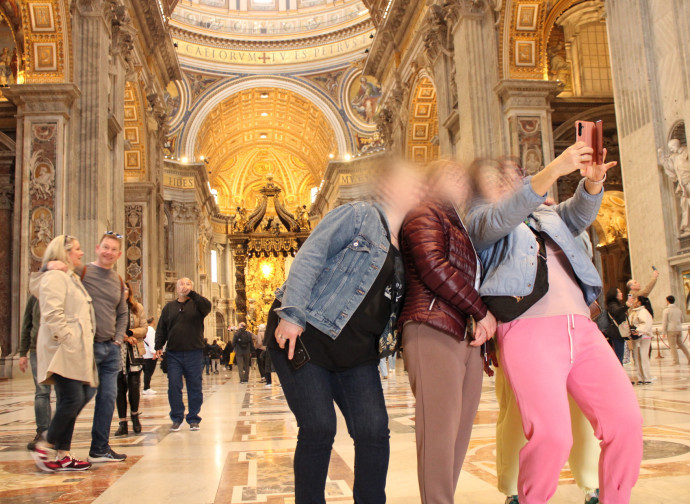
Considering St Peter's through the eyes of visitors. When we visit the most important temple of Christianity, we are captivated by the majesty of the spaces, the statues, the paintings and all the other works of art, from Michelangelo's Pietà to Bernini's canopy, which make the Pope's Basilica a unique and irreplaceable work of art. But how do the thousands of visitors who pass through Filarete's bronze door every day behave? Do they realise that they are in a sacred place? Is there enough space for the faithful who come to St Peter's to pray as well as to be tourists? And is the risk of Eucharistic profanations in St Peter's as high as that reported in the Daily Compass less than a month ago?
Let's pretend we are visitors entering St Peter's for the first time, perhaps coming from the other side of the world, and therefore not accustomed to the specificity of a Church which is not only the main place of worship for Catholics, but also a major tourist attraction. What kind of church will they find? What effect does it have?
Starting from these questions, we entered the basilica again with a different perspective, aiming to describe St Peter's as seen by visitors. We got the impression that it is a gigantic tourist attraction, where the sense of the sacred is in danger of being lost amidst the confused and disorderly clamour of tourists from all over the world, most of whom have lost their sense of the sacred. They wander around haphazardly, as they would in the Colosseum. Partly because there are no signs encouraging them to do so and partly because no one makes them reflect on this, they show no reverence, unlike in other temples or churches where the sacred is immediately perceived.
PILGRIMS OR VISITORS?
It is Friday morning. Our reportage begins immediately after passing through the security checks at Bernini's colonnade. Upon arriving at the entrance, we notice something new. A sign divides those who have come to pray from simple visitors. Those want to pray must pass through the gallery that also leads to the grottoes, while visitors climb the staircase to the portico, where only the central door is open.
This new route for worshippers is empty; in fact, we don't see a single person. “It was introduced on 1 March,” explains a friendly member of staff, “to allow those who want to come to St Peter's just to pray to avoid queuing or waiting like tourists.” They enter through the glass door on the left, just after the reception desk and before the toilets. Simply tell the attendant that you are there to pray and they will open the door for you. Simple. You go up an external staircase that ends next to the basilica. A reserved route marked by tape begins here, turning to the right and leading to the Holy Door and then to the Door of the Blessed Sacraments, located between the Holy Door and the central bronze door. From there, it's a short walk to the basilica. The route is completely empty and unknown, partly because it's very new and poorly signposted, with just one sign. However, there is one advantage: as soon as you enter the Basilica, you can head straight to Michelangelo's Pietà, walking past the crowds of tourists gathered around it. The view is unobstructed here, and if the security guard at St Peter's Basilica allows it, you can stop to pray for a few minutes. Visitors behind you cannot do this, as they are forced to give way to others after taking the obligatory photo.
The route then leads immediately to the tomb of St. John Paul II and the Chapel of the Blessed Sacrament. Entry to both is regulated by the 'Sanpietrini' staff, and those arriving from the prayer route have priority over tourists. The tape separating visitors from worshippers continues to the Chapel of Our Lady of Succour, reaching the right transept where the confessionals are located. And here it ends. To reach the other side of the basilica, where Masses are being celebrated, the faithful must join the stream of visitors and cross the central nave to reach the altar of St Joseph Chapel or the Chapel of the Blessed Sacrament, where weekday Masses are usually celebrated.
A MASS IMMERSED IN THE CLAMOUR
Warning: One of the characteristics of Masses in St Peter's is that, if you do not know the timetable, it is really difficult to tell when mass starts — this has been the case since time immemorial. The voices of the priest and singers are completely drowned out by the noise of tourists. This curious effect is easily understandable given the vastness of the place and the number of people present, but it is difficult to accept. The liturgical service is holy, however, with readers and singers performing with dignity. Considering the standards in some Italian parishes, this is not to be taken for granted. It should also be noted that, at least in St Peter's, there is a certain solemnity throughout the Mass and a due level of care. The only discordant note, which is not the celebrant's fault, is that the congregation almost never responds. This may be because they are foreigners, but the mixture of Italian and Latin in the liturgy creates a sense of alienation amid the confused chatter around them. Alter servers arrive to assist with Communion, positioning themselves next to the priest and regulating the flow to ensure there is no profanation. During Masses in the central nave, where the influx of worshippers is greater and control is more difficult, the risk of profanation increases, as we have documented previously.
THE CANON’S BOX
The blessing booth, located in the left aisle, is one of the most popular places. A priest is stationed there to bless devotional objects, chains and rosaries as needed and to distribute forms for requesting Masses according to the intentions of the faithful. The faithful line up, fill out the form in front of the priest and, if they wish, leave an offering, which the priest collects. In contrast, the listening point set up nearby during the Jubilee has been unsuccessful. 'In all these months, I've never seen anyone there,' explains the priest. It would be best to remove it as soon as possible and store it in the attic as an example of a failed experiment in providing psychological support inside the Basilica.
Visitors on the loose
Everywhere, there is a constant stream of tourists walking around with their heads tilted upwards, armed with mobile phones, taking photos indiscriminately and often doing whatever they want. Some pose for photos in front of the canopy; others lean on the altar balustrade while listening to the guide; others talk on their phones while walking; and others take awkward group photos. They show no awareness that they are in a sacred place. Some walk around with their hands in their pockets; others scroll their mobile phones as if they were at a tram stop; and others strike a pose to support the twisted columns of the high altar, as if they were at the Leaning Tower of Pisa. On entering and leaving, no one makes the sign of the cross, at least during the time we observed. This attitude is no different to that displayed the next day when visiting the Roman Forum.
Even when visitors encounter a moment of prayer by chance, they are distracted and curious in a touristy way. After the 11 o'clock Mass, at noon, the priest and altar server walk briskly to the high altar and recite prayers to St Peter, the Creed (in Latin) and the Lord's Prayer. Even though they are witnessing a moment of prayer, visitors are not disturbed by the sight of a priest in vestments doing his job. They continue to take photos of him as if he were a gladiator in the Imperial Forums, talking and looking elsewhere. Only two women at the Our Father understand and raise their arms. For everyone else, it must be an attraction included in the St Peter's package.
Just a tourist spot. This prompts the question: why not educate visitors on how to move among the statues and tombs of the popes with the care and respect that was lacking on our tour? There should be signs, warnings and admonitions from tour guides, and it should be made clear from Via della Conciliazione onwards that one is entering a sacred place. This would ensure that even the most careless tourists learn to respect the sacred.
