
Pope Leo denounces Orwellian tendencies to the diplomatic corps
Leo XIV did not mince his words at the traditional meeting with the ambassadors at the beginning of the year. He defended life, family and religious freedom, but also criticised so-called 'new rights' and inclusive language that excludes those who do not conform to ideologies.


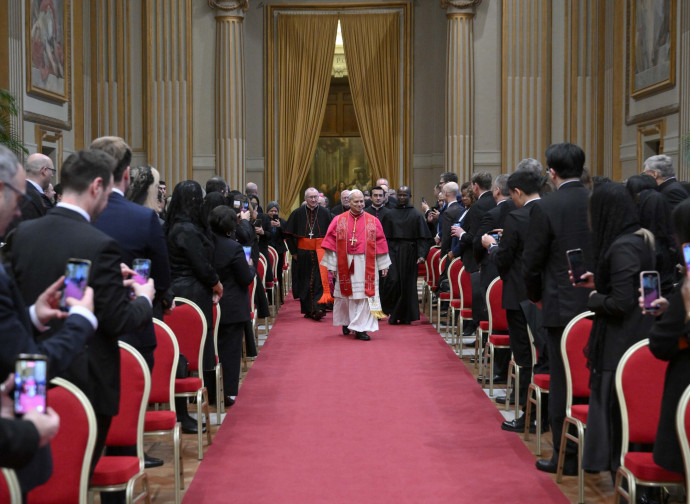
In his traditional address to the diplomatic corps accredited to the Holy See, Leo XIV began with an overview of the international situation, starting with the vision of the world in the 5th century as set out by St Augustine in The City of God. The speech was delivered in English, with a short passage in Italian.
The Pope addressed topics and words that are anathema to political correctness. He argued that Church and State are not antithetical and that a correct reading of Augustine's idea of the City of God and the earthly city demonstrates this. In his famous work, the saint of Hippo raises alarms that, according to Pope Leo, are still relevant to political life: "false representations of history", "excessive nationalism" and "distortion of the ideal of the political leader". The Pope laments the "weakness of multilateralism", a view consistent with the Holy See's traditional foreign policy. "A diplomacy that promotes dialogue and seeks consensus among all parties," observed Leone, "is being replaced by a diplomacy based on force, by either individuals or groups of allies." This is occurring at a time when "war is back in vogue and a zeal for war is spreading", as "the principle established after the Second World War, which prohibited nations from using force to violate the borders of others, has been completely undermined".
However, this 'diplomatic' part was followed by a reflection that was probably less welcome to many governments and international organisations. Prevost took issue with the United Nations, arguing that it must strive to reflect "the situation of today’s world rather than that of the post-war period", and urging it to focus its efforts more efficiently "in pursuing policies aimed at the unity of the human family instead of ideologies". The word "ideology" was repeated frequently in yesterday's text, as when the Pope criticised the West for reducing "the space for genuine freedom of expression", while a new language with an Orwellian flavour is developing. In an attempt to be increasingly inclusive, this language ends up excluding those who do not conform to the ideologies that animate it.
Pope Francis raised the issue of freedom of conscience being under threat. In this regard, he defended conscientious objection, which "allows individuals to refuse legal or professional obligations that conflict with moral, ethical or religious principles deeply rooted in their personal lives". He cited cases of refusal of military service in the name of non-violence and refusal of practices such as abortion or euthanasia by doctors and health professionals. Prevost argued against the tendency to criminalise conscientious objection, stating that it is "an act of fidelity to oneself" and that "at this moment in history, freedom of conscience seems increasingly to be questioned by States, even those that claim to be based on democracy and human rights".
The Pope's speech cited religious freedom as one of the fundamental rights under threat today. Benedict XVI defined this as the first of human rights. While speaking about all religious communities, Prevost also pointed out that "it cannot be overlooked that the persecution of Christians remains one of the most widespread human rights crises today, affecting over 380 million believers worldwide. They suffer high or extreme levels of discrimination, violence and oppression because of their faith." The Pontiff recalled that the situation had worsened in 2025 due to ongoing conflicts, authoritarian regimes and religious extremism.
This enabled him to share his thoughts on the many victims of violence, including religiously motivated violence, in Bangladesh, the Sahel region and Nigeria, as well as those affected by the serious terrorist attack on the parish of St Elias in Damascus last June, and the victims of jihadist violence in Cabo Delgado, Mozambique. In this way, he acknowledged the religious nature of the persecution and killing of Christians in these regions.
Moreover, the Pope did not remain silent about the "subtle form of religious discrimination against Christians, which is spreading even in countries where they are in the majority, such as in Europe or the Americas. There, they are sometimes restricted in their ability to proclaim the truths of the Gospel for political or ideological reasons, especially when they defend the dignity of the weakest, the unborn, refugees and migrants, or promote the family."
In addition to migrants, refugees and prisoners, the Pope's speech focused on families and the unborn. “The vocation to love and to life, which manifests itself in an important way in the exclusive and indissoluble union between a woman and a man,” said Prevost, “implies a fundamental ethical imperative for enabling families to welcome and fully care for unborn life. This is increasingly a priority, especially in those countries that are experiencing a dramatic decline in birth rates.”
He specified that "in light of this profound vision of life as a gift to be cherished, and of the family as its responsible guardian, we categorically reject any practice that denies or exploits the origin of life and its development". "Among these," he said, "is abortion, which cuts short a growing life and refuses to welcome the gift of life." For this reason, the Pope reiterated the Holy See's position that "expresses deep concern about projects aimed at financing cross-border mobility for the purpose of accessing the so-called 'right to safe abortion.' It also considers it deplorable that public resources are allocated to suppress life, rather than being invested to support mothers and families". In the name of protecting every unborn child and providing effective support to women, Prevost also condemned surrogacy. He said that it transforms "gestation into a negotiable service, this violates the dignity both of the child, who is reduced to a 'product,' and of the mother, exploiting her body and the generative process, and distorting the original relational calling of the family." He also condemned euthanasia, considering it a form of "deceptive compassion".
The Pope reiterated that "the protection of the right to life constitutes the indispensable foundation of every other human right" and that "a society is healthy and truly progresses only when it safeguards the sanctity of human life and works actively to promote it". Another controversial passage is where Leone lamented "an actual 'short circuit' of human rights. The right to freedom of expression, freedom of conscience, religious freedom and even the right to life are being restricted in the name of other so-called new rights."
Focusing on current international crises, the Pope mentioned Ukraine, the Holy Land, Haiti, Myanmar and Venezuela, and made an "appeal to respect the will of the Venezuelan people". The speech reiterated the Catholic Church's long-standing positions and the Holy See's policy of defending peace and truth.
