
Tensions in Israel: the war will also take its toll on Netanyahu
Behind the apparent unity around the prime minister, Israeli society is deeply divided, and its stability will depend greatly on the outcome of the war with Iran. There is also unrest and uncertainty in the Palestinian territories. The Latin Patriarchate has closed the Holy Sepulchre in Jerusalem for security reasons.


Israel is a powder keg: the war against Iran, waged together with the United States, has shattered all certainty. National cohesion? It's a facade, hiding nervousness and tensions that could erupt at any moment. Netanyahu galvanises the Knesset, waving the flag of 'existential defence' and transforming Parliament into a stronghold of unanimity and harmony. But beneath the surface, the country is riven by deep divisions. Israelis live suspended between pride and terror. The future is a game of roulette, with not only national security at stake, but also the nation's very survival.
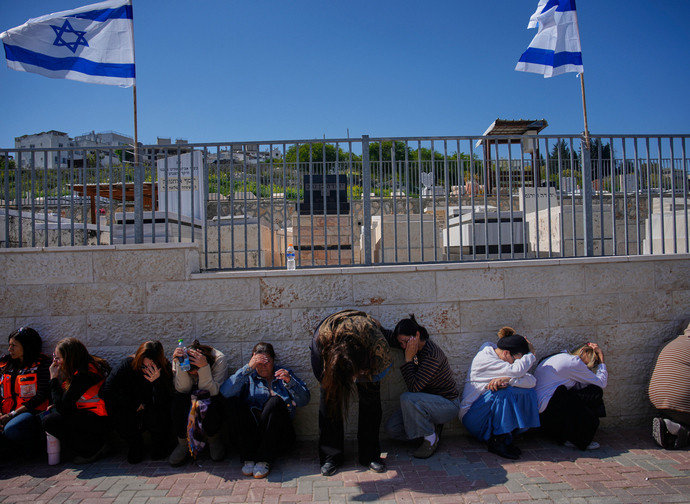
A tense silence echoes through the streets. In schools, in markets and among the families of the 50,000 reservists who have been mobilised, there is an oppressive atmosphere charged with anxiety. People are coming together, forming networks to provide psychological support. But the cost is high: draining uncertaint, paralysing fatigue and burning tension. Every day is a leap into the dark and every night is spent in vigilance against new attacks. Society is walking on a thin thread, ready to break (in the photo by LaPresse, Israeli citizens take shelter at the sound of sirens warning of Iranian missile attacks).
But not everyone is giving in. Activists, academics, and former security chiefs are sounding the alarm: an open war with Iran could isolate Israel, destroy its economy, radicalise the conflict, and increase the death toll. Isolated demonstrations break the apparent calm, reminding us that consensus is never total. In the limited spaces for public debate, there is a growing fear that Israel has embarked on a path of no return. War is not just a military issue, but a social and psychological one too. The future is being played out between the strength of cohesion and the unsustainable weight of a new regional escalation. Then there is the fear of attacks. Not only in Israel, but throughout the world.
Although Prime Minister Netanyahu usually divides society, in times of crisis he garners support that evaporates in times of peace. History repeats itself: external threats produce internal unity. However, if the emergency drags on, cracks, criticism and divisions re-emerge. Among right-wing parties, support is unwavering; the hard line is dogma. Even in the centre, fear is driving people to rally around the government. However, this confidence is fragile and ready to vanish if the war continues.
The army commands respect and trust. Every family has a direct link to it through compulsory service, which fosters social cohesion. In these early days of the conflict, support is solid and almost ritualistic. The existential threat is prompting society to distinguish between politics and military operations.
The army is seen as the only bulwark. Polls consistently rank it as one of the most respected institutions, far ahead of political parties or the government. However, this consensus is not eternal; mistakes, losses, and a lack of results could undermine this unshakeable faith. Everything will depend on how the war evolves.
The new front with Iran has already crippled the Israeli economy, which has been weakened by years of tension and instability. Netanyahu is taking evasive action by mobilising reservists and emergency funds, and providing support for businesses and workers affected by the conflict. The Ministry of Finance is providing lines of credit and offering guarantees to businesses in areas at risk of missile attacks. However, every day of war leaves a scar: public spending is soaring and the budget is faltering. Israel is on the brink of disaster because war is unforgiving.
The start of the conflict had an immediate impact on the Palestinian territories, where the reaction is multi-layered — political, military and, above all, social. In a context already marked by economic fragility and chronic tensions, the confrontation between Israel and Iran is perceived as further instability.
In Gaza, the first tangible effect was an increase in collective anxiety. The population fears that the conflict could lead to border crossings being closed again, movement being restricted and supplies being blocked. In a territory where access to essential goods is already precarious, any regional crisis has an immediate impact on daily life. Markets are experiencing a rush to buy basic foodstuffs as families try to prepare for possible prolonged disruptions.
Politically, Hamas has strongly condemned Israel's military action, describing it as an act of aggression that will further destabilise the entire region. The Islamist group, which governs Gaza, has expressed solidarity with Tehran, emphasising the political and strategic ties that have been established over the years. Official rhetoric speaks of a united front against what is described as Israeli military expansion. Other factions, such as Palestinian Islamic Jihad, have echoed these sentiments, reiterating their support for Iran and denouncing the risk of a wider conflict.
The situation in the West Bank appears equally tense. In cities and refugee camps, people are concerned about possible repercussions: increased controls, military incursions and clashes with Israeli settlers. While the Palestinian National Authority maintains a more cautious position diplomatically, there is a prevailing feeling of mistrust within civil society towards any development that could worsen already difficult living conditions.
Among ordinary citizens, uncertainty prevails. Many fear that the conflict between Israel and Iran will further overshadow the Palestinian cause on the international stage, while others view the crisis as a potential opportunity to redefine the regional balance of power. In Ramallah, Bethlehem and Beit Sahour, discussions oscillate between fear of new suffering and hope that global attention will bring the Palestinian issue back to the forefront of the diplomatic agenda. The Palestinian reaction is not uniform: armed groups condemn Israel outright, institutions are cautious and there is widespread unease among the population. In a territory already scarred by years of conflict, this war is viewed as a potential catalyst for instability, with the capacity to directly impact daily life and the future balance of power in the region.
In a recent speech, the Latin Patriarch of Jerusalem, Cardinal Pierbattista Pizzaballa, made a heartfelt appeal for all peoples in the Middle East 'to be able to live a dignified life', linking the region's current situation — particularly the events involving Iran and ongoing conflicts — to the universal need for justice, peace, and dignity.
According to the Patriarch, not even war and tensions can erase the human desire for a society based on essential values. He urges the search for peaceful solutions that avoid an escalation of violence. His statement serves as an invitation to maintain hope and pursue the path of dialogue and reconciliation with determination.
Against this backdrop of tension, the Patriarchate has announced the temporary closure of the Holy Sepulchre for security reasons. This directly impacts the Christian communities living in Jerusalem, who are forced to adapt to an increasingly unstable and dangerous environment. The closure of this sacred site is a tangible sign of the difficulties imposed on the spiritual and religious life of local populations by the Middle East crisis, highlighting the urgent need to stop the conflict before it is too late.
