

Pro-abortionist Philip VI to be granted privilege of Protocanon causes scandal
The King of Spain is to assume the title of Protocanon of the Chapter of the Basilica of Santa Maria Maggiore. An ancient privilege which, however, gives rise to scandal today and should therefore not be granted. This is because Philip VI (like Macron) is pro-abortion.

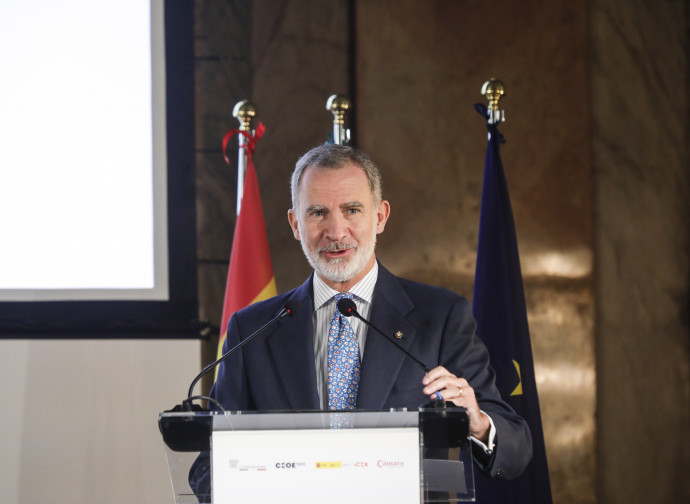
Tomorrow, Friday 20 March, during a closed-door ceremony in the Basilica of Santa Maria Maggiore, King Philip VI of Spain will assume the title of Protocanon of the Liberian Chapter. According to the papal basilica's website, the Liberian Chapter comprises the cardinal archpriest (currently Rolandas Makrickas of Lithuania) and 12 canons, all of whom are appointed by the Pope.
Based on the historical ties between the basilica and the formerly deeply Catholic royal family of Spain, the King of Spain holds the title of protocanon of the aforementioned Chapter by ancient privilege. These relations have contributed to the splendour of the early Christian basilica, built during the pontificate of Liberius, over the centuries. They culminated in 1603 with the Chapter's invitation to King Philip III to assume the role of protector and protocanon. Another king, Philip IV, established the Opera Pia of Spain in 1647, providing an annual endowment for the basilica. Fast forward to the present day: with the bull Hispaniarum Fidelitas on 5 August 1953, the revered Pope Pius XII confirmed the privileges granted to Spain, including the enrolment of its Head of State as an honorary Protocanon of the Liberian Chapter. This recalls 'the bonds of piety and devotion that have united the Iberian nation with the Basilica of Saint Mary Major'. Furthermore, the Chapter has since celebrated three Masses each year for the prosperity of the Spanish people and their king: on the liturgical memorial of Saint Ferdinand of Castile (30 May), on the Solemnity of the Assumption of Mary and on the Solemnity of the Immaculate Conception.
Returning to the present day, after the ceremony at Santa Maria Maggiore, King Felipe and Queen Letizia Ortiz will be received by Pope Francis. This concludes the chronicle of the historic and close bond between throne and altar. However, today, given the prevailing secularism in Europe, including Spain, this bond is merely pro forma and leads to contradictory outcomes which cause scandal and confuse people. Consider Philip VI's actions and words on the subject of abortion.
In 2022, the Spanish king enacted Ley Orgánica 4/2022, which introduces criminal penalties for anyone who ‘harasses’ a woman intending to have an abortion or the healthcare workers performing the abortion through ‘annoying, offensive, intimidating or coercive acts’. This law has since been used to arrest young pro-life activists who were ‘guilty’ of praying outside an abortion clinic in Madrid. While some might argue that this is a 'duty' for a head of state, this is not the case: no signature can be considered a 'duty' when it comes to threatening innocent human life.
However, King Felipe went further than his institutional 'duty'. On 24 September 2025, he delivered a speech to the United Nations General Assembly in which he spoke of 'gender equality' and stated: 'Spain aspires to remain a global benchmark on issues such as the fight for sexual and reproductive rights' (our italics). The latter expression is understood to be synonymous with contraception and abortion. The King of Spain is clearly in step with the Sánchez government on this issue, which presented its proposal to enshrine the ‘right’ to abortion in the Constitution just a few days after Felipe VI’s speech at the UN. This proposal has made progress in recent months. In practice, Spain is following in the footsteps of Emmanuel Macron’s France. Another parallel emerges here. Since 2018, Macron has held the title of honorary protocanon of the Lateran Chapter, a title reserved for French heads of state who wish to hold it and dating back to the time of Henry IV of Bourbon’s (1553–1610) renunciation of Calvinism.
Does it make sense to retain privileges that originated in an era when Europe recognised itself as Christian and when sovereigns, regardless of their private conduct, knew the value of natural moral law? In today's European context, where many laws on marriage, the family and life contradict natural law, it is clear that awkward situations arise when titles linked to the Church are associated with figures in direct opposition to the Church's teaching. At the very least, in cases of open opposition to the Magisterium on serious matters such as abortion, the ancient privilege should not be granted. This would avoid scandal and benefit souls.
