
Müller: ‘A de facto heresy on the part of the FSSPX’
The schism within the Society of St. Pius X is taking place. Interview with Cardinal Müller: “I ask for a theological response to the errors that constitute heresy in practice”; “Welcome those who leave”; “Abolishing Ecclesia Dei was a mistake”; “There is ideology in Traditionis custodes; tradition needs pastoral care.”


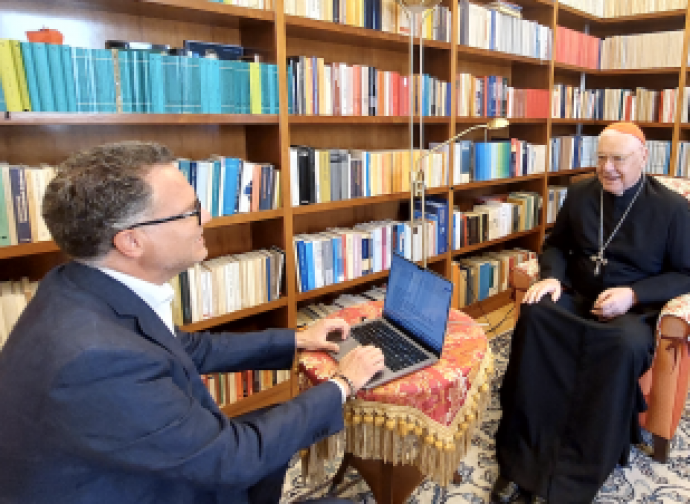
‘It is more than a schism; it is heresy in practice. We must now respond systematically to these errors and prepare to welcome those who leave the Society of Saint Pius X.’ Cardinal Gerhard Ludwig Müller looks up and gazes out of the window of his study, which overlooks the Apostolic Palace. The Lefebvrian schism has just come to a head on this sweltering morning, whilst tourists outside swarm about, oblivious to the wound that this act inflicts upon the Church. Yet Müller knows that this is a point of no return.
Your Eminence, the consecration of the four bishops of the FSSPX without a papal mandate began with a contradiction. When asked ‘do you have the mandate?’, the response was a non-answer.
A wound, certainly. It brings to mind the Donatists, who felt superior, thinking they had a position from which to judge the Magisterium and decide what was Catholic and what was not.
Your address at the Consistory had the merit of bringing the issue before the Pope. How did the cardinals react?
I was surprised by the number of fellow cardinals who responded positively to my proposals. It is our responsibility as cardinals of the Holy Roman Church to defend orthodoxy. St Irenaeus himself said that all churches must be in agreement with the Church of Peter and Paul. And he said this in opposition to the Gnostics. After all, Gnosticism lies at the root of every rebellion. It is when human reason seeks to be superior to the reason of God. Behind all heresies lies Gnosticism, because it presupposes a conception superior to the revelation presented in the visible Church.
And is there more heresy or more Gnosticism within the Fraternity?
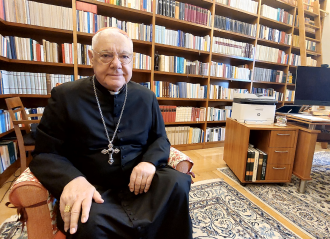 There is heresy in practice. Here, one cannot distinguish between schism and heresy. The denial of the Pope’s primacy in practice—which they nevertheless accept in theory—is a practical form of heresy. They are reminiscent of the liberals and Freemasons of nineteenth-century Germany, who would have accepted the king’s absolutism only if he had accepted their proposals.
How did Pope Leo react to your proposals?
He did not react directly, but he is aware of my position.
Let us turn to the proposals. What is the line to be followed on a doctrinal level?
Respond immediately. I am thinking of a structured and systematic response.
How might this be organised?
I am thinking of an international theological commission, which would address all the errors of the Fraternity in order to get to the root of their opposition. It is now essential to provide a scientific theological response, which will then enable the Congregation for the Doctrine of the Faith to arrive at a definitive clarification.
Some voices within the Catholic world have reassured the faithful by saying that, ultimately, the Pope’s authorisation is merely a matter of legalism…
It is not legalism. It is very serious to call it legalism; it is a matter of substance for the Church. The Fraternity always speaks of the primacy of the Pope as defined by the First Vatican Council, yet it does not accept this doctrine; they wish to be Catholic without respecting the fundamental role of the Pope. I would have them read what St Thomas said about the primacy of the Pope. It is the same behaviour as Luther’s, who said he would have kissed the Pope’s slipper if the Pope had accepted his interpretation of the Gospel. Unacceptable.
Why?
Because the act of ordaining a bishop is an act of the Church; in its absence, it becomes a sect. No one can say, ‘I have the right to make myself a bishop’. The doctrine of primacy is evangelical; to claim that it is merely legalism amounts to a break with the Pope and the destruction of the sacramental structure of the Church. Luther did the same. They want to be ‘super-Catholics’ using Protestant hermeneutics. Like Henry VIII, who said: ‘I am more Catholic than the Pope’.
 How do you respond to the objection raised by Ecône, which claims to be acting for the salvation of souls?
I respond with St Augustine, who rebutted the Donatist sects, which proclaimed themselves to be the only pure Church in contrast to the sinful Church: the Church is a corpus permixtum where sinners coexist with the saints. We are all sinners and we are all saints. If anything, it is the faithful who are seduced by this claim who are putting their souls at risk.
Another objection concerns the state of necessity, that is, the setting aside of certain laws of the Church if a situation of danger so requires.
But the state of necessity cannot authorise you to go against what Jesus Christ has established! Perhaps divine wisdom had not already foreseen this too? The truth is that the state of necessity is misunderstood. It exists only in their imagination.
But it is plain to see that the Church is experiencing heterodox influences and misleading doctrines, as well as excessive Protestantisation and secularisation…
There are no errors of the Church; this is impossible a priori. There are errors within the Church, but not errors of the Church. Do they not know that the Church is indestructible and infallible? Even in the time of the Arians there were errors within the Church, but not of the Church. This notion of a ‘state of necessity’ is an ideological self-justification whereby everyone wishes to define themselves as the ultimate authority.
You were Prefect of the Congregation for the Doctrine of the Faith. How did you deal with theaffaire involving the Lefebvrians?
If I may use a metaphor, I would say they were circling round the issue of religious freedom. But what I seemed to perceive is that they do not accept that God grants us freedom even when there are erroneous consciences. The State cannot impose a religion, but before God we are  obliged to obey revelation.
Let us move on to the second proposal: the creation of a structure similar to the Ecclesia Dei, which could welcome future defectors from the now schismatic Fraternity…
The abolition of theEcclesia Dei was a mistake because its responsibilities and areas of competence were split up. Instead, what is needed is a single body to deal with both liturgical and dogmatic matters, aimed at those who, from tomorrow, wish to return to the Church, to help them distinguish between issues properly pertaining to the liturgy and those that are purely doctrinal or concern the correct understanding of the mission of the Pope and the bishops. And furthermore: to learn to distinguish between errors within the Church and errors of the Church itself, which, as mentioned, are impossible.
A new structure within the Congregation for the Doctrine of the Faith?
Not necessarily. Under its umbrella, but not necessarily originating from it. It must have a certain degree of independence and autonomy to deal exclusively with these people.
The old Ecclesia Dei deserves credit for fostering the reconciliation of many groups with the Church.
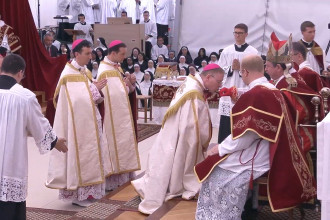
That is true. I myself have seen the fruits of this. On Saturday I shall be in Courtlain, France, for the ordination of seven deacons and priests from the Institute of the Good Shepherd. In Wigratzbad, there is the Fraternity of St Peter with a very vibrant seminary. These are fruitful communities, with vocations and a solid faith, which need guidance, and I am happy to provide it.
Will you celebrate Mass in the Vetus Ordo?
Yes. I am not a fan of the Mass in the Vetus Ordo, but it is a pastoral concern of mine that I am happy to address because it is, to all intents and purposes, part of the Church’s heritage and must not disappear.
What do you think of the proposal to create an ordinariate to regulate all those communities that wish to live out the tradition within the Church?
Canonically, it is possible; there are already examples of this sort for the so-called traditionalist world, but also for former Anglicans.
I have no preconceptions; I think we can reflect on this possible outcome.
However, there is the obstacle of the Traditionis custodes, the motu proprio by Pope Francis which regulates the ancient liturgy in a restrictive manner, undermining the efforts of the Summorum Pontificum, which, on the contrary, brought about a ‘renaissance’ of rediscovery of tradition…
The approach taken in Traditionis custodes was ideological; it failed to recognise that one reason people seek the Mass in the Vetus Ordo is precisely because they have witnessed abuses of the Mass in the Novus Ordo for far too many years. It is true that abuses in the renewed rite were discussed, but no action was taken. Instead, two weeks ago action was taken to halt the attempt in Germany to entrust the homily to a lay faithful. It is Vatican II itself which affirms that the priest is the sole minister of worship and of the Word. In the same way, action should also be taken against other abuses, but individual bishops must and can do so within their own dioceses. They have the power and the legitimate authority to do so.
Which abuses in the ordinary form of the Mass do you consider most serious?
I would say the failure to accept that the essence of the liturgy is the adoration of God. Some interpret it as entertainment, as a show. And this leads to the priest taking centre stage; he is indeed a minister of Jesus, but not the leading actor.
In a certain traditionalist circle that winks at Écône, this justification is put forward: ‘But how can this be? You excommunicate the Lefebvrians who are faithful to tradition, but not the Germans who are now Protestants?’
It is an objection that, humanly speaking, I can understand. Heretical tendencies within the Church, for example, which seek to bless same-sex couples, are a grave error within the Church and, as such, must be opposed. But the objection does not correspond to theological reality. The Society of St Pius X is not being punished because it is ‘orthodox’, but because it has proceeded to ordain bishops whilst breaking communio with Peter, which is a necessary condition. One evil cannot be excused by another evil.
