

Leone marks 10 years of Amoris Laetitia, but the Dubia remain unanswered
The Pope has issued a laudatory message for the tenth anniversary of Pope Francis’ most controversial document, describing it as 'luminous' and brushing aside the critical points in a few words. Yet that text triggered an earthquake. It would have been better to say nothing.


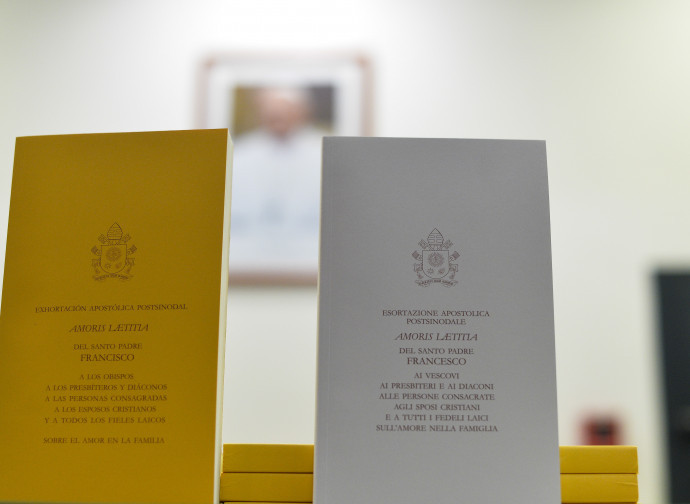
Yesterday, 19 March, the Solemnity of St Joseph, a message from Leo XIV was published to mark the tenth anniversary of Francis's apostolic exhortation Amoris Laetitia. It is a brief text that evades the major doctrinal and pastoral issues it has raised. It is intended to establish a continuation of the same approach within 'synodal discernment'. At the end of the message, the Pope announces that he has convened the presidents of the episcopal conferences from around the world for 26 October 2026, 'to proceed, through mutual listening, to a synodal discernment on the steps to be taken to proclaim the Gospel to families today, in the light of Amoris Laetitia, taking into account what is being realised in the local churches'.
Upon reading the Message, one is struck by the strong endorsement of Amoris Laetitia, which is described as a 'luminous message of hope regarding conjugal and family love'. This is something for which 'we must give thanks to the Lord for the impetus given to the study and pastoral conversion of the Church', and it is a 'precious teaching that we must continue to deepen today'. Indeed, the forthcoming work of the major meeting on 26 October is framed 'in the light of Amoris Laetitia'.
Such a hasty assessment of Francis's exhortation cannot be considered satisfactory. It would have been better to say nothing. Amoris Laetitia is the most controversial text of Francis's magisterium. It has torn the Church apart and scandalised and shaken many consciences. Books of opposition have been written about it, moral theologians have been divided amongst themselves, and the John Paul II Institute has been sacrificed. In the Vatican, many high-profile appointments have been made to ensure that this line continues. The entire synod that led to Amoris Laetitia was orchestrated behind closed doors like a political manoeuvre, and the text of the exhortation was artificially tailored.
Regarding Chapter VIII, which Pope Francis now summarises in the three-part phrase 'accompany, discern and integrate fragility', some cardinals requested clarifications (the famous dubia), which were resubmitted a second time because they went unheeded. Many Christians, faced with Amoris Laetitia's disruptive statements, have uttered their own 'non possumus'. This Exhortation caused an earthquake within the Church and, for this reason, it is inappropriate to describe it as 'luminous', given that it was perceived as dark by many.
One final aspect is worth noting: the Exhortation never expressly stated that remarried divorcees could receive Eucharistic Communion. Yet, through certain footnotes, it implied this indirectly, a point subsequently elaborated on by the Argentine bishops and confirmed in writing by the Pope through an act of formal magisterium. From a procedural standpoint, too, there was little that was 'luminous'.
It is also notable that Leo XIV states that 'the two apostolic exhortations ", issued by St John Paul II in 1981, and Amoris Laetitia (AL), have both stimulated the Church's doctrinal and pastoral commitment to serving young people, spouses, and families'. However, it is impossible for two contradictory statements to be in continuity with one another. Saying that remarried divorcees cannot receive Communion and saying that they can reflect no continuity whatsoever. Furthermore, this juxtaposition of the two Popes and the two Exhortations seems to overlook the fact that Amoris Laetitia cited paragraph 84 of Familiaris Consortio in an artificial and manipulative manner, essentially rendering it meaningless.
Finally, one last aspect makes this message unsatisfactory: the reference to the context in which Amoris Laetitia was situated — the 'new synodality' — and the desire to continue operating within that context in future. It is regrettable that the Message pays excessive attention to changes in historical circumstances, which is the essence of Francis's version of the new synodality. This is pursued as if it were a call from the Holy Spirit. Amoris Laetitia is said to have arisen from the recognition of 'the "anthropological and cultural changes" (AL, 32), which have intensified over the course of thirty-five years'; thus, the forthcoming meeting of the presidents of the episcopal conferences must proceed 'taking note of the changes that continue to influence families'. The synodalist interpretation should therefore continue.
Some might argue that with this document, Leo XIV means to say that the time has come to forget and turn the page. If so, why commemorate the tenth anniversary of Amoris Laetitia? There was no obligation to do so; oblivion would have been more assured. Others might also say that this is the 'Prevost method': softening the tone, making no official corrections and, in the meantime, effectively promoting a different approach. This could be the case, but why commit to drawing on the 'light' of Amoris Laetitia for the future? Some might argue that we are in the realm of pastoral care, where 'fruits' matter. But what would the fruits of Amoris Laetitia be? It has initiated a process of revision — not only pastoral, but also doctrinal — of unprecedented scope.
The document did not intend to limit itself to the pastoral care of the family; rather, it aimed to change the concept of marriage and introduce variations to Catholic doctrine on the exercise of sexuality. In doing so, it annulled the doctrine of intrinsically evil acts and undermined Veritatis splendor.
Leo XIV’s Message makes no mention of the serious doctrinal issues surrounding Amoris Laetitia, nor of the fact that the four cardinals' Dubia are still awaiting a response.
