

Israel and US reckon with ammunition stocks
No one knows exactly how many missiles Iran has, but there are growing doubts about the ability of Israel, the United States and their Gulf allies to sustain a prolonged conflict with limited ammunition and anti-missile defence systems, given the huge amount of equipment being sent to Ukraine. Yesterday, Trump urged companies to boost arms production.

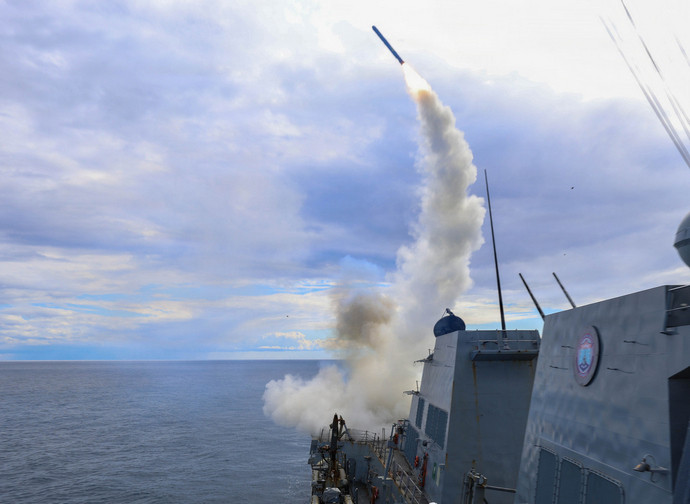
In a prolonged conflict, with Tehran warning that it has prepared to resist aggression from the United States and Israel for a long time, the fate of the military campaign launched by Washington and Tel Aviv on 28 February could be decided by ammunition stocks rather than the vehemence of the initial attacks on Iranian territory.
This would certainly not be the first time that the availability of ammunition has influenced the outcome of modern-day conflicts involving complex and expensive offensive and defensive weapons.
In 2011, for example, NATO's European air forces took six months to defeat Libya's weak armed forces due to a shortage of aircraft bombs. This led many air forces to request help from the United States in supplying precision weapons.
Washington responded with astonishment and sarcasm, but several US military sources have told the American media over the last four years that reserves of air defence missiles, including those for the sophisticated Patriot, Standard and Thaad systems, have been depleted by large US supplies to Ukraine and Israel. These missiles can cost more than $3 million each and the production and delivery times are between 12 and 18 months, which is too long when you consider that two or three anti-missile missiles may need to be launched to intercept a ballistic missile.
According to several analysts, the United States had to reach an agreement with the Yemeni Houthi militias last year after almost exhausting its stocks of Standard missiles on ships operating in the Red Sea and the Gulf of Aden. These missiles were used to intercept ballistic and cruise missiles, as well as a large number of drones, launched by pro-Tehran militias. Like their Iranian counterparts, these weapons are produced in large numbers and at very low cost.
Ukraine has also often found itself short of air defence missiles, especially US Patriots, which are considered the only ones capable of intercepting Russian Iskander ballistic missiles. However, after the upgrade of Russian weapons, which are now capable of manoeuvring before reaching their target in order to evade air defences, the interception rate of these missiles is now less than 10 per cent.
Even Israel had almost exhausted its anti-missile weapons, such as Arrow missiles and those of the David's Sling and Iron Dome systems, ten days after starting the war against Iran in June 2025, while Iran still had at least 2,000 ballistic missiles and many thousands of drones in its arsenals.
Raids by American B-2 bombers on Iranian nuclear sites brought that conflict to an end, saving Benjamin Netanyahu's face. Today, new estimates from Mossad and the CIA suggest that Iran has an arsenal of around 2,500 ballistic missiles, with the Revolutionary Guards directly managing the production of approximately 100 per month.
Together with drones, this arsenal could be used to attempt to saturate radars and air defence systems with simultaneous wave launches. Iran has already achieved some results by striking important radar installations at American bases in the Gulf and Israel, probably thanks to satellite data support from Russia and China.
However, it is difficult to say how long Iran's missile stocks will last, as their underground depots are a priority target for Israeli and American air raids. If the conflict were to last several weeks, victory would certainly go to those who have not yet exhausted their weapons.
According to experts interviewed by the Financial Times, rather than launching large waves of missiles, the Iranians in the current conflict tend to launch a greater number of smaller waves, prioritising less sophisticated types in order to wear down the enemy's defences against less valuable targets and save the most powerful missiles for the coming days.
Tehran is modulating the daily pace of launches in an attempt to conserve its missiles, but the bombing of factories could affect production and maintenance.
Nevertheless, it appears that the Israelis and Americans are at greater risk of running out of missiles, particularly those intended for air defence. Several sources and military commentators in the United States have warned about this risk. According to sources cited by US television station CNN, the Chairman of the Joint Chiefs of Staff, General Daniel "Dan" H. Cartwright, and other Pentagon officials have warned in recent weeks about the possible effects of a prolonged operation against Iran on troops and assets deployed in the Middle East, as well as the impact on weapons stocks, particularly those intended to support Israel and Ukraine.
The Wall Street Journal reports that Trump was warned by generals that stocks of the expensive anti-missile missiles that make up the ammunition for the THAAD, Patriot and Standard systems are limited due to supplies being sent to Ukraine and Israel, as well as last year's military campaigns against the Houthis and Iran — although the exact numbers remain secret.
The number of cruise missiles that can be deployed from aircraft and ships to strike targets in Iran is also reportedly limited, raising the risk that aircraft and ships in other theatres of war will be deprived of ammunition for the war in Iran.
Yesterday, Trump also met with executives from Pentagon contractors to discuss increasing the production of weapons and ammunition, according to a White House official who spoke to CNN. The president told Politico that companies are working around the clock to ramp up production, which is a clear sign that the shortage of ammunition is real and critical.
This is partly because many of the US's allies that use 'Made in the USA' air defence systems risk being unable to receive more missiles in a timely manner. This is particularly true in the Gulf, where the United Arab Emirates, Saudi Arabia, Oman, Kuwait and Qatar appear to have substantially reduced their stocks of American missiles after just four days of fighting off Iranian drones and missiles. However, both the United Arab Emirates and Qatar have denied the rumours reported by Bloomberg.
Even in Europe, where there is a growing debate about sending air defence systems to protect Cyprus and the Arab kingdoms of the Gulf, military leaders are busy explaining to governments that there are very few weapons available, as Ukraine has effectively absorbed almost all of NATO's anti-aircraft and anti-missile stocks.

USA against Iran, a war with no prospects that damages Europe
Once again, it seems that the US and Israel are intent on destabilising areas that are, in energy and geopolitical terms, in Europe's 'backyard'. The only certainty is that the conflict will hit Europe and its economic interests hard. Starting with oil supplies.
Attack on Iran: Israel drags the US into 'its' war
At dawn today, several Iranian cities were bombed, including the capital, Tehran. The real goal is to overthrow the Ayatollah regime — a dangerous illusion that in this way it is possible to achieve Israel's security and balance in the Middle East.