

Holy Thorn of San Giovanni Bianco, 10 years on from the last miracle
Today marks the end of the celebrations in honour of the relic of the Passion of Jesus kept in the town in the province of Bergamo. The last miraculous flowering took place on 27 March 2016, attested to by a commission and recognised by the bishop. This is the story.


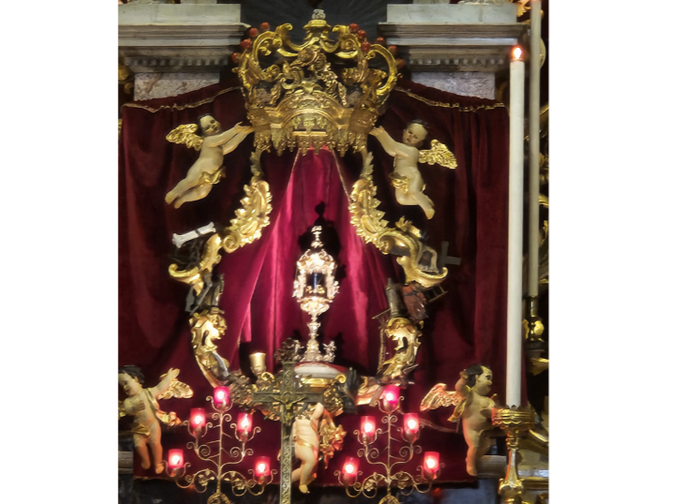
Today, the celebrations marking the 10th anniversary of the last miraculous flowering of the Holy Thorn in San Giovanni Bianco in the province of Bergamo, Italy, come to an end. The relic of the Passion of Jesus is kept in the parish church of St John the Evangelist. The Bishop of Ventimiglia-San Remo, Monsignor Antonio Suetta, was invited to the two-week celebrations. On Sunday 22 March, he blessed the faithful with the relic during the traditional procession through the streets of the Val Brembana village, which thousands of people took part in. He then presided over the Solemn Mass. The closing celebrations will be led by the Bishop of Bergamo, Monsignor Francesco Beschi, who will preside over Mass at 8.30 pm today.
Ten years ago, it was Monsignor Beschi himself who recognised the miracle after the significant blooming on Easter Sunday. It is worth recalling that the bishop had appointed an ad hoc commission – that year the Feast of the Annunciation and Good Friday coincided, a circumstance that had led to other blooms in the past and which, ten years ago, had prompted prayers for the miracle to be repeated – which had observed the Holy Thorn during the winter immediately preceding the miracle and also on Good Friday and Holy Saturday in 2016; and then again, on Easter Day, after the blossoming had taken place, it had observed the precious relic on several occasions. The commission comprised priests (including the parish priest at the time, Fr Diego Ongaro), the mayor of the town, the director of the Department of Oncology and Haematology at the Papa Giovanni XXIII Hospital in Bergamo, a notary, and other specialists.
On 28 March 2016, Easter Monday, the commission drew up a report stating that the Holy Thorn 'had undergone a change in colour, particularly pronounced on the buds at the tip; these also appeared different from previous observations'. On that same day, the bishop issued a statement confirming the miracle had occurred, emphasising 'the prudence, seriousness and expertise of those to whom I entrusted the task of observing the relic'. He then offered this reflection: 'The fact that this sign occurs during the celebrations of the Annunciation, the Passion and Death of Jesus, and his Resurrection, calls us to consider with both mind and heart the manifestation of God’s love, as revealed in the story of Jesus of Nazareth, in the mystery of the Incarnation, and in his Passion and Death.'
But how and when did this relic, which is part of the crown of thorns placed upon our Lord's head, arrive in San Giovanni Bianco? It arrived during a battle fought at Fornovo (Parma) on 6 July 1495 between the Italian League and the army of King Charles VIII of France. During the battle, an Italian mercenary named Vistallo Zignoni managed to seize a casket containing relics of the Passion of Jesus, which he subsequently sold to the Venetians. However, Zignoni kept one of the relics for himself: the Holy Thorn that is the subject of this article, which he donated to the church in his native village: San Giovanni Bianco.
Many authentic sacred thorns are recorded worldwide, several of which are found in Italian towns where miracles similar to those that occurred in San Giovanni Bianco have been recorded. However, the majority of these are contact relics, meaning they are not part of the Crown of Thorns but were simply placed upon it.
For several centuries, the Crown of Thorns has had a special connection with France. In fact, it was King Louis IX (1214–1270) who purchased it from Baldwin II of Constantinople, who had pawned it to the Venetians in need of money. Louis IX then wished to carry the casket containing the relic in procession to Sens Cathedral, dressed in a tunic and barefoot. To house the relic fittingly, he had the Sainte-Chapelle built, which was completed in 1248. He also placed other relics of the Passion there, including the Holy Sponge, parts of the Cross, and the Holy Lance. Today, the Crown of Thorns is no longer kept in the Sainte-Chapelle, but in Notre-Dame Cathedral. However, it is not complete, as has happened with other relics. The crown that wounded Jesus's head has been 'distributed' over the course of history, with the thorns having been removed from it.
Returning to the Holy Thorn, which has been kept in San Giovanni Bianco for over five centuries, the various miracles that have occurred in this small Bergamo town bear witness to its authenticity. Similar phenomena to those of 2016 have occurred several times in the past. There have been at least four other famous instances of flowering: in 1615, when it was witnessed by Bishop Giovanni Emo; in 1885, when it was noted by the bishop of the time, Gaetano Camillo Guindani, and signed by thirty-five witnesses; in 1921, when the thorn turned vermilion; and in 1932, when it was witnessed by Bishop Luigi Maria Marelli. In this last instance, the thorn turned blood-red and small buds appeared. These facts have been verified and attested to by numerous witnesses, confirming once again that there is no contradiction between the findings of reason and the tenets of faith.
