
French nun attacked in Jerusalem, a symptom of radical Zionism
Another attack against Christians in the Holy City, this time targeting a French nun who was violently assaulted on Mount Zion. This is not an isolated incident, but rather the result of a climate of hatred fuelled by the most extreme elements of religious Zionism.


Yet another attack against Christians in Jerusalem. This new episode of violence forms part of an increasingly worrying picture of growing hostility towards religious minority communities. The message seems clear: the most radical factions of religious Zionism are gaining visibility and influence within an increasingly polarised political and social context.
These are neither isolated incidents nor marginal aberrations. A pattern is emerging of constant pressure, manifesting itself in the urban landscape and in the day-to-day management of the city. Last Wednesday, 29 April, in broad daylight, a French nun named Marie-Reine, who is the secretary of the École Biblique, was attacked on Mount Zion, near the Church of the Dormition. After being verbally abused, she was hit from behind, knocked to the ground and kicked.
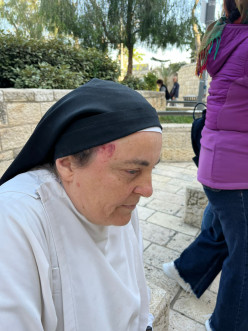 This is not an isolated incident, but an indicator of structural tensions running through the Holy City that call into question its historic vocation for coexistence. The nun was walking along a street leading to a holy site when a man approached her, insulted her and then attacked her (You can watch a video of the attack here). The police intervened and arrested the attacker. The nun’s injuries are not serious, but she is still in shock. Above all, Christian communities share the perception that the frequency of such incidents is altering the very nature of daily life in the Old City.
Harassment, spitting, insults and shoving have become part of the routine for religious figures, who are recognisable by their habits. Monks and nuns report being frequent targets in a context where simply walking through the city streets has become highly risky. Slogans such as “Death to Christians”, “Go away” and “This is not your land” appear on walls alongside other graffiti expressing direct hostility towards the Christian presence. Added to these incidents are more serious acts, such as vandalism against churches, desecration of monasteries and cemeteries, and damage to religious symbols.
The picture that emerges is no longer that of isolated incidents, but of a sequence that is part of a broader pattern. Available data indicates an increase: 155 incidents against Christians and Christian institutions were documented in 2025, compared to 111 the previous year. The largest number of cases were physical assaults (61), followed by attacks on church property (52), harassment (28), and the defacement of signs bearing religious symbols (14).
Against this backdrop, the number of families choosing to leave the city is also rising. These are not sudden decisions, but choices that have been made over time due to an increasingly difficult daily life. Factors such as insecurity, economic hardship and administrative restrictions combine with the perception of a gradual narrowing of scope for freedom.
The permit system restricts Palestinian Christians' movement to holy sites, while economic pressures and disputes over church property further fuel tensions. Some religious institutions openly discuss the demographic erosion of the Christian presence. Against this backdrop, one might speak of 'low-intensity ethnic cleansing': a gradual transformation that is affecting the city's social and religious composition.
On the political front, positions are becoming increasingly radicalised. Some of this tension is attributed to the most extreme currents of religious Zionism, including factions linked to Kahanism — a political movement dating back to the 1970s — which have, in some cases, expressed an exclusive vision of Jerusalem as a space reserved solely for the Jewish population. Among the political figures in this sphere is Minister Itamar Ben-Gvir, who advocates an identity-based framework based on a religious interpretation of law and state.
In this context, the messianic project of controlling the 'Promised Land' sometimes takes precedence over civil law, with implications that, according to various analysts, fuel a climate of legitimisation of direct action. The government led by Benjamin Netanyahu also relies on the support of these political forces. This situation, according to various interpretations, contributes to creating a context perceived as offering little restraint against incidents of intolerance. Not only does the institutional response often appear insufficient, but silence or caution are also interpreted as ambiguous signals.
Recent reports detail incidents that occurred during the same period. Whilst Patriarch Pierbattista Pizzaballa was prevented from entering the Church of the Holy Sepulchre during Easter celebrations, groups of extremists allegedly carried out acts of desecration against Christian and Muslim religious sites in the Old City. They documented these acts and shared the footage on social media with impunity.
On the international stage, Israel reaffirms its role as a guarantor of religious freedom. Prime Minister Netanyahu has repeatedly stated that the country provides a safe environment for Christian communities. However, the public perception is more complex, with incidents of discrimination and intolerance being seen as on the rise amidst growing political and social polarisation. Even some official statements are interpreted by observers and local communities as contradicting the official narrative.
The Latin Patriarch of Jerusalem has also intervened, strongly denouncing the deterioration of the city’s atmosphere in his recent pastoral letter. “We are witnessing a climate of hatred spreading through the streets, in gestures and in language,” he wrote, emphasising that these are no longer isolated incidents, but rather a cultural trend. Pizzaballa speaks of the city’s moral fabric being progressively weakened and warns that the normalisation of contempt poses a profound risk to coexistence. “Jerusalem cannot survive as a holy city if it becomes a place of exclusion,” he adds, calling on institutions and religious communities to take responsibility. He describes silence in the face of injustice as a form of complicity and emphasises the need to restore dialogue as the only possible means of achieving social cohesion.
The attack on the French nun is part of a sequence that goes beyond a single incident. It is part of a broader transformation marked by the interplay of political dynamics, religious tensions, and profound social changes. As investigations continue, one question remains: what scope is there still for coexistence in a city holy to three religions, where the balance appears increasingly fragile?
