

Francis's 'laypeople in power' wrongly used by Lefebvrians
Following Cardinal Ouellet's article on lay appointments during the Bergoglian pontificate, the Fraternity has seized the opportunity to justify the episcopal ordinations of 1 July, based on the separation between order and jurisdiction, and to criticise Vatican II's ecclesiology. The occasion is twofold, but so too is the blunder.
- Dossier: The FSSPX Case


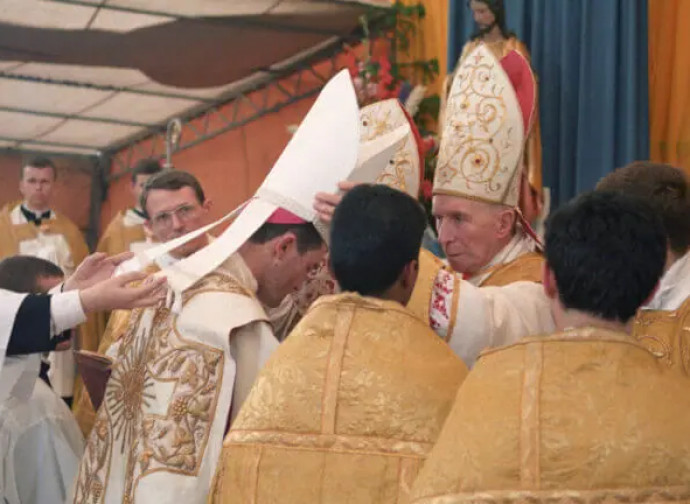
Fr Jean-Michel Gleize, a leading theologian and priest of the Priestly Fraternity of St Pius X, commented on Cardinal Marc Ouellet's recent reflections on Francis's decisions to expand the participation of laypeople in the governance of the Church. 'This initiative,' the cardinal wrote on 16 February, 'clashes, however, with the ancestral practice of conferring positions of authority on ordained ministers.' Francis's appointments of laypeople to 'positions of leadership' within the Church do indeed confer a power of jurisdiction that is independent of the power of the priesthood.
A week later, on 24 February, Gleize seized the opportunity by publishing an article with the eloquent title 'Ordre et juridiction: le Vatican à la croisée des chemins' (Order and Jurisdiction: The Vatican at a Crossroads) on Laportelatine.org, the official website of the French District of the FSSPX. Fr Gleize explains that these appointments imply that ‘the power of jurisdiction does not derive in any way from episcopal consecration, nor, even less so, from priestly ordination. This necessarily presupposes that if one posits the idea that the rite of episcopal consecration confers both powers — order and jurisdiction — then it becomes impossible to entrust positions of authority in the Church to persons other than ordained ministers, as this would be contrary to divine law.' The Fraternity, which announced the consecration of new bishops on 1 July without a papal mandate, 'intends to justify and legitimise this act' by relying on the aforementioned essential and radical distinction.
The argument is clear: Francis was able to make his choices based on the traditional separation between the powers of order and jurisdiction. The Fraternity claims that it can ordain bishops against the Pope’s will based on this same separation, without falling into schism ipso facto. The dilemma facing the Vatican is easily summarised: if the Society is condemned, then Francis’s appointments must also be condemned; if Francis is 'absolved', then the Society should be too.
The FSSPX theologian goes even further. He claims that the distinction between the two powers formally opposes the 'new ecclesiology of Vatican II', as set out in number 21 of the constitution Lumen Gentium (LG), which states that jurisdiction is conferred by the act of episcopal consecration itself, while the Pope's intervention merely serves to moderate its exercise. Consequently, Cardinal Ouellet and his supporters, such as Cardinal Ghirlanda, who advocate the 'Franciscan' shift regarding the participation of the laity in governing power, should, for the sake of consistency, criticise conciliar doctrine.
In the eyes of Abbé de Cacqueray and the Fraternity, Pope Francis’s appointments allow them to kill two birds with one stone: by emphasising the separation between the power of order and the power of jurisdiction, they legitimise the consecrations of 1 July, and they also condemn the ecclesiology expressed in LG 21. This would confirm the criticisms that the Fraternity has been raising on this matter for decades.
Let us begin with this last point. As we have already demonstrated, the text of LG in question does not teach that the power of order is conferred through episcopal ordination. Gleize confuses the munus with the potestas and fails to understand the clarification provided in the Nota explicativa previa. In summary: episcopal ordination confers three interior qualities, or munera, which derive from conformity to Christ the Head and internally dispose the new bishop to the exercise of his ministry. However, it is only the juridical determination that gives the bishop the power to govern and teach the Church (as well as legitimately exercise the power of order).
In partial defence of Fr Gleize, it is worth noting that there is still much confusion on this subject today, and many theologians believe that the Second Vatican Council intended to affirm that jurisdictional power originates in the sacrament, contrary to traditional doctrine and practice. However, as early as 1982, the future Cardinal A. M. Stickler highlighted in De potestatis sacrae natura et origine (Periodica de re canonica, 71, p. 83) that the Nota explicativa 'expressly established that the "munera" conferred through Holy Orders do not signify the "potestates"'; the conferral of power, on the other hand, 'requires a legal determination' by the competent authority. Gianfranco Ghirlanda SJ, whom Fr Gleize also cites as a restorer of the correct distinction between the power of order and the power of jurisdiction, emphasised the distinction in a 2017 article entitled 'The Origin and Exercise of the Bishops’ Power of Government' (Periodica, 106 (2017), pp. 539–541). A 2000-Year-Old Question', Periodica, 106 (2017), pp. 539–541) emphasised the distinction between 'munus' and 'potestas', whereby 'no. 21 of the Constitution cannot be interpreted as an affirmation of the sacramental origin of both the power of sanctification and the powers of teaching and governance”. Conversely, he cites a statement by the Doctrinal Commission that they 'do not wish to enter into the question of the origin of the bishops' power', meaning that 'it cannot be said in any way that Vatican II intended to abolish the distinction between the power of order and the power of jurisdiction, nor to affirm the sacramental origin of the power of jurisdiction'.
However, even on this first point, the Society is mistaken. We have already addressed the problematic nature of Pope Francis’s lay appointments when necessary (here and here), but the point is that the separation between the power of order and the power of jurisdiction is not an issue. The problem with the FSSPX's thesis is that it deduces the lawfulness of conferring episcopal ordination against the Pope's will in order to evade his jurisdiction from this separation. Gleize’s argument is a blatant non sequitur: the distinction between the two powers simply means that ordination is conferred differently to jurisdiction; the former through the sacrament and the latter through canonical determination. However, it does not follow that episcopal consecration can be lawfully conferred contrary to the will of the competent authority, nor that the episcopal ministry, including sacramental power, can be legitimately exercised outside of hierarchical communion.
The FSSPX stubbornly refuses to acknowledge that, in a legitimate consecration, the Pope's jurisdiction is always exercised because, by divine right, he designates the future bishop either directly or through the authority he recognises. Therefore, consecrating a bishop against the Pope’s will amounts to usurping his jurisdiction, even if one repeatedly states that one does not intend to confer jurisdiction upon the new bishop. The reason is simple: through episcopal consecration, one is received into the Mystical Body, not merely the sacramental Body of the Lord. The bishop's role is to lead and govern the Church, not merely administer the sacraments. Given the nature of the episcopate and its relationship to the governance of the Church, appointing a bishop against the Pope’s will is a schismatic act in itself because it involves conferring a sacrament that conforms one to Christ the Head against the visible Head of the Church, the Pope. It is contradictory to conceive of a sacrament that orders the subject to the governance of the Church independently of, and outside of, hierarchical communion with the Church itself.
When the Pope confers a power of jurisdiction upon a lay person, for example by appointing them as prefect of a Dicastery, it raises the question of which key offices cannot be legitimately assigned except to those who have received Holy Orders. This is the issue that Cardinal Ouellet’s statements bring to the attention of Pope Francis. However, a bishop who confers episcopal ordination on candidates not designated by the legitimate authority and against the will of the Roman Pontiff usurps the jurisdiction of the Apostolic See. Among the rights and privileges conferred upon it by Christ God Himself, this includes the right to designate a bishop, whether directly or indirectly (Pius IX, Quartus Supra). What ends up on the Pope’s desk this time can only be a notification of excommunication.
The condemnation of the forthcoming consecrations on 1 July does not stem from the alleged erroneous ecclesiology of LG. The Church has always taught the distinction between the two potestates; however, it has never permitted the ordination of a bishop against the Pope’s will, nor the exercise of ministry outside hierarchical communion.
