
‘Families, breed earthworms’: How the Vatican is saving the planet
‘Integral Ecology in the Life of the Family’ is a new document published by the Vatican’s Dicasteries for Integral Human Development and for Laity, Family and Life. It is a compendium of environmentalism with a clerical twist that is far removed from Catholic thought.



Ingredients: incompetence on environmental issues, scant theological knowledge, abundant cultural subservience and a dash of clericalism. Preparation: Blend everything together, gradually adding a generous dose of activism until you obtain a document that is unnecessarily long and far removed from Catholic thought.
This is the recipe for the latest document produced in collaboration by two Vatican dicasteries: the Dicastery for Promoting Integral Human Development and the Dicastery for Laity, Family and Life. Entitled 'Integral Ecology in the Life of the Family', it was published on 27 April. At 84 pages long, it is yet another homage to the 2015 encyclical Laudato Si, on which Pope Francis invested much of his pontificate. However, this has had the effect of introducing concepts such as sustainable development, borrowed from mainstream environmentalism, into the Magisterium. These concepts are, by their very nature, incompatible with Catholicism.
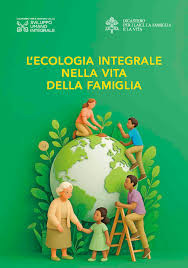 The new Vatican document continues along these lines, aiming to apply the "ecological conversion" so dear to Leo XIV's predecessor to every sphere of life. The focus here is on the family, which is encouraged to carry out a series of actions in the style of WWF guides in order to embrace their Christian faith. Following an initial section that summarises the contents of Laudato Si and the controversial 2020 encyclical Fratelli Tutti to explain integral ecology, seven themes are presented on which families are encouraged to focus. These themes reiterate familiar slogans that have been heard frequently since 2013, such as listening to the cry of the earth and the poor and vulnerable, adopting and promoting an ecological economy and lifestyles, integral ecology and education, and fostering ecological spirituality from a family perspective, families that participate in community life.
Dozens of proposals are made to families, ranging from the most trivial and obvious, such as avoiding wasting water, electricity and food or sorting waste, to more demanding ones. A few examples are given below, which require no further comment: ‘If you have access to an outdoor space, set up a compost bin or a worm farm. If you do not have access to such a space and the local council does not organise composting, ask your local school or parish if they would be willing to host a compost bin for community use; collect rainwater; visit flea markets; visit local farms and workshops with your family to get to know the people who work there and foster a sense of community; repair broken toys together with the children. Teenagers can repair their own sports equipment and adults can restore and preserve possessions from previous generations, such as furniture or even homes’; ‘Ask the local school to implement ecological improvements to its facilities’; ‘Ask the local school to update its activities and teaching materials on ecology’; and ‘Take the opportunity to pray surrounded by nature, which may involve an open-air Mass with the permission of the local priest’.
These proposals, which range from the mundane to the bizarre, stem from a cultural subservience to the dominant environmentalist ideology. This means that concepts and ideas found in any environmentalist publication are repeated verbatim, with the scale, causes and solutions of a supposed global environmental crisis being taken for granted. For example, there is no recognition of the contradiction between the desired focus on sustainable agriculture and the imperative to use solar panels, which literally take vast tracts of land away from agriculture in order to produce energy in quantities that are destined to remain marginal.
While some references are made to Centesimus Annus (1991) by Saint John Paul II, the concept of 'human ecology' is abandoned in favour of the substantially different 'integral ecology' espoused by Pope Francis. The latter does indeed call for respect for life, attention to the most vulnerable and the centrality of the family (points which are strongly emphasised in the document), but everything is indiscriminately lumped together, on the same level as ethical finance and critical consumption. Clearly, the true objective is 'ecological conversion', and the 'holiness of the family' serves that purpose. In the Vatican document's vision, families are even seen as nuclei of environmental activism.
In contrast, St John Paul II describes a 'human ecology' in Centesimus Annus, implicitly setting it against environmental ecology. In this model, the necessary care for the environment is a consequence of respect for the order created by God, which places the family (founded on marriage between a man and a woman) and life at the summit of the hierarchy. 'The first and fundamental structure in favour of "human ecology"', writes St John Paul II, 'is the family, within which man receives his first and decisive notions of truth and goodness, learns what it means to love and be loved, and thus what it means in concrete terms to be a person' (no. 39). Recognising that the earth is a gift from God to humanity, who must use it for good, requires first recognising that humanity is a gift from God and must therefore respect the natural and moral order.
Once again, therefore, it becomes clear not only the discontinuity of Francis's pontificate with respect to the magisterium of his predecessors, but also how those teachings have spilled over into the current pontificate.
There are evidently cardinals in the Roman Curia who continue to produce documents in accordance with Pope Francis’s directives, seeking to influence his successor. Waiting until the age limit is reached or the end of a term of office may not be the best solution for the good of the Church.
