

Communion for dogs: the Bishop of Chur sees no sacrilege
No excommunication for three parishioners who shared the Holy Host with their dog: according to Bishop Bonneman, they did not intend to commit sacrilege. However, the problem remains because the 'incident' stems from liturgical abuses and a misinterpretation of the Eucharist.


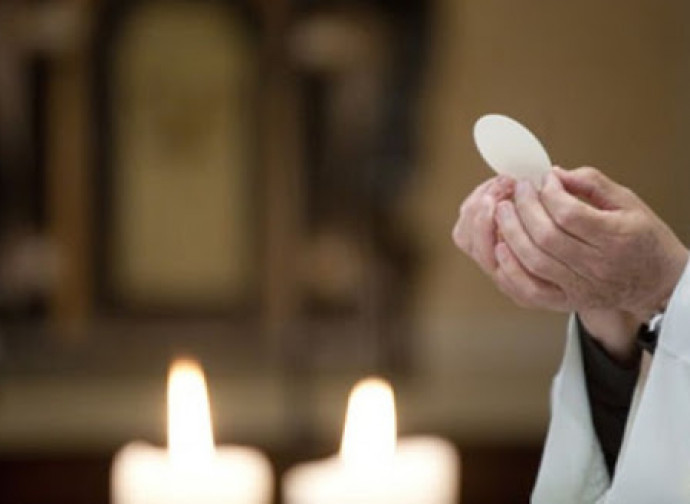
The 'incident' is easily summarised (see here). On 4 October 2025, the Feast of St Francis of Assisi, the parish of the Good Shepherd in Zurich decided to organise an outdoor celebration to bless animals. Due to bad weather, the blessing was moved indoors and incorporated into the Eucharistic celebration. At the moment of Communion, some of those present noticed that three people were sharing the consecrated host with their dogs.
The Bishop of the Diocese of Chur, Monsignor Joseph Bonnemain, to whom the incident was reported, correctly decided to launch an investigation to ascertain the facts. On 17 April, the diocese announced that the three individuals in question had not incurred the excommunication 'latae sententiae' provided for in Canon 1382 §1 for 'those who profane the consecrated species, or remove or retain them for a sacrilegious purpose', as the investigation had not revealed any intent to commit a sacrilege. The diocese also announced that, on 5 June, the bishop will hold a meeting for the entire parish on the Apostolic Exhortation Desiderio Desideravi, followed by solemn Eucharistic adoration and Holy Mass, which will be presided over by the bishop himself.
Without access to the material gathered from the bishop's investigation, it is difficult for us to assess the diocese's judgement regarding the sacrilegious intent of the act in question. However, there are some points to clarify. Firstly, not all grave sins are sanctioned by law, yet grave sins they remain. From a moral standpoint, therefore in terms of sinfulness, the act committed by these three individuals appears to be quite clearly a grave sin of sacrilege, unless they were severely impaired in their intellectual and decision-making capacities (which they were not). One might argue in their defence that they acted out of ignorance, but the only ignorance that excuses guilt is that which is involuntary or insurmountable. A faithful Catholic is required to know the conditions for receiving the Eucharist, the minimum of which is baptism and only human beings can be baptised. If these people were unaware of this fundamental doctrine, this would constitute gross or supine ignorance, i.e. neglecting to know what one ought to know. This ignorance not only fails to excuse the act, but actually makes it worse.
The diocese’s terse statement makes no reference to the gravity of the sin committed; it merely describes the incident as 'highly reprehensible'. This is already problematic.
As mentioned, it is difficult to assess the offence given the scarcity of available evidence. However, it should be noted that the sacrilegious nature of an act does not necessarily imply an intention to offend God or, in this specific case, hatred directed against the Holy Eucharist. In an article from 2003 entitled La protección penal de la Santísima Eucaristía, bien de la Iglesia y bien de los fieles, en el c. 1367 del CIC (in Fidelium Iura, 2003, 13, p. 172), the canonist Juan Ignacio Bañares, professor at the University of Navarra, emphasised that ‘certain intentions (obscene or superstitious) involving contempt for the Divine Presence in the Eucharistic species, combined with the external act of retaining them or taking them away, sufficiently manifest the will to commit the offence’. The element constituting the substance of the offence is the contempt or humiliation of the Eucharist on the part of the person committing the offence”. According to the emeritus professor of canon law at the University of Münster, Klaus Lüdicke, acts that manifest contempt for the Eucharist and entail the desecration of the sacrament include giving it to animals (Münsterischer Kommentar zum Codex Iuris Canonici, 1367/3).
Beyond the failure to excommunicate the three people involved, the diocese’s attitude is deeply troubling. Primarily, the parish priest should be the first to be sanctioned, as he had no qualms about turning the church into Noah's Ark and celebrating Holy Mass in the presence of all manner of animals. If the weather did not permit an outdoor celebration, the blessing could easily have been postponed. We have no qualms about scheduling the baptism of children several weeks or even months after birth, so why could the blessing of the animals not have been postponed by a few days, out of respect for the sacred place and the Eucharistic celebration?
Secondly, how could the parish priest not have prohibited Communion in the hand in such a context? It would have been all too easy for the faithful to come forward to receive Communion after petting Fufi to keep him quiet, or even with Fido in their arms.
Thirdly, the ministers of Communion are required to ensure that the consecrated host is consumed immediately in their presence. This is a problem that affects our liturgies. 'Care should be taken [...] to ensure that the communicant receives the host immediately in the presence of the minister, so that no one departs carrying the Eucharistic species in their hand' (Redemptionis Sacramentum, 92). However, this instruction is disregarded by the vast majority of priests and other ministers of Communion, even in St Peter’s Basilica. A few months ago, Andrea Zambrano reported on this 'carelessness', which makes profanations of the Eucharist possible (see here). This was precisely what happened in Zurich. Had the minister of Communion fulfilled his duty, the problem would not have arisen. The Instruction also states that 'if there is a danger of profanation, Holy Communion should not be distributed in the hands of the faithful'. In a celebration attended by all sorts of people, would it not have been appropriate to take this precaution? But, as we know, Communion in the hand has become more sacrosanct than the Eucharist itself.
With all due respect to the Bishop of Chur, rather than commenting on Desiderio Desideravi, in which the profanation of the Eucharist and sacrilege are not mentioned, he should draw attention to the norms of Redemptionis Sacramentum, which were written specifically to curb liturgical abuses and restore discipline. The Instruction recalls that 'acts which objectively endanger the validity and dignity of the Most Holy Eucharist are always to be considered grave', and § 92, quoted above, is explicitly mentioned amongst these acts.
