
US, 250 years of independence, it was not a revolution
On 4 July 1776, a new nation was born, free from British taxes and European turmoil. This event was radically different from the project to reshape man and society in France. This American advantage was gradually eroded from 1968 onwards.


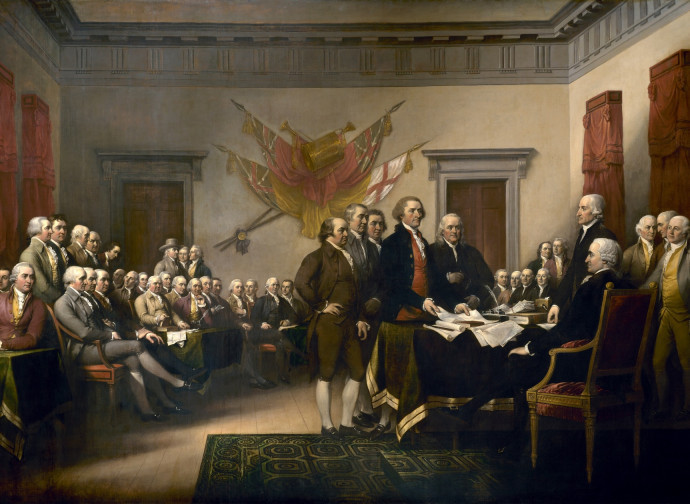
When we think of the United States of America, from our European perspective we get the impression that it is a ‘young’ nation. Yet it is already 250 years old. On 4 July 1776, on the other side of the Atlantic, the historic Declaration of Independence was proclaimed, a pivotal moment in the history of the West: for the first time, a new nation was born across the Atlantic that inherited Western culture and interpreted it from its own perspective. Above all, it interpreted it without the schizophrenia of Europe, without the more than two centuries of religious wars that had bloodied the Old Continent, tearing apart the res publica christiana.
How can we define the events of 1776 and the years that followed? Were they a Revolution, as school textbooks often still label them, or were they a ‘mere’ war of independence? This question is not a trivial matter, but allows us to reflect on the historical identity of the United States of America.
To answer it, we must understand the underlying causes of these events, focusing our attention on the series of oppressive taxes that the colonists were forced to pay from 1765 onwards to cover the costs of the Seven Years’ War. The Thirteen Colonies were a sort of 18th-century tax haven: low taxation, but few rights. There were no representatives of the colonists in the Parliament in London: this made them free ports but also colonies. The Thirteen Colonies were extremely wealthy: after the Mother Country, they were the most prosperous territory in the British Empire. When the government of King George III sought to impose taxes on sugar (the Sugar Act), on stamp duty (the Stamp Act) and, in essence, on every consumer good – from paper to tobacco, from wine to glass – the colonists rebelled, taking up arms in defence of their rights: if the king wished to impose such widespread indirect taxation, he had to summon representatives of the colonists to Parliament. This did not happen, as London had no intention of extending such rights – which had been in force in England for centuries – to the colonies.
The so-called American Revolution was therefore a revolt against fiscal oppression by a government perceived as distant, the effects of whose policies were felt not to improve the economic development of the colonies, but rather to crush them under a mountain of taxes deemed unjust because they were unconstitutional. Hence the famous Boston Tea Party, a sensational protest against the tea monopoly, which may bring to mind, in recent years, similar protests by Italian farmers against the milk quotas imposed by the European Community.
There you have it: in purely linguistic terms, the event of 1776 was not a Revolution. It was an uprising. Since it took place manu militari, we could call it a War of Independence. Otherwise, it would have been a ‘US-Exit’, to use the terminology of today’s politics.
Things turned out differently in the French Revolution: a Revolution, in fact, aims to reshape society and reprogramme every single individual according to precise philosophical intentions, notably by pursuing a Gnostic doctrine. The first revolutionary was, in fact, the devil himself: it was Lucifer who led the Rebel Angels against God. The Revolution follows, some time later, that principle of rebellion against an established order: for this reason, once set in motion, it has no end and generally spirals into a cycle of death that inevitably leads to the ruin of all revolutionaries.
In the case of the French Revolution, those who were initially hailed as heroes of the people soon became traitors: first the Girondins, then Hébert, followed by Danton and the Indulgents, then the Robespierrists, and finally the regime’s supporters. The Revolution is unforgiving and, to justify power seized through oppression and deceit, tends to set itself up as the new defining principle of society: in revolutions, a new model of man is defined, history books are rewritten, and even the calendar is altered. Yet always, in the deceitful attempt to ‘liberate’ man, it actually subjects him to a new and more terrifying regime: one dictated by rebellion against order and, as such, a direct emanation of Luciferian thought. It is no coincidence that all revolutions, from 1789 onwards, have been dedicated to the (never successful) attempt to eradicate Christianity from society.
France, a victim of the Revolution of 1789, has perpetuated its principles. French laïcité is a form of state atheism: as such, it systematically prevents the connection between man and the Transcendent in a utopian attempt to build a purely human society. This approach is the product of Voltairean Enlightenment thought. In the United States, however, the religious element remains very strong. The very motto of the United States of America is In God we trust. And yet the Enlightenment did play a significant role in the Declaration of Independence; but it was curbed by the conservatism inherent in American society. In America, the ideas of Voltaire and Rousseau did not find sufficient traction. No one stirred up society in the name of the empty words that dulled the minds of those who frequented the French cultural circles of the age of Louis XV and Louis XVI. In America, there were no figures like the salonnières – from Madame de Genlis to Madame Necker – who founded the most progressive salons within which future revolutionaries were shaped. The absence of this social element is due to the age-old dichotomy between town and country: even in France, such salons were exclusively Parisian. Progressive and Enlightenment culture was represented by Paris and Paris alone. On closer inspection, the French countryside was rather similar to the American one: the mindset was that of the peasant, and the peasant has never been a revolutionary, because he lacks the cultural and philosophical qualifications that might count him amongst the supporters of a political doctrine. The peasant does not engage in politics; the peasant works the land and wants only one thing from the government: lower taxes.
That is why it is incorrect to speak of the American Revolution. In the United States, there was no Revolution in the true sense of the word; if anything, there was a rebellion against excessive taxation, which led to the independence of the Thirteen Colonies when the time was ripe. Or, if we really must use the term ‘Revolution’, let it be clarified by adding an adjective: let us refer to 1776 as the ‘Conservative Revolution’. This is the key to understanding the United States of America.
Precisely for this reason – because they did not experience a Revolution in the true sense of the word – the United States has been able to represent, for the Western world, a bulwark of freedom against the oppression of revolutions in power: first the Soviet Union, then the regimes born of the 20th-century revolutions, from Cuba to Iran. Note: what has just been written is a representation of power. No government is perfect and therefore can fully embody the concept of freedom, which, as an abstract term, remains confined to the realm of abstraction. However, in an attempt to grasp the deeper meaning of the history of recent centuries, it is possible to define the USA as the nation (among the great powers) that, more than any other, has stood up in defence of freedom because it is one of the few that has not undergone a revolution but which, on the contrary, has clearly affirmed the value of the rule of law and individual freedom against impositions imposed from above. And there is more. All other nations (France, Russia, Germany, China, and even Italy, as well as England during the two revolutions of the seventeenth century) have undergone revolutions that have scarred society and injected it with dangerous ideological seeds.
Not so in the United States of America during the early centuries of its history. For this reason, it enjoyed a cultural advantage that surpassed that of other nations: an advantage which, unfortunately, has been eroded since 1968, the year of the Sexual Revolution, which began precisely in American universities and then spread throughout the Western world. Coincidentally, it is precisely from that date that we have witnessed the inexorable decline of the world’s leading power, into which the very same germs that had infected other nations have finally found their way. Germs that are perhaps even more dangerous today because they are still alive: wokism, the latest metastasis of the revolutionary cancer, was born in the USA and it is there that it has caused the greatest damage. Who knows whether the Founding Fathers of the United States of America would ever have imagined all this, when they declared in no uncertain terms at the close of the Declaration of Independence: ‘with firm faith in the protection of Divine Providence, we mutually pledge our lives, our fortunes and our sacred honour’.
