
Taybeh, where last remaining Christians are held hostage by security measures
In Taybeh, the last entirely Christian village in the West Bank on the outskirts of Ramallah, security is once again in danger of becoming a pretext for new restrictions. Pizzaballa’s appeal is not enough to halt the exodus.


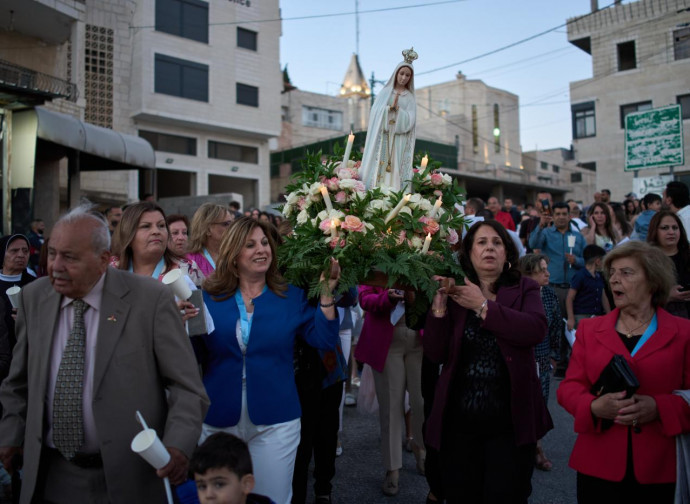
A new barrier is being lowered, and behind it lies an ancient community: houses, churches, families, olive trees and cultivated land. In Taybeh, the last entirely Christian village in the West Bank on the outskirts of Ramallah, security is once again in danger of becoming a pretext for new restrictions. The Israeli army has declared the area a 'closed military zone' for non-resident Israelis, stating that the measure was adopted to prevent further violence in the area.
Formally, the order does not prohibit Palestinians from entering or leaving. However, the decision harbours a danger: while a right may be formally recognised, it can be difficult to exercise. For the inhabitants of Taybeh, getting around means facing constant checks and checkpoints, long waiting times, and a great deal of uncertainty that inevitably creeps into daily life and creates conditions of isolation. Going to work or school, or getting to a hospital, can turn into an obstacle course. Controlling the territory in this way could make every journey more uncertain and every return less guaranteed.
The danger is that Taybeh will end up with increasingly restricted freedom, to the point where it becomes a community in limbo, cut off from the world. This cannot be concealed behind administrative jargon. Taybeh is a small, vulnerable community already affected by emigration, economic hardship, pressure on its land, and tensions with the surrounding Israeli settlements. The new measure is being implemented in an area where movement is already restricted by a dense network of checkpoints and restrictions. It is not necessary to use the word 'expulsion' to create a sense of uprooting. A community can also be weakened by making it more difficult, uncertain and expensive to remain there. When normal life becomes an obstacle course, leaving ceases to seem like a distant possibility and begins to become a real option.
Cardinal Pierbattista Pizzaballa has described the situation in the West Bank as 'very fragile' and constantly deteriorating, emphasising the impact of checkpoints and restrictions on communities' lives. In Taybeh itself, the pressure has become very real in recent months. Last June, a massive fire broke out near the village. According to the Palestinian Civil Defence, Israeli settlers reportedly hindered firefighting operations, while the Israeli army initially delayed firefighters' access due to security coordination procedures. The fire was eventually brought under control, but this incident adds to a series of attacks and acts of intimidation.
As early as the first few months of 2026, reports had emerged of land confiscations, raids and vandalism against residents. Speaking about the situation of the Christian community in the Holy Land, Pizzaballa stated that their numbers are gradually dwindling, and that it is difficult to ask families to stay when they no longer see a future there. 'It takes great courage to stay,' observed the Patriarch.
Against this backdrop, the United Nations inquiry into settler violence in the West Bank takes on particular significance. The report states that the Israeli authorities are directly involved in the settlers’ harassment of Palestinians, often accompanying or protecting the attackers. According to the investigation, attacks on Palestinian villages and farmland have increased, and the violence has taken place within a climate of impunity fostered by judicial and security institutions. Israel naturally rejects the report’s conclusions, arguing that its institutions condemn abuses against Palestinians.
The cause for alarm is therefore not merely the violence perpetrated by settlers, but what happens when this violence becomes intertwined with the exercise of state power. When those who are supposed to guarantee security fail to protect a population from attacks, fear becomes a daily reality. This is where the story of Taybeh takes on a significance that extends beyond the Christian village itself.
It is not just the story of a community exposed to violence. It is also the story of an ancient presence that is slowly being consumed by insecurity, isolation, and a loss of prospects. Small communities do not require an expulsion order to face tragedy. It can unfold gradually: young people leave, families dwindle, land is abandoned or occupied by settlers, economic activity weakens and churches are left empty. Ultimately, only the stones, empty houses and olive trees remain, along with the memory of a presence that has weathered wars, empires and political upheavals for centuries. This is a silent and almost invisible process, and for this very reason it is all the more dangerous. The community does not vanish overnight; it gradually shrinks until its survival becomes impossible.
According to the military authorities, the Israeli army's measure stems from the need to halt the violence perpetrated by ultra-Orthodox settlers and to protect the inhabitants. This is a point worth noting. However, an unavoidable contradiction remains: protecting a Palestinian community once again requires further military control of the territory. While non-resident Israelis are barred from entering, the Palestinian inhabitants continue to live under a system of movement restrictions that makes daily life more difficult.
Taybeh is not a symbol conjured up by the news. It is a real village with families who want to continue living on their land. Its churches, olive trees and houses bear witness to a Christian presence that is deeply rooted in the history of Palestine. This is why what is happening there deserves our urgent attention, before the emergency becomes the norm and isolation turns into abandonment. The real threat is not merely the lowered barrier. It is the acceptance of closure. It is the idea that checkpoints, blocked roads, inaccessible land and new bans are now an inevitable part of life. This is how a territory can change its character without anyone having to formally announce the transformation.
Despite harassment and attacks by ultra-Orthodox Israeli settlers, Taybeh remains. The bells ring, the olive trees remain on the hills and families continue to live in their homes. But the space around them is growing ever tighter. When the space to live, move about and plan for the future shrinks, even remaining on one's own land can become an act of resistance and courage.
