
Freemasons' funerals cancelled. Suetta condemned, Staglianò spared
Following the Daily Compass' exclusive, everyone is pouncing on the two cancelled Freemason funerals in Italy. However, while the Bishop of Sanremo is being criticised by the media and Freemasonry, whereas Bishop Staglianò’s ‘mess up’ is ignored. Without any checks or explanations, he authorised the funeral in Rome, forcing the Secretariat of State and the Pope’s Vicar to rectify his oversight. The news has even disappeared from the Freemasons’ website.

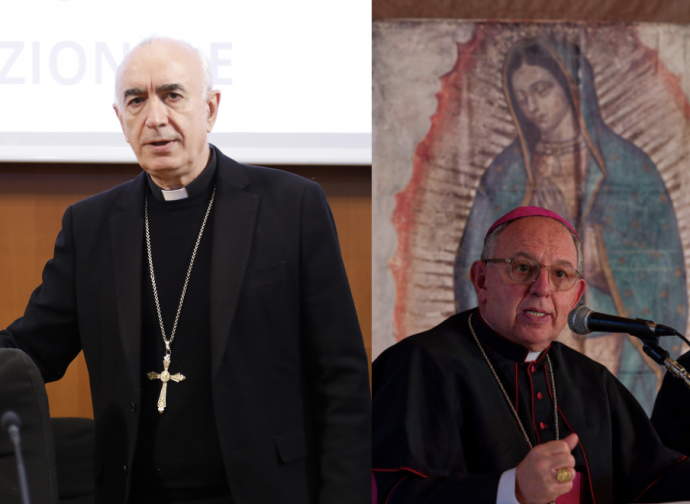
Following the huge outcry sparked by Daily Compass' scoop regarding the church funeral of the Masonic 'master' Bruno Battisti D'Amario, one thing is certain: the Vicariate of Rome and the rector of the Church of the Artists, Monsignor Antonio Staglianò, are keen to keep the story of the last-minute cancellation of the funeral under wraps, as well as the unforgivable chain of errors that led to the granting of permission. This is a unique decision in recent times, and one that has probably not been taken in Rome since the funeral of Piergiorgio Welby.
However, it is Monsignor Antonio Suetta alone who is being blamed, the Bishop of Sanremo and Ventimiglia, who took the same decision to call off the already scheduled funeral of a local Freemason scheduled in the same period and notably after the decision to cancel the funeral in church by the Vicar of Rome.
A truly curious double standard. Let us consider the matter as it unfolded.
Following Saturday's news report, in which we stated that the Diocese of Rome had cancelled the previously scheduled funeral of Ennio Morricone's guitarist at the last minute, precisely as a result of telephone calls made by the Daily Compass, in which we informed the officials at the church of Santa Maria in Montesanto in Piazza del Popolo, Rome, of the deceased's senior role within Freemasonry, the Diocese of Sanremo-Ventimiglia announced a similar measure: the suspension of the funeral of Mario Tarducci, formerly a Venerable Master of the Grand Orient of Italy, which was due to take place shortly afterwards.
Suetta's decision was prompted by local newspapers in western Liguria referring to Tarducci (pictured) as a Freemason. Suetta then invoked canon 1184 of the Code of Canon Law, which prohibits Christian funerals for ‘manifest and unrepentant sinners’, and halted the Christian funeral service, bolstered by the simultaneous decision of the Vicar of Rome, Baldassarre Reina, once he had been informed.
Curiously, however, the two related stories – Rome and Sanremo – were treated by the media in completely different ways. Suetta’s decision was portrayed as uncharitable and reactionary, whereas the case involving the Reina-Staglianò couple was covered by media outlets (from Ansa to Corriere) with a suspiciously detached tone. The decision was treated as a minor news item, rather than a major controversy.
Suetta has been the target of widespread criticism. This started with Paolo Oggero, who told Ansa that it was a ‘decision that goes against every form of charity’, and included La Stampa, which highlighted the families’ opposition and portrayed the Church in Sanremo as grim and stepmotherly. The following day, Secolo XIX interviewed Antonio Seminario, Grand Master of the Grand Orient of Italy. He preached on death, saying that 'barriers must come down', and that 'being a Freemason does not mean being an enemy of the faith'. He thereby presumed to instruct the bishop on how to do his job, whilst continuing to call for dialogue with the Church.
Surprisingly, the Roman affair that had set the controversy in motion was kept on a low profile. This was partly because Ansa, the first news agency to cover the story after the Daily Compass' scoop, obtained a statement from Monsignor Staglianò. He is the president of the Pontifical Academy of Theology and the rector of the Church of the Artists. In the statement, he did not hesitate to cover up the mistake he had just made.
Staglianò said he had been notified by the Secretariat of State and had contacted the Congregation for the Doctrine of the Faith to deal with the unexpected turn of events, contrary to what he had told us at the Daily Compass the day before, after being informed by his staff. This led the Pope’s Vicar General for the Diocese of Rome, Cardinal Baldassarre Reina, to call off the funeral.
Staglianò's account of events, as if it were merely an oversight, was deemed sufficient by all the newspapers, which reported the news without stirring up controversy, unlike Sanremo, nor did they bother to investigate the facts any further.
However, the ploy of the notice from the Secretariat of State allowed Staglianò to avoid the embarrassment of admitting that he had been alerted to the incident by a news website such as ours. Evidently, no one – least of all Staglianò – had found it necessary to ascertain the identity of the deceased, whose funeral was due to take place just a few hours later.
However, this puts the ambitious bishop of pop theology, with his passion for dialogue with lodges and Freemasons (as discussed previously HERE and HERE), in an even more difficult position.
By attributing responsibility for informing him to the Secretariat of State, he has clearly shown that he was primarily responsible for the affair surrounding D’Amario’s funeral.
He later told the Daily Compass that he had been informed of his high-ranking Freemason membership at 8 am on Friday by the Secretariat of State, coincidentally just one hour before our phone call, because a Grand Orient of Italy article had recently been published 'revealing' his secret.
But this is not true. The Grand Orient article celebrating Morricone’s ‘master collaborator’ was published on Wednesday, two days earlier. Clearly, Staglianò could not admit that he had been 'caught out' by the Daily Compass. Even if he had learnt of it from the Secretariat of State, however, this would only make his situation worse because it would mean that he had been woken up by the Vatican over a mistake he himself had made. The mistake was failing to verify the identity of the deceased, for whom he had decided a few days earlier to make an exception by opening the church which is usually closed in August.
What information did Staglianò and his colleagues use to verify the deceased’s Catholic background? How was it possible for a deceased person presented as an ‘artist’ to be granted a funeral in such a prestigious church without verification by those in charge? One of two things must be true: either Staglianò knew the family, in which case he must have known who D’Amario was, or he did not know them. But if so, what strong pressure led to the decision to grant an exceptional opening of a church that is otherwise closed? Is a simple request from a relative sufficient simply because the deceased is an 'artist'?
Staglianò was unable to answer these questions, even in a subsequent interview with the Daily Compass, limiting himself to saying that the daughter had introduced him as a Catholic. A Catholic? Or a 33rd-degree Freemason, the highest rank in the lodges, as D’Amario was?
Speaking of his daughter. Since yesterday, the article celebrating Battisti D’Amario that was published on the website of the Grand Orient of Italy has been taken down for some reason. It simply no longer appears. Unable to seek an explanation from the Freemasonry, we put the question to Staglianò, who replied that it was perhaps due to a request from his daughter, who had taken offence. But what did she take offence at? By discovering that her father was a high-ranking Freemason, or by the controversy surrounding the cancellation of the funeral?
Clearly, Staglianò knows more than he is revealing. In any case, by involving the Secretariat of State, he has shown the Vatican leadership that he caused a 'mess' that required the intervention of the Holy See's top officials and that he was unable to manage the aftermath. This forced the Pope's vicar to take responsibility for such a delicate matter and cancel a funeral he had already arranged. Not exactly a success.
