

EU bishops oppose revocation of baptism – Church’s freedom is at stake
The Commission of the Bishops’ Conferences of European Countries has issued a firm and well-reasoned ‘no’ to amending baptismal registers, ahead of the European Court’s ruling on a request for cancellation made by a Belgian citizen. This issue raises questions about the relationship between politics and religion, and highlights the flaws in the concept of state neutrality.


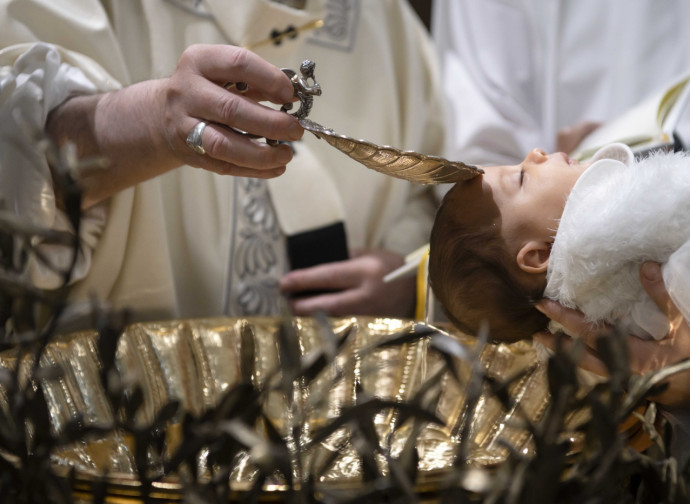
The Court of Justice of the European Union (CJEU) is due to deliver a judgment shortly on a specific case concerning a request for 'de-baptism'. A Belgian citizen is requesting that his name be removed from the church’s baptismal registers because he no longer wishes to be a member of the Catholic Church. The diocese appealed to the Belgian authorities, and the case subsequently reached the European level. Currently, national legislation stipulates that this is not possible, obliging the church to record the newly expressed wish in the register without removing the name.
One of the parties involved considers this measure insufficient and inappropriate as it fails to respect freedom of conscience and infringes the rights established by the General Data Protection Regulation. It is presumably on the basis of the latter that the European Court will rule. The Commission of the Bishops’ Conferences of the European Union (COMECE) was right to set out the Catholic Church’s arguments against amending baptismal registers in a legal document.
The issue is legal, but above all political, given that it concerns the relationship between politics and religion, the state and the church, and civil law and canon law. This is why the issue is so significant, extending far beyond the case in question. The issue is particularly pertinent to religious freedom, which is now recognised not only by the liberal state, but also by the Church. But do they understand it in the same way? This minor case could destabilise the current consensus and shake things up on this thorny issue.
All European states, and the EU itself, currently claim to be neutral on religious matters, thereby declaring their lack of competence in this field. This neutrality is exercised in two ways: either by keeping all religions out of the public sphere, or by allowing all religions to have their own presence in it. While it is called neutrality in both cases, it is not. In both cases, the state regulates religion, intervening from above and from the outside to determine its place and compel it to act or refrain from acting. It does not recognise religion. The state either prohibits religion from existing in the public sphere or regards it as just like all the others, devoid of its own unique character and dignity. These two interpretations of freedom of religion do not make religion truly free, even while recognising individuals' freedom to voluntarily adhere to one or the other.
Freedom of religion is not the same thing as freedom for religion. In both cases mentioned above, the state considers itself superior to religion; its neutrality is, in effect, a form of sovereignty. The Catholic Church has its own doctrine, one tenet of which is that baptism is an indelible sacrament. It is the gateway to other sacraments and signifies an essential, not merely nominal, incorporation into the Body of the Church.
Baptism has always existed, exists now, and will always exist, and the presence of the baptised person’s name signifies precisely this. However, the state, in its sovereign neutrality, is entirely incompetent in matters of religious doctrine. Therefore, it may deny the validity of these doctrines by invoking one or the other of the laws it has promulgated in accordance with its own sovereignty.
If the State were to invoke not its positive laws, which have no foundation other than its own established and imposed sovereignty, but the 'common good', things would change. Religions would then take on a distinct character, and the Catholic religion would shine so brightly that the State would have to renounce its neutrality. However, the liberal state cannot go that far if it remains such. For this reason, it is reasonable to assume that the expected ruling in October will permit the removal of names from baptismal registers. If not this time, then next time, as the circumstances point in that direction.
After all, if the Catholic Church confines itself to basing its prerogatives solely on a freedom of religion similar to that of the liberal state, without asserting its unique identity in the public sphere, it cannot expect to be treated differently. If it demands respect for its baptism in the same way that it demands respect for Islamic family law, it has no grounds for being recognised in its own right rather than through the prism of the sovereign state's prejudices.
One such prejudice is freedom of conscience. Indeed, in cases of 'de-baptism', one of the criteria used to assess policy — alongside the protection of personal data — is freedom of conscience. Therefore, one is free to be baptised and free to be 'de-baptised'. The modern liberal state reasons in this way because, just as its sovereignty is empty, so too is freedom of conscience. The state cannot conceive that religious life contains anything objective, transcendent, ontological, eternally valid or indelible, such as the character of baptism in the Catholic religion, and that this must be defended because it has public value. To the state, this would constitute a restriction on freedom of conscience, which is only free if it is empty and can be filled with one thing one moment and its opposite the next.
