
Ukraine: Vatican paves way for dialogue with Moscow
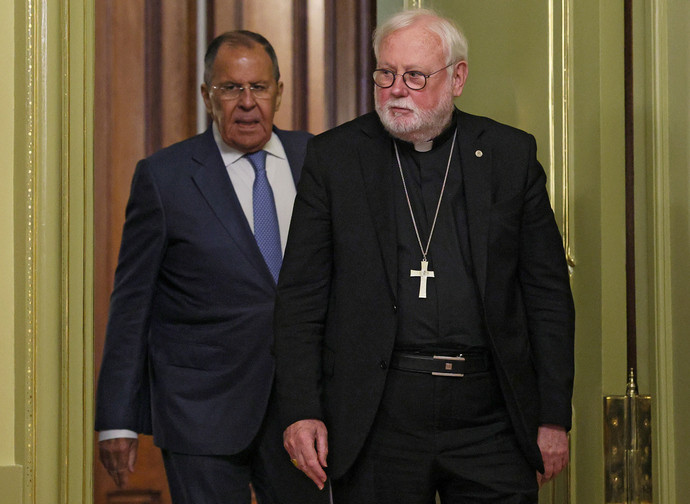
The Holy See seems to be the only entity that realises the risks of a slow slide towards open war between the West and Russia. Accordingly, the Secretary for Relations with States, Monsignor Gallagher, is in Moscow, where he met Foreign Minister Lavrov yesterday to discuss the possibility of negotiations.

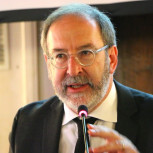
'We feel pain and anger, not hatred. Hatred kills those who hate; if the Ukrainians felt hatred, they would have been finished long ago.' These were the words of the Catholic Bishop of Kharkiv-Zaporizhzhia, Pavlo Honcharuk, yesterday at the Meeting of Rimini during the session dedicated to Ukraine. His testimony was certainly uplifting, as was that of Yaryna Grusha, a Ukrainian language and literature lecturer at the University of Milan, who shed light on the country's cultural vibrancy amidst the bombings.
However, the format of the session did little to help people understand the current situation or the risks posed by this war, now in its fifth year, including to Europe and the world. Admittedly, it was not – nor was it intended to be – a round-table discussion on the subject. However, apart from the reference to Russia conquering countries in order to recruit people to conquer others, much of what was said could be applied to any situation of war or hardship. Sticking to Ukraine, what is being said today could have been said in 2022: on the one hand, the Russian aggressor; on the other, a people whose 'strength lies in love' and who are defending themselves.
In reality, however, things are far more complex, and the situation has changed significantly. It is an objective fact that Moscow has encountered unexpected resistance and is mired in a war with no end in sight. This will have severe domestic consequences, the impact of which on Russia's future is difficult to predict.
However, the situation on the Ukrainian side is also far from ideal: for weeks, there have been street protests against President Zelensky, who is accused of sacking Defence Minister Mykhailo Fedorov in July. Fedorov had rekindled hopes (real or imagined) of turning the tide of the war in just six months. Meanwhile, thousands of men are trying to evade forced conscription and attacks on recruiters are on the rise. Many have crossed the border by paying substantial bribes to corrupt officers.
The radicalisation fuelled by a protracted war has also brought back the spectre of pro-Nazi nationalism. This has provoked a reaction from Poland, which was itself a victim of that nationalism. Poland was previously the most generous country in terms of welcoming Ukrainian refugees and supporting Kyiv, both politically and militarily.
Above all, Ukraine's defence has been supported from the outset by substantial Western military aid in the form of weapons, military advisers and intelligence operations, not to mention economic aid. In total, the EU alone has invested over 200 billion euros in Ukraine over four years, comprising military, financial, and humanitarian aid.
Whether or not one agrees with this support, the fact remains that this has never been a simple Russia-Ukraine conflict (Russia has also received international aid, of course). For example, despite fighting a heroic defence, the Armenians of Nagorno-Karabakh (Artsakh in Armenian) were forced to capitulate to Azerbaijan's demands in 2023, resulting in the annexation of the region and the forced exile of the Armenian population. This took place amid the West's indifference, despite it enjoying excellent relations with the aggressor and failing to invest a single euro to support the victim.
As the war in Ukraine drags on, the risk of European countries becoming directly involved is growing, given the stance of major governments. Russia is certainly experiencing difficulties too, but no one can predict how the situation might unfold or whether President Vladimir Putin’s leadership is actually at risk.
Therefore, as things stand, there are only two ways to end the war: either there must be a resumption of genuine dialogue and negotiations with Moscow, involving a willingness to make territorial concessions, or NATO must step in directly to defeat Russia and push it back to its pre-2014 borders (assuming, of course, that this is possible). The latter is the solution towards which we are slowly sliding, and it is what Zelensky has always aimed for, knowing that it is the only way to regain the lost territories. The consequences of such a scenario are easy to imagine.
However, it seems that only the Vatican is aware of this. It is no coincidence that the Pope sent Monsignor Paul Richard Gallagher, the Secretary for Relations with States, to Moscow. Yesterday, he met with the Russian Foreign Minister, Sergey Lavrov. He stated that 'dialogue is more important than ever'. Speaking to journalists alongside Lavrov at the end of the meeting, Gallagher added, 'This war must end', emphasising that negotiation is the only way forward because the conflict 'cannot be resolved by military means'. The Holy See is therefore taking active steps and offering its 'diplomatic support'.
In order to avoid nightmare scenarios, the hope is that other Western governments, starting with Italy, will come to their senses and follow the Holy See in pressuring Russia to open negotiations. After all, after four and a half years of war and the damage to his own territory, a negotiated solution may well be in Putin's interests too.
