

Trump in Davos: the war of the worlds begins
The American president's speech at the Davos Forum reveals the true intentions of the US. The idea of global governance and multilateralism, as promoted by the Davos Great Reset initiative and the UN, is being abandoned. Furthermore, the entire global 'order' of the last 80 years is being called into question, including the monetary and financial order that was redesigned in 1971 and the geopolitical balance of power. Nations and the real economy are making a comeback. The world is being divided into spheres of influence before our very eyes. And Europe is standing by and watching.

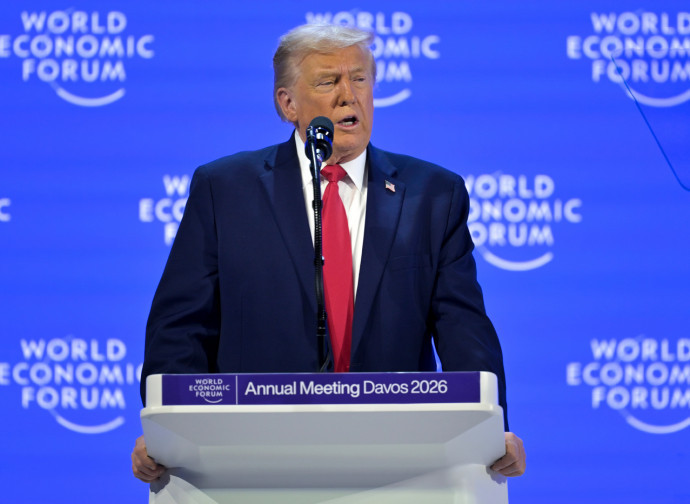
Veni. Vidi. Vici. These words sum up the spirit with which President Trump travelled to Davos for the annual meeting of the World Economic Forum, a public-private organisation that has been pursuing the goal of creating 'a better world' since 1971. Trump's long-awaited, somewhat improvised speech did not directly address the globalist and liberal world based in Davos, which has always opposed him and now must make the best of a bad situation. Evidently, the real 'meetings-clashes' take place behind closed doors, and we are unlikely to hear any official reports about them.
In his highly self-congratulatory speech, Trump limited himself to an apology for the extraordinary economic results and global pacification achieved by his administration in its first 12 months, thereby overturning the legacy and image of a collapsing country left by 'sleepy' Joe Biden. However, to understand where this is leading, we must not limit ourselves to analysing the words of the boastful president. By connecting the dots between what has been said and not said, and, above all, between what has been done and not done in recent months, a fairly clear picture of the pursued strategy emerges.
Geopolitically, the United States has definitively abandoned any ambition to export the liberal-democratic model to the rest of the world, choosing instead to focus on its own serious internal problems. These range from uncontrolled immigration and fentanyl-related devastation to deindustrialisation and the collapse of the middle class; from societal polarisation and the decline of the American dream to a financial crisis with an out-of-control debt trajectory and threats of de-dollarisation that could dethrone the dollar and call into question the US's leadership role.
Economic growth is critical for financial stability: with federal debt exceeding $38 trillion and growing by around $500 billion per quarter, the risk of 'bankruptcy' is higher than ever. To avoid this, the US must grow and reindustrialise by increasing energy sources, deregulating, and attracting direct investment. It must also secure foreign purchases of arms, natural gas, and Treasuries; cut unproductive spending; improve trade imbalances; and preserve the dollar's role as the global reserve currency.
However, this is a mission impossible, hidden beneath the picture of the 'magnificent and progressive' future of the US under Trump that is too good to be true. He is pursuing his goal with excessive zeal in order to convince his interlocutors that the US is the most prosperous and powerful country in the world — the place where the best deals can be made. The reality is much more prosaic and explains both Trump's rhetoric and his aggressiveness, bordering on brazenness, in order to achieve his goals at any cost. After all, he made this clear during his election campaign: 'Make America Great Again' was the slogan for which he was elected, and he deserves credit for pursuing this goal directly and without pretence. It should also be remembered that Trump is in his second, and at least in theory final, term of office: he has nothing to lose and is not particularly interested in consensus, instead aiming to carve out a place for himself in the history books. It is a pity that European leaders are not also thinking of prioritising the development and well-being of their own peoples.
There is no time for diplomacy; the trend must be reversed immediately, whatever the cost. This necessity explains why the US can no longer afford to lead Europe and NATO, especially given the urgent need to reposition itself in the Pacific — the true centre of the world — which is home to the Russian Federation, China, India and Japan. These countries are often referred to as the new 'C5', which should replace the obsolete G7. This would be a new order in which there would be little room for the European Union, the United Kingdom and Canada.
By establishing the 'Board of Peace' for the reconstruction of Gaza, Trump is aiming to create a small, alternative UN under his control, with the aforementioned great powers participating alongside countries considered 'aligned' or 'alignable' with US interests, ranging from Belarus and Turkey to Argentina and Italy (perhaps), as well as Israel and the Arab countries.
Europe, which Trump has never recognised, is therefore not included. Macron's France has not accepted the invitation after being publicly mocked, while Merz's Germany does not intend to participate. The United Kingdom will participate with Tony Blair instead of Prime Minister Starmer. Each country joining the Board will have to contribute $1 billion, and it is likely that the club will deal not only with the reconstruction of Gaza and the stabilisation of the Middle East, but also with the composition of the great powers' interests, spheres of influence and bilateral relations, which are still being defined.
Trump 'resets' the Great Reset: there is no time for happy degrowth, climate ideology — the 'Green New Scam', as he calls it — or woke delusions. The imperative is to grow and preserve internal social peace in order to strengthen the country, including in terms of defence. To grow, however, energy is needed, hence the decision to increase hydrocarbon production and accelerate the development of the latest generation of nuclear power.
This perspective also explains the US withdrawal from 66 international organisations, many of which belong to the UN. This is both to save US taxpayers' money and to escape the control of opaque bodies whose agendas are not aligned with the administration's priorities.
For the first time since the War of Independence, the US is distancing itself from its former staunch ally, the United Kingdom. Returning to an industrial vision also presupposes fighting the financialisation of the economy, led by the City of London and Wall Street. The focus shifts to Main Street: the sharp appreciation of gold, silver and platinum in recent months is a sign of a 'return to reality' and a break with the monetary and financial balances that have been in place since the gold exchange standard ended in 1971.
From this perspective, the relentless attacks on the Fed chairman, Jerome 'Late' Powell, for his alleged slowness in lowering interest rates become easier to understand. Beyond the offensive manner in which this is being done, it is pointless to complain about Trump's attack on the Fed's supposed 'independence': the US central bank has never been independent. Founded in 1913, it was established as an integral part of the banking and financial cartel, serving large corporations and Wall Street.
The systematic destruction of the dollar's purchasing power through ultra-expansionary monetary policies is proof that the Fed has betrayed its mandate to preserve monetary and financial stability. Hopefully, the new Fed, which will probably come under the de facto control of the Treasury, will adopt a more ethical approach to money creation. But don't bet on it. A strong fight against crony capitalism is also desirable. This has its roots in the 'deep state', as evidenced by the CIA and the military–industrial complex. They hope to cripple Trump in the mid-term elections in November 2026, in order to resume the Clinton–Obama–Biden agenda in concert with the globalists entrenched in the WEF and European chancelleries.
To avoid any misunderstanding, let me clarify: the fact that the existing globalist order deserves to be destroyed does not mean that all of Trump's methods and choices are acceptable. Nor can we delude ourselves that the results achieved are definitely positive. However, given the state we find ourselves in, particularly in Europe, there is no room for half-measures or homeopathic remedies. Gordian knots must be cut with a sword, not least because time is running out. This includes the risks of military escalation in confrontations between Europe and the Russian Federation, and in the Middle East, where Israel continues to pursue the mirage of a 'final solution' against Iran.
While the 'Trump method' undoubtedly creates confusion and has its critics, it cannot be said to have caused any major damage yet. It is better to look at what he does than what he says: if he succeeds in dismantling the globalist, liberal and 'woke' agenda of the World Economic Forum in Davos, he will already have earned our gratitude. If the current 'Bonapartist' phase is rejected in the midterm elections, we can expect a revival of the Great Reset initiative throughout the Western world instead. Starmer's United Kingdom, Mark Carney's Canada, Macron's France, Merz's Germany, and the European Commission are pinning their hopes on Trump being crippled in November. In the meantime, they are buying time and continuing with their plans for social control, including the repression of internal dissent through the Digital Services Act, as well as plans to digitise identity and money. They are also not backing down on their energy transition and military Keynesianism policies, which risk not only making Europe geopolitically irrelevant, but also leading to economic and social collapse, as could happen in Germany in the not-too-distant future.
If the United States succeeds in bringing down this agenda, it will be a positive development, regardless of one’s opinion of Donald Trump. The war of the worlds is heating up: Italy and Europe would be wise to stop following the Pied Piper of Davos and consider how to position themselves.
