
The Pope at the Sagrada Familia: “Faith gives shape to the stones”
Exactly one hundred years after the death of Antoni Gaudí, the Mass celebrated by Leo XIV in the Expiatory Temple and the blessing of the Tower of Jesus Christ, making it the tallest church in the world. In this Biblia pauperum of our times, an “eloquent catechesis made of stone, color, and light.”


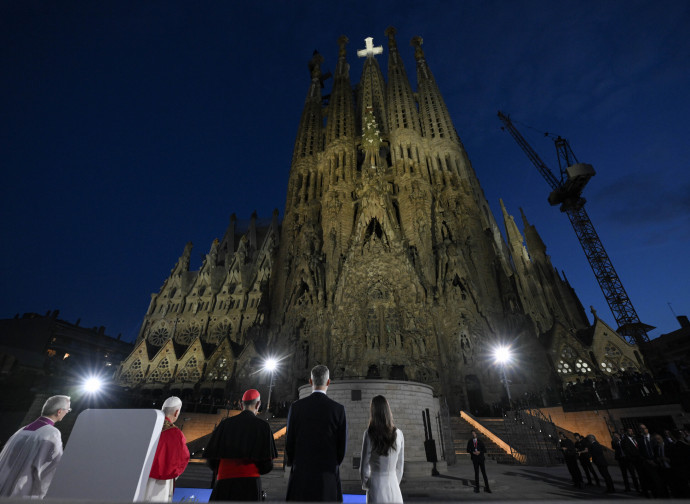
The jubilant crowd that filled the streets of Barcelona last night as Pope Leo XIV made his way to the Sagrada Familia must have echoed the crowd that accompanied architect Antoni Gaudí’s coffin a century ago. Shortly before 10 p.m., the blessing of the Tower of Jesus Christ (delivered half in Catalan, following the linguistic controversies of recent days) marked the culmination of the Pope’s second intense day in Catalonia, which began in the morning with a visit to the inmates of the “Brians 1” Penitentiary and continued in the Marian heart of Catalonia, from the “Moreneta,” the Black Madonna of Montserrat, where he shared the Rosary and lunch with the Benedictine community. Descending from the “Holy Mountain,” which was one of Gaudí’s sources of inspiration, the Pontiff returned to Barcelona. In the afternoon, he met with representatives of charitable and assistance organizations at the Church of San Agustí—which, he recalled, he had found closed back in 1984 when he was a young priest—and finally attended the most eagerly awaited event, exactly one hundred years after that June 10, 1926, when the “Dante of architecture” passed into eternity. Yesterday, at his tomb, there was a Pope named Leo, the same as the reigning Pontiff at the time Gaudí took charge of the construction of the Temple Expiatori de la Sagrada Família.
The Cross of Christ is the focal point of the building and was at the center ofthe Pope’s homilyand the subsequent blessing, which concluded with the singing of the Vexilla Regis. Leo XIV was welcomed by King Felipe VI and Queen Letizia, as well as by Valentina, a blind young girl who explained the unique features of the Tower of Jesus Christ to the Pontiff, using a miniature model of the structure—which, at 172.5 meters, makes it the tallest church in the world—to guide her by touch, “not to top worldly rankings, but to guide the steps of God’s pilgrim people in this land of Catalonia, with the cross illuminating the path, like a lamp lit in anticipation of the Bridegroom’s return,” the Pope said during Mass. Prevost is the third successor of Peter to visit the Sagrada Familia, following St. John Paul II in 1982 and Benedict XVI, who consecrated it in 2010, “recalling that it is a visible sign of the invisible God, for whose glory its towers rise. “In continuity with the prayer of my Predecessor,” the Pope emphasized, “I will shortly bless the highest tower, that of Jesus Christ.” Work is still underway, which does not make it “an unfinished work, but a temple still under construction,” not a “flaw,” but a “desire,” since this condition “does not signify a lack, but expresses a promise,” he explained in perfect “Gaudí-esque” spirit.
In the footsteps of the builders of medieval cathedrals Gaudí did not, in fact, conceive of the Sagrada Familia as the work of a single man, but of a community spanning generations. A dimension effectively expressed by Leo XIV: “This church is a single building, composed of many stones. A house that grows steadily over the years, according to an identical plan” and therefore “is still today a construction site, reminding us that Christian life is always a journey, because it is a project that God brings to completion.” Provided that roles are respected, since He is the builder, the Pope recalls in reference to the reading from the Second Book of Samuel, where the Lord announces that He will build a house for David and not the other way around, since “it is not we who give God a place, as if He were an element in a series or a part of a whole greater than Himself. Rather, it is God who gives us a place.” And the inner masterpiece can only be centered on Jesus, just as in the Sagrada Familia, where “the Cross of Christ, placed at the top of this Basilica, is the Cross of the last who become first, of sinners who become saints, of the dead who will rise again.”
The tower blessed last night is a tangible image of the centrality of the Cross of Christ, in which “our faith reaches its summit, as professed by the inscription at the base of the spire: ‘Tu solus Sanctus, Tu solus Dominus, tu solus Altissimus’.” This is the heart of Gaudí’s message, which unfolds across the three facades of the Nativity, the Passion, and the Glory: “The First becomes the last for us in the Nativity; through His Sacrifice, He redeems us through the Passion; His death grants us eternal life by making us sharers in divine glory. As we admire the tower of Jesus Christ, we lift our gaze to Him, to Him who alone reveals to us the truth of God and the truth of ourselves.” The Sagrada Familia is “much more than a monument,” the Pope had said at the beginning of his homily, and it is also much more than a construction site: it is “a spiritual pilgrimage, leading to an encounter with Christ born, died, and risen for us,” to which we are almost led by the hand by the “architect burning with faith” who, in this Biblia pauperum of our times, conceived an “eloquent catechesis made of stones, colors, and light,” making room for the true Artist “who has imprinted His splendor upon the cosmos. Created in his image, man responds to God’s work with his own ingenuity: this is how the artist turns talent into praise and creativity into a witness to the Creator himself,” who becomes palpable in Gaudí’s work and spirituality because “faith gives form to the stones and meaning to the building we are inhabiting together.”
A witness that is renewed in the Sagrada Familia as in the “ancient cathedrals, which are in themselves rich messages of evangelization. In this temple of images, it becomes even more evident how art and beauty are preeminent channels of evangelization,” and precisely in that Spain which, from Zapatero to Sánchez, has accelerated secularization yet welcomed the successor of Peter with a warmth that far exceeded expectations. A paradox, like the construction site of the Sagrada Familia itself, where the anti-religious persecution of the 1930s spared not even Gaudí’s designs—destroyed by a fire set by anarchists—but where today a towering cross rises above the Tower of Jesus Christ, before which one cannot help but, as the motto of the apostolic journey states, “raise one’s gaze.”
