
The Pope at the Rimini Meeting: ‘It is time for responsibility’
An atmosphere of celebration and great enthusiasm accompanied Leone XIV’s visit to the Rimini Meeting. He identified the fundamental task of Christians in a world ‘that hungers and thirsts for justice’ as the ability to create opportunities for encounter with everyone, starting from faith.

'It is time for responsibility', aresponsibility born of the legacy of a culture of encounter fostered by the Communion and Liberation movement, and which is the hallmark of the Rimini Meeting.
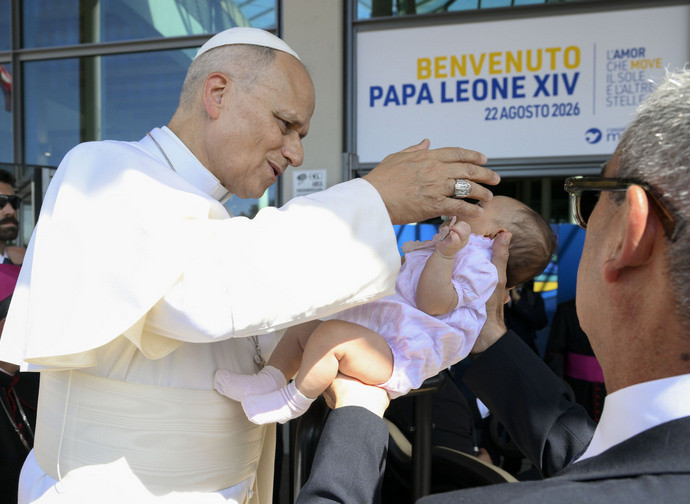
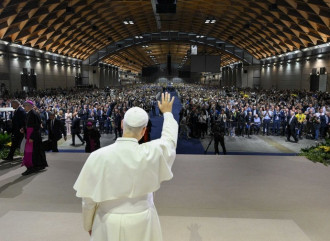
This is how Pope Leo XIV addressed the enthusiastic crowd at the Meeting yesterday afternoon, 22 August. This enthusiasm infected Leo XIV himself during his nearly hour-long walk through the Rimini Exhibition Centre pavilions, where he was greeted by over 50,000 people. Pausing in a hall where thousands had gathered — those unable to find a seat in the large auditorium where he would later deliver his address to 20,000 people — he began with a cheerful, 'Hello everyone! Good morning. You have no idea how wonderful it is to see you all here together.” And then: 'Thank you, thank you! The loudest applause must be for Jesus Christ – we are all disciples of Jesus!'
The 'historic responsibility' to which the Pope referred is that of building peace 'within the wider communion of the Church, in the service of a humanity that hungers and thirsts for justice'. Leo XIV identifies precisely the Meeting and the experience that gave rise to it as a model for the whole Church because it is rooted in a 'millennial tradition of faith that becomes culture'.
 Referring to the theme of the 2026 Meeting, 'The love that moves the sun and the other stars', he emphasised that this love 'has not disappeared; it has lost neither its vigour nor its intensity, even though it is a love that willingly remains silent, unlike the noisy forces that shake the earth, the heavens, and all creatures'. The Pope also warned against 'false realism, which arms minds, words and nations', contrasting it with 'the realism of mercy, by which there can be no enemies and everyone — even adversaries — are brothers and sisters to be looked in the eye and encountered in truth'. Continual conversion is required because 'sin does exist, of course, but the redeeming love of Christ is stronger still, committing us to purifying our thoughts, interests, habits, associations, plans and investments — every aspect of life — from all that the culture of power has polluted'.
'Let us therefore free our coexistence from suspicion, culture from arrogance, education from ideology, work from the idolatry of profit and technology and finance from the business of death,' continued Leo XIV. Let us rein in technological development when it becomes pervasive and destructive. We need courageous pioneers who, by changing their own course, can convince and inspire everyone to make the required conversion.’
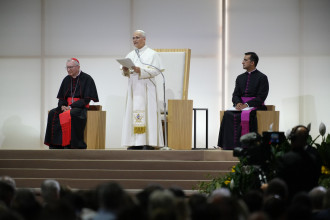 Once again emphasising the 'synodal style', the Pope also underlined the importance of listening, 'a gift that we all recognise, but which has often been lost in certain sectors of the Church'. 'We must continue to discover just how precious this gift is,' he continued, 'beginning with listening to the Word of God, listening to one another, and listening to the wisdom we find in men and women, in members of the Church, and in those who are searching for the truth but who are not yet — and perhaps will never be — members of the Church.'
Following on from this, the Pope addressed the internal affairs of Communion and Liberation, which have led to the CL Fraternity being placed under administration in recent years. He called on them to 'love and preserve the unity of the "companionship" through which Christ has reached you and draws you to himself'. ‘Even difficult times,’ said Leo XIV, quoting Pope Francis, ‘can be moments of grace and rebirth.’ Whilst his presence at the meeting was clearly a show of support for Fraternity president Davide Prosperi, Leo XIV spoke of the mystery of the plan of mercy running through history and referred to 'unarmed beauty', highlighting a theme dear to Don Julian Carron. Carron was Prosperi's predecessor at the helm of the Fraternity and a key figure for those criticising the current leadership.
The Pope thus entrusted a dual responsibility to CL and the Rimini Meeting. This message was immediately taken up by Prosperi and Bernhard Scholz, president of the Meeting Foundation, at the end of the visit. Scholz highlighted the ‘great celebration full of enthusiasm’ that accompanied the Pope’s visit and stated that ‘the message the Holy Father has entrusted to us will guide our path’. 'We listened with trepidation to his words on the "great historical responsibility in the service of a humanity that hungers and thirsts for justice",' he added.
And Prosperi after expressing 'the gratitude of our people for the gift received on this extraordinary day' and affirmed that 'we are filled with the desire to respond to the "historic responsibility" he has entrusted to us: to bear witness to the power of Christ’s love through the education we have received, promoting good by fostering friendship and hope.' The Holy Father challenges us to open ourselves up to encountering everyone; this is the 'true catholicity' to which the movement wishes to bear witness.'
